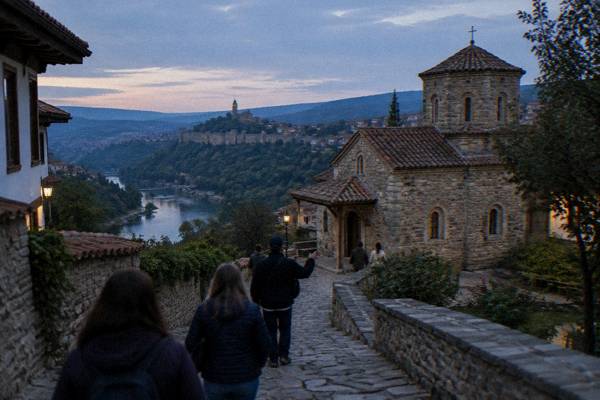
Is Veliko Tarnovo Worth Visiting?
Is Veliko Tarnovo worth visiting? A sourced answer covering Tsarevets Fortress, the Sound and Light show, Arbanasi, ticket prices, transport times and the best months for the medieval capital of Bulgaria.
Veliko Tarnovo, in Bulgaria, is an inland city on the Yantra river with no sea coast, and it was the capital of the Second Bulgarian Kingdom for more than two centuries, from the late 12th century to the 14th. The municipality had an estimated 77,067 residents on 31 December 2025. The short answer to whether it deserves your time: if medieval history, a fortress hill above a river bend, museums priced in single euro figures and a compact walkable core appeal, then yes, and the pages of this Veliko Tarnovo Travel Guide break that case down sight by sight below.
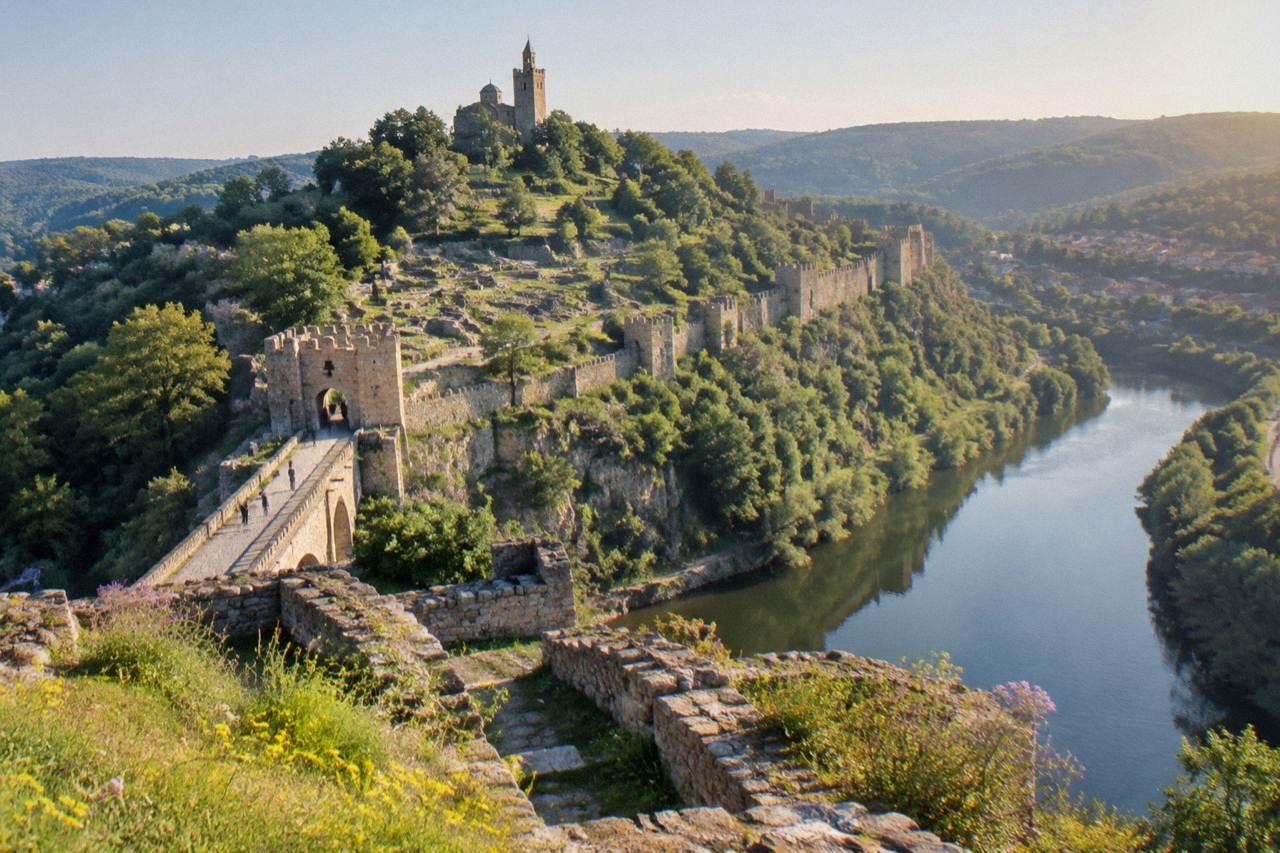
Yes, for a two to three day city break built around Tsarevets Fortress, the Sound and Light show, Trapezitsa, Samovodska Charshiya, General Gurko Street, the Varosha quarter and nearby Arbanasi village. The Regional Museum of History's ticket page lists a Tsarevets adult ticket at 7.67 euro, several core public spaces are free, and the city sits on rail lines from Sofia, Varna and Ruse, which keeps the trip practical as well as rewarding.
Nothing in the city is a UNESCO World Heritage Site or on the Tentative List, so if a heritage badge is what you are chasing, that is not what this city offers. What it offers instead is concentration: the fortress, the churches, the old trading street and the river gorge sit close together, and the municipality runs its museum network under one operator, the Regional Museum of History, with a shared ticket page and consistent euro pricing since Bulgaria adopted the currency on 1 January 2026 at a fixed rate of 1.95583 lev per euro.
The city also carries a specific historical weight that smaller Bulgarian towns cannot match. Bulgaria's independence was declared on 22 September 1908, with the Manifesto read at the Church of the Holy Forty Martyrs, and the Ivan Asen II marble victory column of 1230, commemorating the Battle of Klokotnitsa, stands in the same church. The Tarnovo Constitution of 1879 ties the city to the modern Bulgarian state as well as the medieval one. That double story, medieval capital and national cradle, is the reason the calendar holds a city holiday on 22 March every year.
The question of what the city is actually known for has its own deeper answer in what Veliko Tarnovo is famous for, and the question of how long to allow is covered in how many days you need in Veliko Tarnovo.
What Are The Sights That Make Veliko Tarnovo Worth The Trip?
The core sight set is Tsarevets Architectural-Museum Reserve with the Patriarchal Cathedral of the Holy Ascension on its hill, the Trapezitsa reserve on the opposite bank, the Church of the Holy Forty Martyrs, the multimedia visitor centre Tsarevgrad Tarnov, the Samovodska Charshiya street, General Gurko Street, the Varosha quarter and Arbanasi village about 2.8 km straight-line from the centre, and the Sound and Light audio-visual show watched free from Tsar Asen I Square.
Want to wander that sight set with audio commentary? Book a self guided audio tour.
The fortress numbers matter because they anchor the whole visit. Tsarevets is open daily with no day off: April to September 08:00 to 20:00 with last entry at 19:00, October 09:00 to 18:00, and from 25 October 2026 winter hours apply with entry 09:00 to 16:00 and closing at 17:00. A Tuesday maintenance slot of 09:10 to 11:00 is listed on the ticket page. The Patriarchal Cathedral on the hill is inside the same ticket, with its own hours running April to September 09:00 to 19:00, October 09:15 to 17:30 and winter 09:15 to 16:45.
Trapezitsa costs less and closes earlier in the year: it is closed to visitors from 30 November 2026 to 31 March 2027, and its funicular stops for the season on 31 October 2026. While it runs, the funicular operates 09:00 to 16:00 with a lunch break from 12:00 to 13:00, and a return ride costs 5.11 euro. The Sound and Light show runs on announced evenings only, not nightly, and watching it from Tsar Asen I Square is free. The Asenevtsi Monument, Samovodska Charshiya, General Gurko Street and the Varosha quarter are public spaces, open at all hours and free to walk on your own.
Beyond the fortress hill, the museum network adds depth for a rainy afternoon: the Archaeological Museum on Sylvester Penov Street, the Konak museum of the Revival and Constituent Assembly in an 1872 building, Sarafkina House on General Gurko Street from 1861, and the Prison Museum, open Tuesday to Saturday. The walking tours on the roster are paid products, but the open public spaces of the old quarters can be walked on your own at no charge.
The trio above covers three of the bookable angles on the city: a self-guided monastery visit, a guided trip out to the Buzludzha monument and Shipka, and a short indoor talk on Bulgarian poets. For the monastery, the self-guided product page is at the Holy Transfiguration Monastery self-guided tour, or Check availability directly on the tour page.
What Does A Trip To Veliko Tarnovo Cost?
The museum's ticket page lists Tsarevets at 7.67 euro for an adult and 10.23 euro for a family ticket covering parents plus up to 3 children aged 7 to 18, Trapezitsa at 5.11 euro, the Church of the Holy Forty Martyrs at 5.11 euro, the Archaeological Museum at 5.11 euro and a ten-site two-day pass at 20.45 euro per individual, valid 1 April to 30 November, with the Asenevtsi Monument, Samovodska Charshiya, Gurko Street and the Varosha quarter free.
Children under 7 enter museum sites free. The table below gathers the adult and family prices the museum prints, all in euro since the 1 January 2026 changeover.
| Site | Adult | Family |
|---|---|---|
| Tsarevets reserve | 7.67 euro | 10.23 euro |
| Trapezitsa reserve | 5.11 euro | 7.67 euro |
| Church of the Holy Forty Martyrs | 5.11 euro | 7.67 euro |
| Archaeological Museum | 5.11 euro | 7.67 euro |
| Tsarevgrad Tarnov visitor centre | 7.67 euro | 15.34 euro |
| Church of the Nativity, Arbanasi | 7.67 euro | 12.78 euro |
| Two-day pass, 10 museum sites | 20.45 euro | 25.56 euro |
A guided talk at the fortress costs 15.34 euro in Bulgarian, 20.45 euro translated and 25.56 euro in a foreign language, per the museum's ticket page. Whether the whole city feels affordable has its own breakdown in is Veliko Tarnovo expensive.
When Is The Best Time To Visit Veliko Tarnovo?
The ERA5 reanalysis for Veliko Tarnovo, 1991 to 2020, shows a mean daily high of 27.6 C in July and 4.9 C in January with a mean daily low of minus 3.8 C in January, and May carries the highest monthly rain total at 95.7 mm while August carries the lowest at 51.3 mm, so late spring through September combines the warmest museum hours, 08:00 to 20:00 at Tsarevets, with the full sight set open.
Continental means, not promises: the table below is the modelled normal, and any given week can differ.
| Month | Mean high C | Mean low C | Rain mm |
|---|---|---|---|
| January | 4.9 | -3.8 | 56.1 |
| April | 16.9 | 6.0 | 71.6 |
| July | 27.6 | 17.2 | 79.5 |
| August | 28.1 | 17.1 | 51.3 |
| October | 17.6 | 8.0 | 58.9 |
| December | 6.1 | -1.7 | 60.6 |
Winter visits trade shorter hours and the Trapezitsa closure for the Christmas market pattern in Marno Pole park, which follows a late November to 1 January pattern in recent seasons. Summer brings the International Folklore Festival, which ran 18 to 25 July in 2026, and the Arbanasi Summer Music chamber festival in the village churches, which ran 15 to 25 July in 2026. The seasonal trade-offs have their own treatment in the best time to visit guide.
How Hard Is It To Reach Veliko Tarnovo?
There is no airport with scheduled flights serving the city; visitors arrive through Sofia at about 223 road km, Varna at about 214, or Bucharest Otopeni at about 205, and by rail the fastest Sofia connections take 4 h 33 min with a change, usually at Gorna Oryahovitsa, while Varna has one direct train at 3 h 53 min and Ruse a direct one at 2 h 25 min, per the BDZ timetable.
Buses fill the gaps: Sofia runs several operators to the Yug station at 74 Hristo Botev Boulevard, and direct Bucharest coaches take about 3 h 50 min to 4 h 15 min. There is no direct train from Sofia; every rail journey changes, usually at the Gorna Oryahovitsa junction about 10 km away, and slower connections run 6 to 10 hours. Bulgaria is a full Schengen member since 1 January 2025, and the euro is the currency since 1 January 2026, which removes two frictions that older guides still warn about. The nearest-airport question and the station detail each have a dedicated page.
What Can You Do Around Veliko Tarnovo?
The day-trip ring runs from Arbanasi at about 2.8 km to Nicopolis ad Istrum at about 20 km, the Dryanovo Monastery at about 33 km, Tryavna at about 42 km, Etar at about 53 km, Shipka church at about 79 km and the Kazanlak tomb at about 98 km, with the Rock-Hewn Churches of Ivanovo and the Thracian Tomb of Kazanlak, both inscribed by UNESCO in 1979, as the only World Heritage Sites in range.
Nicopolis ad Istrum itself sits on the Tentative List since 1984 and its museum ticket is 5.11 euro. Etar, the architectural-ethnographic complex near Gabrovo, is open year-round with an adult ticket at 7.16 euro per its own admission page. Closer in, the Preobrazhenski Monastery sits about 6 km out and Emen Canyon about 20 km west of the city, its Lower Boaz gorge carrying 90 m sheer cliffs per the municipal tourism site. Check the current price on the official ticket page before booking each of the caves, Krushuna, Tryavna and Bozhentsi.
So Is Veliko Tarnovo Worth Visiting For You?
It is worth it for a traveller whose interest is medieval Bulgarian history, fortress scenery above a river and a walkable old core with euro-priced museums, and less worth it for a beach or nightlife base, since the city is inland, about 77,000 municipality residents and organised around daylight sightseeing. The verdict for your own plan is which trip this is: a two to three day stop between Sofia and Bucharest, or a base for the monastery and valley day trips.
The city holiday on 22 March and the Independence Day programme on 22 September, with the liturgy at the Church of the Holy Forty Martyrs where independence was declared in 1908, give two anchor dates if you want ceremonies and the Sound and Light show in one visit. Whatever you decide, confirm the current prices on the official pages before you go.
Common Questions About Visiting Veliko Tarnovo
Is Veliko Tarnovo Worth Visiting?
Yes, if medieval history and a compact river-gorge city appeal: Tsarevets, Trapezitsa, the Sound and Light show, the old streets and Arbanasi make a full two to three day programme at euro museum prices.
Is Veliko Tarnovo A UNESCO Site?
No. Nothing in the city is inscribed or on the Tentative List. The nearest inscribed sites are the Rock-Hewn Churches of Ivanovo and the Thracian Tomb of Kazanlak, both from 1979; Nicopolis ad Istrum nearby has been on the Tentative List since 1984.
How Much Does Tsarevets Fortress Cost?
The Regional Museum of History's ticket page lists 7.67 euro for an adult and 10.23 euro for a family ticket covering parents plus up to 3 children aged 7 to 18. Confirm before you go.
Does The Sound And Light Show Run Every Night?
No. It runs on announced evenings only, with no fixed schedule. Watching from Tsar Asen I Square is free; check the show's official page for dates.
Can You Fly Into Veliko Tarnovo?
No. No airport with scheduled flights serves the city. Arrivals go through Sofia, Varna or Bucharest Otopeni, then by road, bus or train.