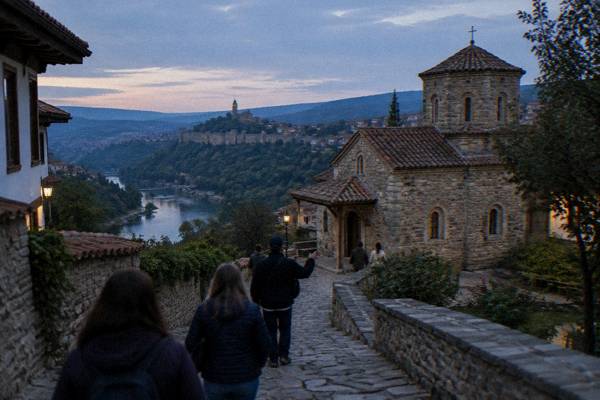
What Is Veliko Tarnovo Famous For?
Veliko Tarnovo is famous as the medieval capital of Bulgaria: Tsarevets Fortress, the Sound and Light show, the Yantra river meanders and the village of Arbanasi. Here is what the city is known for.
Veliko Tarnovo, an inland city in Bulgaria on the Yantra river with no sea coast, is famous first as a capital: the seat of the Second Bulgarian Kingdom for more than two centuries, from the late 12th century to the 14th. The municipality had an estimated 77,067 residents on 31 December 2025, and the city wraps around the meanders of the Yantra rather than a plain. Its fame rests on Tsarevets Fortress with the Patriarchal Cathedral, the Sound and Light audio-visual show, the Trapezitsa reserve, the Samovodska Charshiya and General Gurko Street, and the village of Arbanasi on the plateau above. The Church of the Holy Forty Martyrs carries its own place in history: Bulgaria's independence was declared there on 22 September 1908, when Prince Ferdinand read the Manifesto. Nothing in the city is a UNESCO World Heritage Site or on the Tentative List; the nearest inscribed sites are the Rock-Hewn Churches of Ivanovo and the Thracian Tomb of Kazanlak, both from 1979, and Nicopolis ad Istrum, about 20 road km north, has been on the Tentative List since 1984.
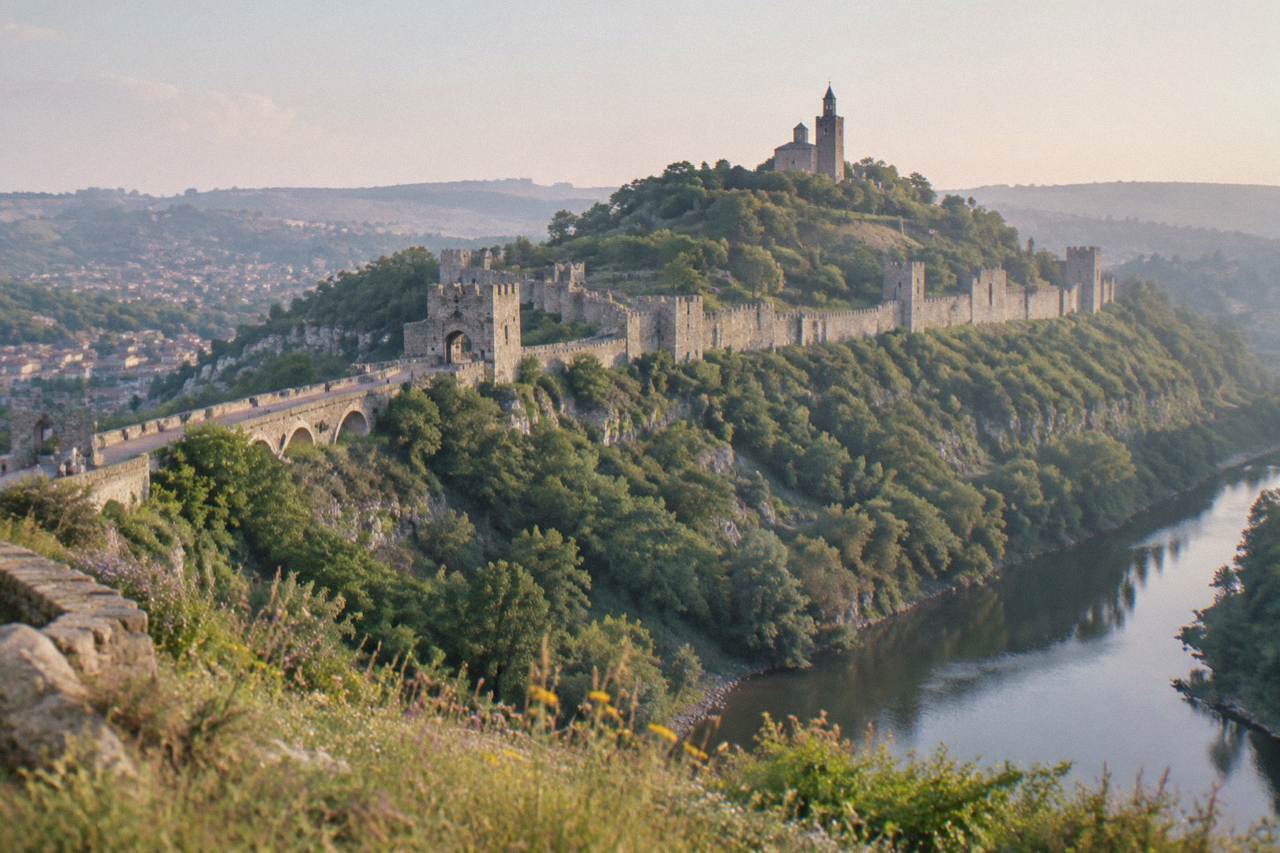
Veliko Tarnovo is famous for being the capital of the Second Bulgarian Kingdom from the late 12th century to the 14th, and for the sights that survive from that era: Tsarevets Fortress with the Patriarchal Cathedral, the Trapezitsa reserve, the Church of the Holy Forty Martyrs and the Sound and Light show on the fortress hill. The city is equally known for the meanders of the Yantra river, for Samovodska Charshiya, General Gurko Street and the village of Arbanasi about 2.8 km straight-line from the centre.
The restoration of the Bulgarian state is dated 1185 to 1186, the uprising of Asen and Peter, and the museum's own page says the city became a metropolitan centre after the state was restored in 1186. The fall to the Ottomans came in 1393, and the Tarnovo Constitution was adopted in 1879. That stretch of history is the reason a mid-sized inland city carries a national role: the city holiday on 22 March marks the Holy Forty Martyrs and the Battle of Klokotnitsa of 1230, whose victory column of Ivan Asen II stands in the Forty Martyrs church.
The famous core is walkable and partly free. The Asenevtsi Monument, Samovodska Charshiya, General Gurko Street and the Varosha quarter are public spaces with no ticket, and the Sound and Light show can be watched free from Tsar Asen I Square on the evenings it runs. For the paid core, the museum's own figures are below.
Staying in the middle of it keeps every walk short. Book a hotel.
| Site | Adult ticket | Hours (April to September) |
|---|---|---|
| Tsarevets Architectural-Museum Reserve | 7.67 euro | daily 08:00 to 20:00 |
| Patriarchal Cathedral of the Holy Ascension | within the Tsarevets ticket | 09:00 to 19:00 |
| Trapezitsa Architectural-Museum Reserve | 5.11 euro | daily 09:00 to 19:00 |
| Church of the Holy Forty Martyrs | 5.11 euro | 09:00 to 18:00 |
| Tsarevgrad Tarnov multimedia visitor centre | 7.67 euro | 09:00 to 19:00 |
| Archaeological Museum | 5.11 euro | 09:00 to 18:00 |
The seasonal traps matter when reading that table. Winter hours at the museum sites start on 25 October 2026, Trapezitsa is closed to visitors from 30 November 2026 to 31 March 2027, the Trapezitsa funicular stops for the season on 31 October 2026, and the Church of the Nativity in Arbanasi is free on its feast day, 25 December 2026. The Museum of New and Newest History is temporarily not accepting visitors.
Why Is Tsarevets Fortress The City's Landmark?
Tsarevets Fortress is Veliko Tarnovo's landmark because it was the fortified heart of the medieval capital and it still dominates the city: the hill holds the remains of the royal palace and the Patriarchal Cathedral of the Holy Ascension, it is open daily with no closing day, and it drew a reported 209,875 visitors in 2025, of whom 103,733 were foreign. An adult ticket is 7.67 euro and a family ticket 10.23 euro, per the Regional Museum of History's ticket page.
The reserve is the museum's flagship. From April to September it opens at 08:00 and takes its last visitor at 19:00, closing at 20:00; in October it runs 09:00 to 18:00; from 25 October 2026 the winter entry window is 09:00 to 16:00. There is no day off, though a Tuesday maintenance slot from 09:10 to 11:00 is listed on the ticket page. The Patriarchal Cathedral on the hill keeps its own hours and is covered by the same ticket.
The fortress also serves as the canvas for the Sound and Light show, the audio-visual programme that runs on announced evenings only, with no fixed nightly schedule. Watching from Tsar Asen I Square in front of Tsarevets is free; paid seats face the hill from a panoramic platform. Confirmed 2026 performances clustered around the national holidays, including 22 September, when the independence anniversary programme adds a liturgy at the Forty Martyrs church, a reenactment and a flag ritual on the hill. The castle question across Bulgaria is answered by this hill more often than by any other site in the country.
A walk of the city can be done independently through the free public spaces, and the walking tours on the roster are paid products. One of them, the Discover Veliko Tarnovo at Your Pace private or self-guided tour, covers the famous core with a private guide or an audio format, and pairs with the full things-to-do overview when planning the days around it. The shape of the visit matters more than the ticket line: the fortress, the two fortress hills and the old streets read as one continuous route.
What Else Is Veliko Tarnovo Known For Beyond The Fortress?
Beyond the fortress, Veliko Tarnovo is known for its old quarters and streets, Samovodska Charshiya, General Gurko Street and the Varosha quarter, all free public spaces, and for the museums of the Regional Museum of History network, from the Archaeological Museum to the Konak of 1872 and the Prison Museum, each at 5.11 euro for an adult. The village of Arbanasi, about 2.8 km straight-line from the centre, adds decorated churches and the Konstantsalieva House to the same story.
Samovodska Charshiya is the revived craftsmen's street of the old town; General Gurko Street runs along the Varosha quarter above the Yantra. None of these charges entry, and none keeps museum hours. The museum network around them is the paid layer: the Archaeological Museum (April to October 09:00 to 18:00, winter 09:00 to 17:30, 5.11 euro), the Museum "Revival and Constituent Assembly" in the Konak built in 1872, the Prison Museum open Tuesday to Saturday 09:30 to 17:30, and Sarafkina House of 1861 on General Gurko Street, also Tuesday to Saturday, all at 5.11 euro adult.
Arbanasi is the hilltop extension of the city's fame. The Church of the Nativity and the Church of Sts Archangels Michael and Gabriel each cost 7.67 euro for an adult, 12.78 euro for a family, and Konstantsalieva House is 7.67 euro, though it drops to Friday-to-Sunday opening, 10:00 to 16:00, from 30 November 2026 to 20 March 2027. A two-day pass covering 10 museum sites costs 20.45 euro for an individual, valid 1 April to 30 November, or 25.56 euro for a family, per the museum's price page.
How Does The Setting On The Yantra Shape The City?
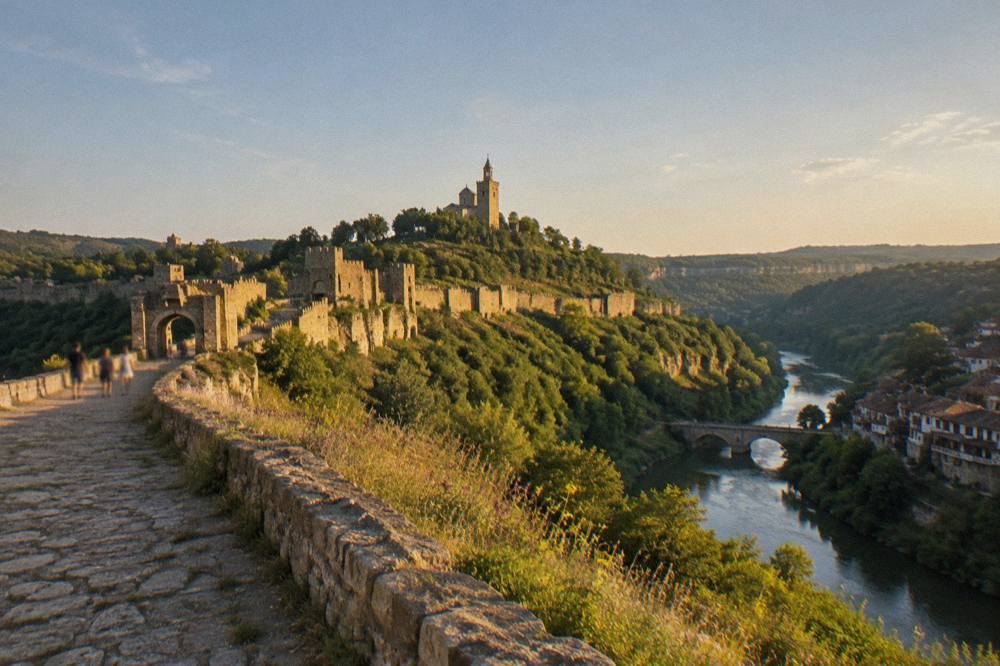
The setting shapes everything: Veliko Tarnovo sits at about 220 m elevation on the meanders of the Yantra river, an inland city with no sea coast, and its quarters climb the slopes above the river bends rather than spreading on a plain. The climate is continental, with an ERA5 reanalysis 1991-2020 mean daily high of 27.6 C in July and 4.9 C in January and a mean daily low of -3.8 C in January, and May carries the highest monthly rainfall at 95.7 mm.
The river gorge is why the viewpoints, the bridges and the old streets matter as much as the buildings. The Asenevtsi Monument stands at the tip of a bend; the fortress hills rise from the water on three sides. Practical Bulgaria facts frame a visit too: the country has used the euro since 1 January 2026, at a fixed rate of 1.95583 lev per euro, and has been a full Schengen member since 1 January 2025. The single European emergency number is 112. The full index of guides sits on Veliko Tarnovo Travel Guide.
| Month | Mean daily high (C) | Mean daily low (C) | Rain (mm) |
|---|---|---|---|
| January | 4.9 | -3.8 | 56.1 |
| April | 16.9 | 6.0 | 71.6 |
| July | 27.6 | 17.2 | 79.5 |
| October | 17.6 | 8.0 | 58.9 |
Those are ERA5 reanalysis, 1991-2020 values, a modelled grid cell rather than a weather-station record. August carries the lowest monthly rainfall in the table at 51.3 mm and the highest mean daily high at 28.1 C. Whether that points a visit toward spring or autumn is a matter of taste; the question of how many days to spend is the more practical one.
What Day Trips Is Veliko Tarnovo Famous As A Base For?
Veliko Tarnovo is famous as a base for the day trips packed into the hills around it: Arbanasi about 2.8 km straight-line from the centre, Nicopolis ad Istrum about 20 road km, Bacho Kiro cave about 31 km, Emen Canyon about 32 km by road, Dryanovo Monastery about 33 km, Tryavna about 42 km, Bozhentsi about 46 km and the Etar open-air museum about 53 km, with Krushuna Falls, Shipka church, Buzludzha, Lovech and the Kazanlak tomb all under about 100 km.
Etar, the architectural-ethnographic complex near Gabrovo, is the one with printed figures: open all year with no days off, an adult ticket at 7.16 euro, per its own admission page. Nicopolis ad Istrum, the Roman city on the Tentative List since 1984, is a Regional Museum of History site at 5.11 euro, open April to September 09:00 to 18:00 and by appointment only in winter. Emen Canyon, the gorge of the Negovanka river about 20 km west of the city, has 90 m sheer cliffs at Lower Boaz, per the municipal tourism site.
| Day trip | Distance from the centre | Entry |
|---|---|---|
| Arbanasi | about 2.8 km straight-line | churches 7.67 euro |
| Nicopolis ad Istrum | about 20 km | 5.11 euro |
| Emen Canyon | about 32 km by road | no ticketed entry |
| Dryanovo Monastery | about 33 km | check locally |
| Tryavna | about 42 km | check locally |
| Etar | about 53 km | 7.16 euro |
| Shipka church | about 79 km | check the site before going |
| Kazanlak tomb | about 98 km | check the site before going |
For the destinations without printed hours, check the current price on the official ticket page before booking. The monasteries complete the ring: Preobrazhenski Monastery about 6 km out, Holy Trinity about 7 km, Kilifarevo Monastery about 17 km, whose small history museum is closed 30 November 2026 to 30 March 2027. That density of medieval, revival-era and natural sites inside a one-hour radius is a real part of what the city is known for.
Which Events And Traditions Is The City Famous For?
Veliko Tarnovo is famous for the Sound and Light show on its announced evenings, for the 22 March city holiday honouring the Holy Forty Martyrs and the Battle of Klokotnitsa, and for the 22 September independence commemorations centred on the Church of the Holy Forty Martyrs, where the 1908 Manifesto was read. The 28th International Folklore Festival ran 18 to 25 July 2026, and Arbanasi Summer Music ran 15 to 25 July 2026 in the churches of Sts Archangels and St George.
The folklore festival and the chamber-music series are both annual fixtures with confirmed 2026 editions. The Etar International Fair of Traditional Crafts is reported for 4 to 6 September 2027 as its 20th edition, and the Kazanlak Rose Festival culmination is reported for 4 to 6 June 2027; both dates are reported, so confirm closer to the time. Kukeri masquerade processions take place in Arbanasi and Veliko Tarnovo around Sirni Zagovezni before Lent, with no 2027 date announced. The Christmas market fills Marno Pole park from late November toward 1 January as its annual pattern, with 2026 dates not yet announced.
Whether the city earns its fame in person is a fair question after this list; the worth-visiting verdict and the old-capital backstory cover it from both ends. The self-guided option can be checked on its own terms: Check availability.
Common Questions About What Veliko Tarnovo Is Famous For
What Is Veliko Tarnovo Famous For?
It is famous as the capital of the Second Bulgarian Kingdom from the late 12th century to the 14th, and for Tsarevets Fortress, the Patriarchal Cathedral, the Sound and Light show, Samovodska Charshiya, General Gurko Street, the Varosha quarter and the village of Arbanasi.
Is Veliko Tarnovo A UNESCO World Heritage Site?
No. Nothing in the city is inscribed or on the Tentative List. The nearest inscribed sites are the Rock-Hewn Churches of Ivanovo and the Thracian Tomb of Kazanlak, both from 1979; Nicopolis ad Istrum, about 20 road km north, has been on the Tentative List since 1984.
Was Veliko Tarnovo The Capital Of Bulgaria?
Yes, of the Second Bulgarian Kingdom, for more than two centuries from the late 12th century to the 14th, after the 1185 to 1186 uprising of Asen and Peter. It fell to the Ottomans in 1393, and the Tarnovo Constitution was adopted there in 1879.
What Is The Sound And Light Show?
An audio-visual programme projected onto Tsarevets on announced evenings only, with no fixed nightly schedule. Watching from Tsar Asen I Square is free; paid seats sit on a panoramic platform facing the hill.
What Currency Does Veliko Tarnovo Use?
The euro, since 1 January 2026, at a fixed rate of 1.95583 lev per euro. Museum tickets are printed in euro, for example 7.67 euro for Tsarevets.
How Far Is Arbanasi From Veliko Tarnovo?
About 2.8 km straight-line from the centre. Its Church of the Nativity costs 7.67 euro for an adult and is free on its feast day, 25 December 2026.