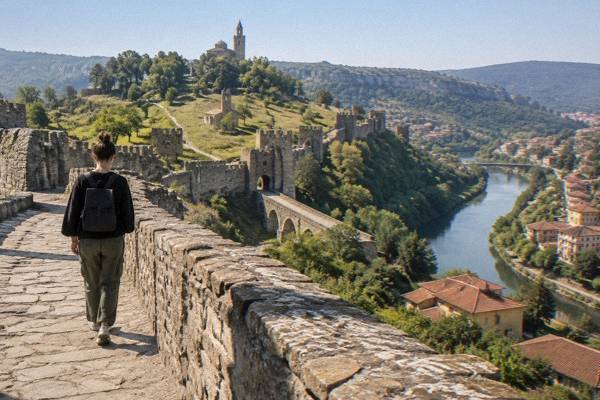
What Is The Most Famous Castle In Bulgaria?
Tsarevets Fortress in Veliko Tarnovo is the most famous castle in Bulgaria, a walled hill that served as the seat of the Second Bulgarian Kingdom. Here is what it costs and how to visit.
Bulgaria's most famous castle stands in Veliko Tarnovo, an inland city on the Yantra river with no sea coast, and it is called Tsarevets. The fortress hill served as the seat of the Second Bulgarian Kingdom for more than two centuries, from the late 12th century until the fall of the city in 1393, and it is the single sight the country's medieval past is anchored to. The Regional Museum of History runs it today as an architectural and museum reserve, open every day of the week, and it drew a reported 209,875 visitors in 2025, more than any other museum site in the region. Around it cluster the rest of the reasons travellers come to the city: Trapezitsa, the Varosha quarter, Samovodska Charshiya, General Gurko Street and the village of Arbanasi.
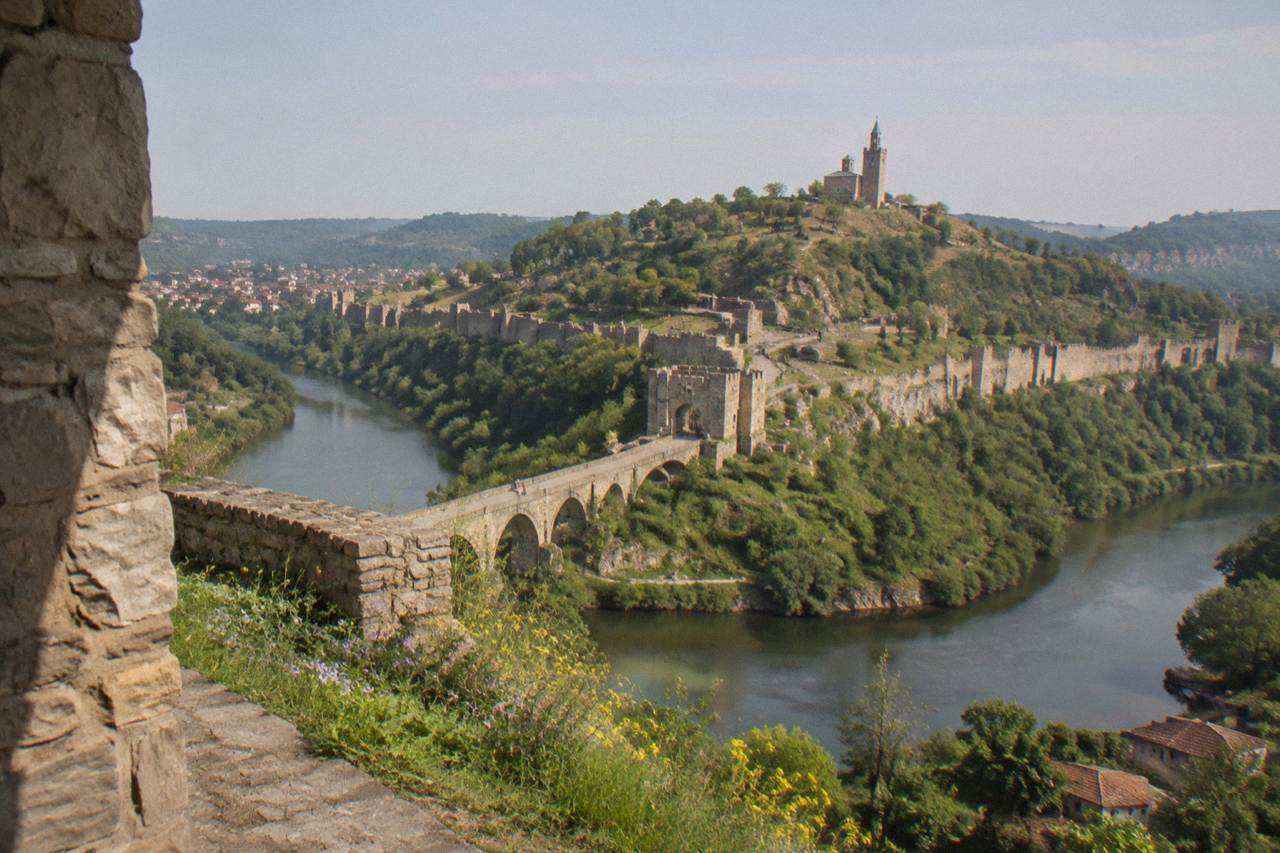
The most famous castle in Bulgaria is Tsarevets Fortress in Veliko Tarnovo, the fortified hill that served as the seat of the Second Bulgarian Kingdom for more than two centuries, from the late 12th century until the city fell to the Ottomans in 1393. The Regional Museum of History operates it today as an architectural and museum reserve, open daily, with the Patriarchal Cathedral of the Holy Ascension included in the entry ticket.
The claim rests on history rather than on theme-park scale. The restoration of the Bulgarian state is dated to the 1185 to 1186 uprising of Asen and Peter, and the city on the Yantra became the capital of the renewed kingdom. The museum's own ticket page describes the site as the heart of that state until 1393, when the fortress fell after a siege. No other fortress in the country carries that political weight: this was a royal seat, and the modern Bulgarian state has returned to the city for its anniversaries ever since. Bulgaria's independence was declared on 22 September 1908, and the Manifesto was read at the Church of the Holy Forty Martyrs in Veliko Tarnovo, tying the medieval capital to the modern state in a single place.
A point worth clearing up: Tsarevets is not a UNESCO World Heritage Site, and nothing else in the city is inscribed or on the Tentative List either. The nearest inscribed sites are the Rock-Hewn Churches of Ivanovo and the Thracian Tomb of Kazanlak, both added in 1979, while the Roman ruins of Nicopolis ad Istrum, about 20 road km north, have sat on the Tentative List since 1984. Fame and UNESCO status are different things, and Tsarevets has the first without the second.
For context on what else the city is known for, see what Veliko Tarnovo is famous for, and for the deeper history, the old capital of Bulgaria. The city's full sight list is on the things to do in Veliko Tarnovo page.
How Much Does Tsarevets Fortress Cost, And When Is It Open?
An adult ticket to Tsarevets Fortress costs 7.67 euro, and a family ticket for parents plus up to 3 children aged 7 to 18 costs 10.23 euro, per the Regional Museum of History's ticket page. The fortress is open daily with no day off: April to September 08:00 to 20:00, October 09:00 to 18:00, and winter hours from 25 October 2026 with entry 09:00 to 16:00 and closing at 17:00. Children under 7 enter free.
A Tuesday maintenance slot of 09:10 to 11:00 is listed on the ticket page, so a Tuesday-morning arrival can mean waiting until late morning. The Patriarchal Cathedral on the hill keeps its own shorter hours, April to September 09:00 to 19:00, October 09:15 to 17:30, winter 09:15 to 16:45, and it is included in the same ticket. A guided talk can be added at the ticket office: 15.34 euro in Bulgarian, 20.45 euro translated, 25.56 euro in a foreign language. Confirm hours before you go, since the museum adjusts them by season.
| Ticket or option | Price (euro) | Notes |
|---|---|---|
| Adult, Tsarevets | 7.67 | includes the Patriarchal Cathedral |
| Family, Tsarevets | 10.23 | parents plus up to 3 children aged 7 to 18 |
| Children under 7 | free | per the museum's ticket page |
| Guided talk, Bulgarian | 15.34 | per talk, added at the ticket office |
| Guided talk, translated | 20.45 | per the museum's ticket page |
| Guided talk, foreign language | 25.56 | per the museum's ticket page |
If you would rather have the story told to you on your own schedule, the self-guided audio tour below covers the city and the fortress together, and the other two picks round out a first visit.
What Can You See On The Tsarevets Hill?
The Tsarevets reserve is the hill itself, the museum's protected architectural reserve on it, and the Patriarchal Cathedral of the Holy Ascension at its top, all covered by one 7.67 euro adult ticket. The cathedral's frescoed interior is the single most photographed space in Veliko Tarnovo, and the hill's walls define the skyline the city is recognised by, so the answer is not one building but the whole fortified plateau above the Yantra.
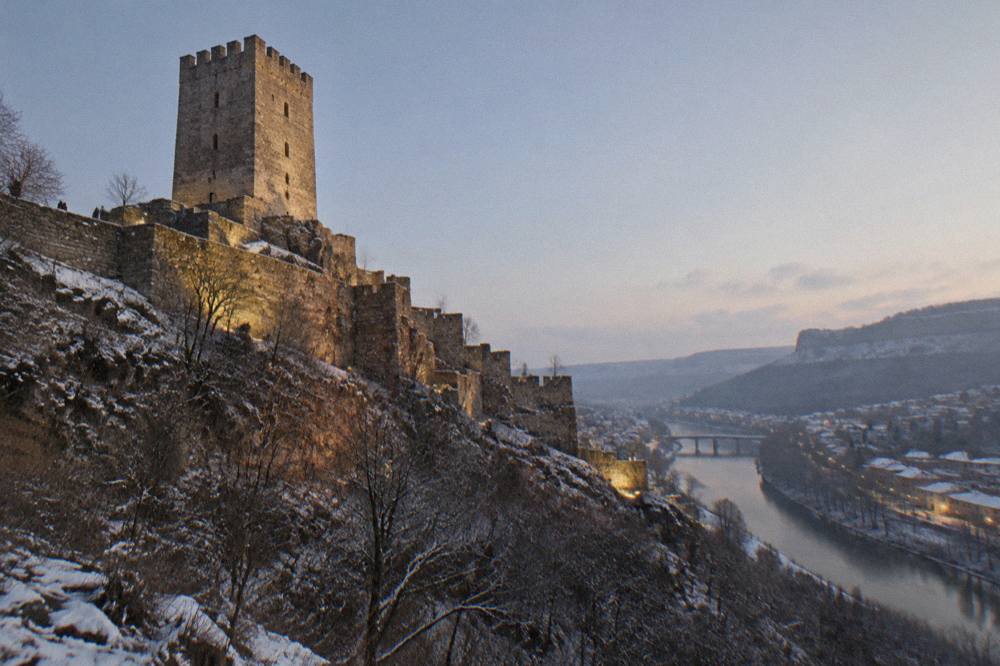
Beyond the walls, the evening display known as the Sound and Light show plays on the fortress hill. It runs on announced evenings only, with no fixed nightly schedule, and watching from Tsar Asen I Square in front of Tsarevets is free, while paid tickets give a seat on the panoramic platform. A related detail: the Church of the Holy Forty Martyrs sits in the city below, outside the fortress reserve, and it holds the marble victory column of Ivan Asen II from 1230, commemorating the Battle of Klokotnitsa. It is a separate museum site with its own 5.11 euro adult ticket. The rest of the planning pages sit on Veliko Tarnovo Travel Guide.
Planning the wider visit is easier with the itineraries already laid out. How many days you need in Veliko Tarnovo covers the pacing question, and whether Veliko Tarnovo is worth visiting answers the harder one.
Is Tsarevets A Real Medieval Castle Or A Reconstruction?
Tsarevets is a real medieval fortress hill whose standing structures have been partly restored, and the Regional Museum of History presents it as an architectural and museum reserve rather than as a ruin or a replica. The hill was the fortified seat of the Second Bulgarian Kingdom from the late 12th century until 1393, when it fell to the Ottomans after a siege, and today's walls and the Patriarchal Cathedral form the museum's presentation of that seat.
The distinction matters for what you should expect. This is not a preserved royal palace with intact halls, and it is not a fictional castle built for tourism. The museum's reserve occupies the hill where the medieval capital's citadel stood, and the Patriarchal Cathedral on it is the structure visitors enter with their ticket. The Sound and Light show adds a nightly-history layer on announced evenings, using the walls as a screen, which is a separate product from the daytime site.
The city around the hill follows the same pattern. Varosha, the old quarter, Samovodska Charshiya with its craftsmen's street, and General Gurko Street are public spaces, free and open at all hours, and the Asenevtsi Monument on the riverbank commemorates the dynasty whose uprising in 1185 to 1186 restored the Bulgarian state. Bulgaria's neighbours contribute their own castles, but for a question about Bulgaria the answer keeps coming back to this hill on the Yantra, and to the medieval towns list in medieval towns in Bulgaria for what to pair it with.
How Do You Fit Tsarevets Into A Visit To Veliko Tarnovo?
Tsarevets sits at the centre of any Veliko Tarnovo itinerary, and the practical answer is to give it a morning or an evening: a morning for the reserve and the Patriarchal Cathedral under the April to September hours of 08:00 to 20:00, or an evening for a paid Sound and Light seat or the free viewing from Tsar Asen I Square. The rest of the city, from Varosha to Arbanasi, about 2.8 km straight-line from the centre, wraps around the hill on foot.
Guided products fill the gap for travellers who want interpretation rather than a bare ticket. The walking tours on the roster are paid products, including the city monuments walk and the self-guided audio tour of the city and the fortress, and day trips from Sofia, Bucharest and Plovdiv bring the castle to travellers who are not staying overnight. The audio tour is the natural pick for a castle-focused visit, since it pairs the fortress with the city around it: Check availability.
If you are staying in the Romanian capital, book a private fortress tour from Bucharest.
Common Questions About Bulgaria's Most Famous Castle
What is the most famous castle in Bulgaria?
Tsarevets Fortress in Veliko Tarnovo. The walled hill on the Yantra river was the seat of the Second Bulgarian Kingdom for more than two centuries, from the late 12th century until 1393, and it is the castle Bulgaria's medieval history is anchored to. The Regional Museum of History runs it today as an open daily reserve.
How much does Tsarevets Fortress cost?
An adult ticket costs 7.67 euro and a family ticket, for parents plus up to 3 children aged 7 to 18, costs 10.23 euro, per the Regional Museum of History's ticket page. Children under 7 enter free. A guided talk can be added at 15.34 euro in Bulgarian, 20.45 euro translated and 25.56 euro in a foreign language.
Is Tsarevets a UNESCO World Heritage Site?
No. Nothing in Veliko Tarnovo is inscribed or on the Tentative List. The nearest inscribed sites are the Rock-Hewn Churches of Ivanovo and the Thracian Tomb of Kazanlak, both from 1979, and Nicopolis ad Istrum, about 20 road km north, has been on the Tentative List since 1984.
Is Tsarevets open in winter?
Yes, daily with no day off. Winter hours start on 25 October 2026, with entry 09:00 to 16:00 and closing at 17:00. A Tuesday maintenance slot of 09:10 to 11:00 is listed on the ticket page. The neighbouring Trapezitsa reserve, by contrast, is closed from 30 November 2026 to 31 March 2027.
Can you watch the Sound and Light show for free?
Yes. The show runs on announced evenings only, with no fixed schedule, and watching from Tsar Asen I Square in front of Tsarevets is free. Paid tickets give a seat on the panoramic platform; check the current price on the official ticket page before booking.
A castle is only part of the reason the city works as a destination, but it is the part the country is known by. Book the fortress for a full day or a long evening, add the Forty Martyrs church and the Varosha streets below the hill, and the most famous castle in Bulgaria will have earned its reputation before you leave.