Is Bulgaria Cheap For Americans?
What Americans actually pay in Veliko Tarnovo and the rest of Bulgaria: sight tickets in euro, the currency changeover, border rules, free sights and season by season costs.
Veliko Tarnovo, an inland city on the Yantra river in northern Bulgaria with no sea coast, prints its main museum tickets at 5.11 euro and 7.67 euro, and that single set of figures frames the whole question of what Americans pay here. The municipality counted 77,067 residents on 31 December 2025, the country swapped the lev for the euro on 1 January 2026 at a fixed rate of 1.95583 lev per euro, and the capital of the Second Bulgarian Kingdom now prices everything a visitor buys in the same currency a traveller from Chicago or Dallas carries on a card. Whether that reads as affordable is a judgement the numbers below let you make yourself, because no cost comparison against the United States or Western Europe has a source behind it.
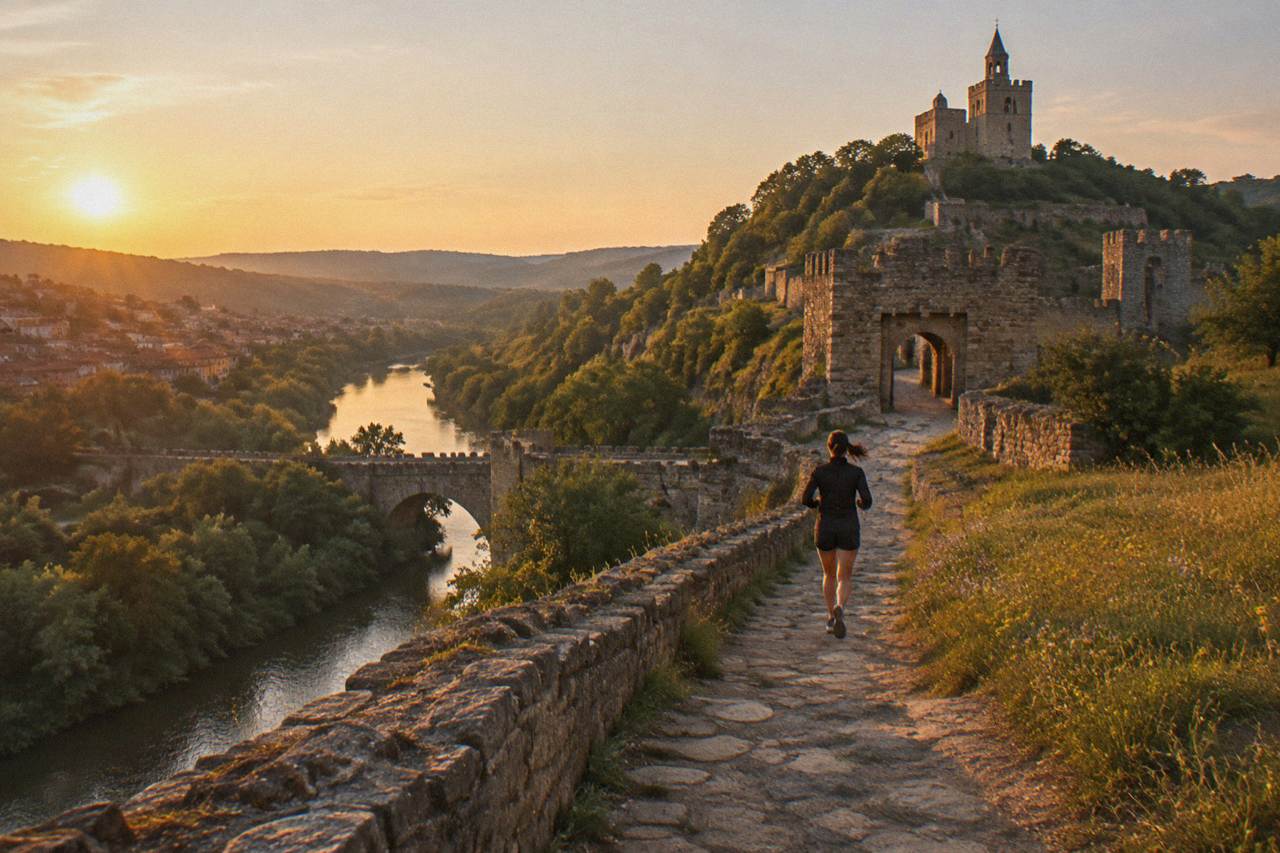
No sourced comparison between Bulgaria and the United States exists on this site, so the answer rests on the printed prices: Tsarevets Fortress lists an adult ticket at 7.67 euro and a family ticket at 10.23 euro, Trapezitsa and several museums list 5.11 euro, and watching the Sound and Light show from Tsar Asen I Square is free on its announced evenings. A two-day pass covering ten museum sites lists at 20.45 euro. Those are the figures a budget can be built on.
The Regional Museum of History, the operator of the fortress and the museum network around it, sells only in euro since the changeover, and quotes its prices exactly: 7.67 euro is the converted figure the museum prints for the standard adult fortress ticket, not a rounded approximation. The same ticket page lists a family ticket at 10.23 euro covering parents and up to three children aged 7 to 18, with children under 7 entering free across the network. Students, seniors and pupils pay reduced rates at the ticket office.
What the question really asks, though, is about the whole basket: rooms, food, transport, tickets. What can be stated is the sight list, and it is short and concrete. The cost question for Veliko Tarnovo itself has its own page, and the safety question Americans ask next has one too.
Sorting out the rooms side of the basket. Book a hostel bed.
What The Sights In Veliko Tarnovo Cost
Every paid sight in the city centre run by the Regional Museum of History lists between 5.11 euro and 7.67 euro for a standard adult, with family tickets listed at 7.67 euro for Trapezitsa and 10.23 euro for Tsarevets. The Archaeological Museum, the Church of the Holy Forty Martyrs and the multimedia visitor centre all print their own figures on the museum's ticket pages, and Etar, the open-air museum about 53 km away by road, lists 7.16 euro for an adult.
Those prices are seasonal in one sense only: the hours change, not the tariffs. From April to September Tsarevets is open daily from 08:00 to 20:00 with last entry at 19:00; in October it runs 09:00 to 18:00; and winter hours start on 25 October 2026 with entry from 09:00 to 16:00. The fortress has no closing day, though a Tuesday maintenance slot from 09:10 to 11:00 appears on the ticket page. Trapezitsa lists 5.11 euro adult and 7.67 euro family, with students and Bulgarian citizens over 60 paying 2.56 euro, but it closes to visitors entirely from 30 November 2026 to 31 March 2027, and its funicular stops for the season on 31 October 2026.
| Sight | Adult Ticket |
|---|---|
| Tsarevets Architectural-Museum Reserve | 7.67 euro |
| Trapezitsa Architectural-Museum Reserve | 5.11 euro |
| Church of the Holy Forty Martyrs | 5.11 euro |
| Archaeological Museum | 5.11 euro |
| Tsarevgrad Tarnov multimedia visitor centre | 7.67 euro |
| Church of the Nativity, Arbanasi | 7.67 euro |
| Konstantsalieva House, Arbanasi | 7.67 euro |
| Etar Architectural-Ethnographic Complex | 7.16 euro |
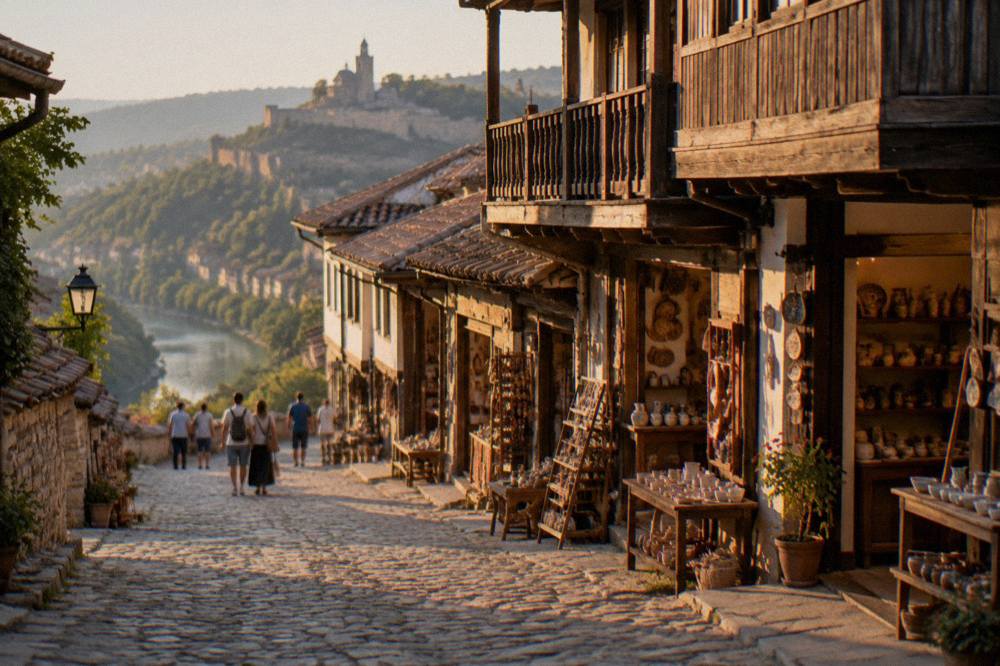
Arbanasi, the village about 2.8 km straight-line from the centre, carries the higher church tickets: 7.67 euro adult and 12.78 euro family at both the Church of the Nativity and Konstantsalieva House. The Nativity church is free on its feast day, 25 December 2026. Konstantsalieva House drops to Friday, Saturday and Sunday opening only from 30 November 2026 to 20 March 2027. Nicopolis ad Istrum, the Roman site on the Tentative List since 1984, lists a 5.11 euro adult ticket and has no family price printed, and the two-day pass valid 1 April to 30 November covers ten museum sites at 20.45 euro individual or 25.56 euro family.
Beyond the museum network, the city's paid products are bookable experiences rather than entries, and their prices render from live listings rather than prose. A tasting experience, an interactive talk and a private eco day sit on the roster alongside self-guided products.
How Americans Reach Veliko Tarnovo
No airport with scheduled flights serves Veliko Tarnovo, so the journey runs through Sofia at about 216 road km, Varna at about 214, or Bucharest Otopeni at about 205, and the train from Sofia involves a change, with the fastest connections on the October 2026 timetable at 4 h 33 min. The Gorna Oryahovitsa airfield near the city has no regular scheduled flights.
The train detail matters for anyone pricing the trip from the Bulgarian capital: there is no direct service, connections change at Gorna Oryahovitsa, and the fastest journey reads 4 h 33 min with a second option at 4 h 51 min. From Varna a single direct train covers the route in 3 h 53 min, and from Ruse a direct one takes 2 h 25 min. Bus services from Sofia take about 3 to 3.5 hours, and direct buses from Bucharest run about 3 h 50 min to 4 h 15 min.
For Americans crossing the ocean first, the choice of gateway shapes the budget more than anything inside the country. Distances from the centre are what they are: about 205 km to Bucharest Otopeni, about 214 to Varna, about 216 to Sofia. The full logistics of getting to Veliko Tarnovo are covered on their own page.
| Gateway | Road Distance From Veliko Tarnovo |
|---|---|
| Bucharest Otopeni (OTP) | about 205 km |
| Varna (VAR) | about 214 km |
| Sofia (SOF) | about 216 km |
Day tours from the gateways exist as paid products on the roster, from Bucharest, from Sofia and from Ruse and Plovdiv, and their prices render from the live listings. For travel within Bulgaria, the Veliko Tarnovo Travel Guide keeps a separate set of pages on trains, buses and driving.
One lower-priced product worth a look is the self-guided visit to the Monastery of the Holy Transfiguration of God, which sits outside the city on the road north. It suits a traveller who has seen the fortress and wants half a day at a monastery without a guide, and it can be checked on the tour page: Check availability.
Which Parts Of Veliko Tarnovo Cost Nothing
The free list is exact: the Asenevtsi Monument, Samovodska Charshiya, General Gurko Street, the Varosha quarter, watching the Sound and Light show from Tsar Asen I Square on its announced evenings, and the Church of the Nativity in Arbanasi on 25 December 2026. All of these are public spaces or scheduled free access, and none requires a ticket.
The Sound and Light audio-visual show on Tsarevets deserves its own sentence, because a widespread claim says it runs every night. It does not. Paid seats exist on a panoramic platform, and the price of those seats should be confirmed with the operator rather than assumed.
No free or tip-based guided walk is claimed anywhere on this site.
What The Euro Means For American Spending
Bulgaria adopted the euro on 1 January 2026 as the 21st euro area member, at a fixed rate of 1.95583 lev per euro, so the lev is no longer the currency and every price an American meets is a euro price. Museum tickets, product listings and any card payment all quote the same currency a US bank converts at its own rate.
Two practical consequences follow. First, there is nothing to convert twice: a ticket printed at 7.67 euro is 7.67 euro, and the museum's own pages have quoted euro figures since the changeover. Second, the old advice about carrying lev is obsolete, and any guide still repeating it predates 1 January 2026. The lev appears in exactly one context now, the fixed conversion rate that defined the changeover.
The border side changed too. Bulgaria has been a full Schengen member since 1 January 2025, with air and sea checks lifted from 31 March 2024, and the Entry/Exit System has run at all Schengen external borders since 10 April 2026, replacing passport stamps with biometric registration. US, UK, Canadian and Australian citizens are reported to be visa-free for 90 days in any 180; confirm current rules with official sources before travel. ETIAS is not operational, and no start date for it may be printed. The single European emergency number is 112.
How The Seasons Change A Veliko Tarnovo Budget
The ERA5 reanalysis for Veliko Tarnovo, 1991 to 2020, puts the mean daily high at 28.1 C in August and 4.9 C in January, with the mean daily low at -3.8 C in January, and May carries the highest monthly rainfall at 95.7 mm while August carries the lowest at 51.3 mm. No month changes what a ticket costs, but winter changes what is open.
The seasonal closures are the real winter cost. Trapezitsa shuts from 30 November 2026 to 31 March 2027, the funicular stops on 31 October 2026, Konstantsalieva House goes to weekends only, the Museum of New and Newest History is temporarily not accepting visitors, and St Dimitar church is open by prior request only in season and closed November to March. Tsarevets itself stays open daily with winter entry hours from 25 October 2026.
| Month | Mean Daily High | Mean Daily Low | Rain |
|---|---|---|---|
| January | 4.9 C | -3.8 C | 56.1 mm |
| April | 16.9 C | 6.0 C | 71.6 mm |
| July | 27.6 C | 17.2 C | 79.5 mm |
| October | 17.6 C | 8.0 C | 58.9 mm |
The best-month question has its own page, and so does the question of how many days Veliko Tarnovo needs. Summer brings the events calendar: the 28th International Folklore Festival ran 18 to 25 July in 2026, Arbanasi Summer Music ran 15 to 25 July in 2026, and the Christmas market in Marno Pole park follows a late-November to 1 January pattern, with 2026 dates to be confirmed with the municipality.
Common Questions About Costs In Bulgaria For Americans
Is Bulgaria Cheap For Americans?
The figures that can be stated are these: Tsarevets lists 7.67 euro adult, the museums list 5.11 euro, the two-day ten-site pass lists 20.45 euro, and several core sights including the Sound and Light viewing from Tsar Asen I Square cost nothing. Whether that reads as cheap against a US budget is yours to judge; no sourced comparison exists.
Does Bulgaria Still Use The Lev?
No. Bulgaria adopted the euro on 1 January 2026 as the 21st euro area member, at a fixed rate of 1.95583 lev per euro. Every price an American meets, from museum tickets to card payments, is quoted in euro.
Do Americans Need A Visa For Bulgaria?
US citizens are reported to be visa-free for 90 days in any 180. Bulgaria is a full Schengen member since 1 January 2025, and the Entry/Exit System has registered travellers biometrically at external borders since 10 April 2026. Confirm current rules with official sources before travel.
What Does A Ticket To Tsarevets Fortress Cost?
The Regional Museum of History lists 7.67 euro for a standard adult and 10.23 euro for a family ticket covering parents and up to three children aged 7 to 18, with children under 7 free. Winter entry hours start on 25 October 2026.
Are The Walking Tours In Veliko Tarnovo Free?
The walking tours on the roster are paid products. The free sights are the public ones: the Asenevtsi Monument, Samovodska Charshiya, General Gurko Street, the Varosha quarter and the free viewing of Sound and Light from Tsar Asen I Square on announced evenings.
What Is Free In Veliko Tarnovo?
The Asenevtsi Monument, Samovodska Charshiya, General Gurko Street, the Varosha quarter, watching Sound and Light from Tsar Asen I Square, and the Church of the Nativity in Arbanasi on 25 December 2026. Children under 7 enter the museum network free, as do people with permanent disabilities with an assistant.
Plan the trip around the printed figures, confirm anything time-sensitive at booking, and the budget writes itself.