What's The Best Month To Go To Bulgaria?
Month-by-month guidance for choosing when to visit Bulgaria, anchored on Veliko Tarnovo: modelled climate normals, museum opening seasons, festivals and the winter closure calendar.
Bulgaria rewards different travellers in different months, and the strongest single answer for a trip built around Veliko Tarnovo, the former medieval capital on the Yantra river, is May, June or September. The ERA5 reanalysis for Veliko Tarnovo, 1991-2020, puts the mean daily high at 21.7 C in May and 23.3 C in September, against 27.6 C in July and 4.9 C in January, and the museum season runs at its fullest from April to September. May carries 95.7 mm of rain, the largest monthly total in the table, so September edges it for dry walking weather.
That is the short version. The longer version weighs the climate month by month, matches it against the opening calendar of the Regional Museum of History sites, and layers in the festival dates that can make one week better than the whole month around it. The deeper breakdowns live in the best time to visit Veliko Tarnovo guide and the Veliko Tarnovo weather reference; this page keeps the national question in view while anchoring every figure to the city that gives inland Bulgaria its character.
What's The Best Month To Go To Bulgaria?
For a first visit that includes Veliko Tarnovo, September is the strongest single month: the mean daily high is 23.3 C, rainfall sits at 63.0 mm on the ERA5 reanalysis, 1991-2020, and every major museum site is still on its April-to-September opening block. May and June follow closely, with highs of 21.7 C and 25.4 C, though May is the rainier of the two at 95.7 mm.
The reasoning behind that ranking is simple. The question is national, but the decision is local: Bulgaria stretches from the Danube to the Rhodopes, and no single month is best for every region. What can be said precisely is what the modelled climate does at Veliko Tarnovo, what the museum calendar does there, and which festivals land in which months. A country-wide itinerary that passes through the old capital inherits all three of those calendars at once. July brings the folklore festival and the warmest weather; December brings the market season and the shortest days.
Two practical facts sharpen the picture. Bulgaria has used the euro since 1 January 2026, fixed at 1.95583 lev per euro at the changeover, and it has been a full Schengen member since 1 January 2025, so month choice has no currency or border consequence. The month you pick is about weather and openings, nothing else.
How The Veliko Tarnovo Climate Splits The Year
The ERA5 reanalysis for Veliko Tarnovo, 1991-2020, a modelled grid cell rather than a station record, shows a continental year: mean daily highs climb from 4.9 C in January to 28.1 C in August, mean daily lows fall to -3.8 C in January, and rainfall runs from 51.3 mm in August to 95.7 mm in May, for an annual total of 798.7 mm. Summer is warm and daylight-rich; winter is cold and short.
The numbers behind that summary, straight from the site's climate table:
| Month | Mean daily high | Mean daily low | Rain |
|---|---|---|---|
| January | 4.9 C | -3.8 C | 56.1 mm |
| February | 7.2 C | -2.3 C | 54.1 mm |
| March | 11.5 C | 1.4 C | 68.6 mm |
| April | 16.9 C | 6.0 C | 71.6 mm |
| May | 21.7 C | 11.1 C | 95.7 mm |
| June | 25.4 C | 15.1 C | 85.0 mm |
| July | 27.6 C | 17.2 C | 79.5 mm |
| August | 28.1 C | 17.1 C | 51.3 mm |
| September | 23.3 C | 12.9 C | 63.0 mm |
| October | 17.6 C | 8.0 C | 58.9 mm |
| November | 11.8 C | 3.1 C | 54.5 mm |
| December | 6.1 C | -1.7 C | 60.6 mm |
Read the table rather than the folklore. August, not July, has the higher mean daily high, 28.1 C against 27.6 C, and August also carries the smallest monthly rainfall total, 51.3 mm. May and June are the two rainiest months on the modelled normals, 95.7 mm and 85.0 mm respectively, which matters for a city whose appeal is walking hills and river gorges rather than sitting indoors. March and November sit in the middle of everything, 11.5 C and 11.8 C mean highs, with rain near 60 mm each. July and August deliver about 13.0 modelled sunshine hours a day against about 5.5 in December.
Winter is a different proposition. January's mean daily low of -3.8 C and December's 60.6 mm of rain, some of it snow, suit a shorter visit built around the Sound and Light show, the indoor museums and the Christmas market season rather than long days outdoors.
Which Months Fit Veliko Tarnovo Sightseeing Best
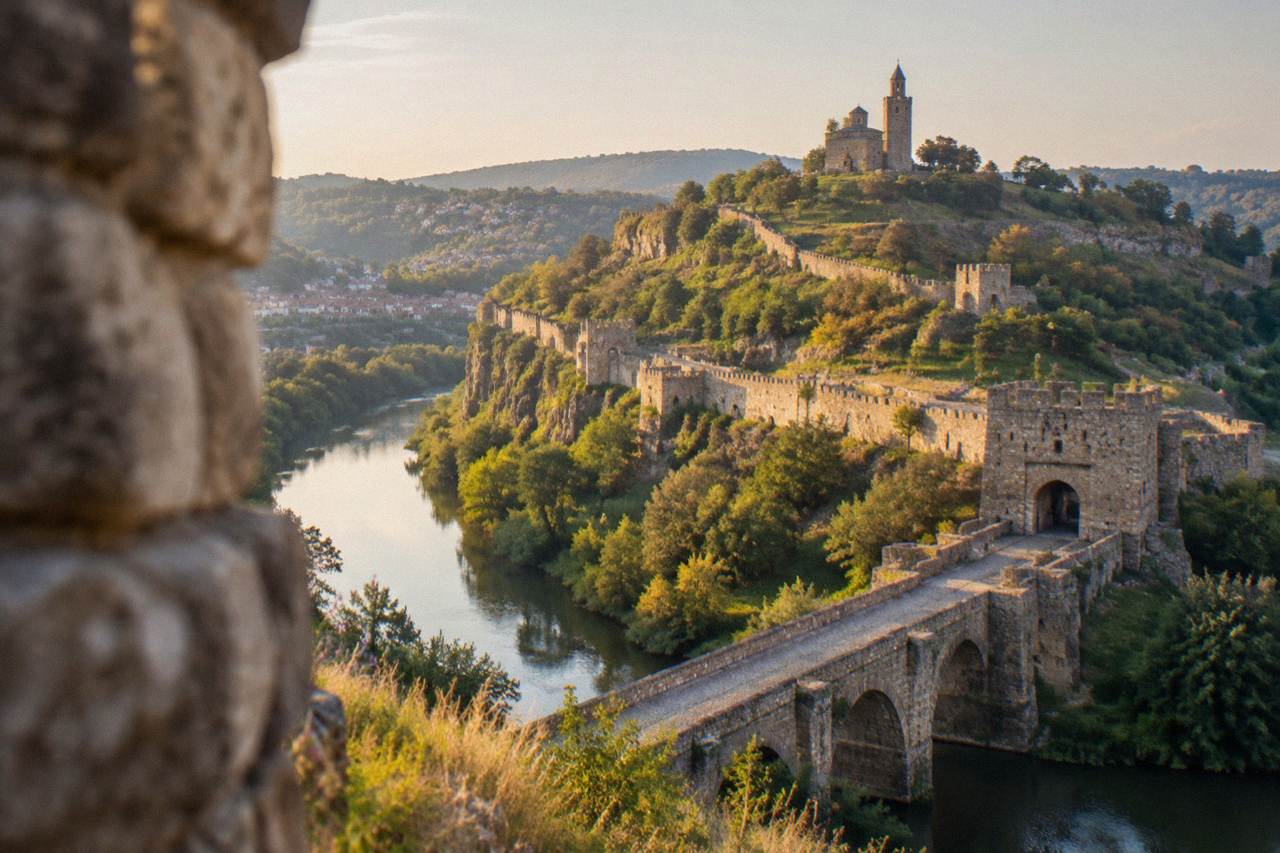
April through September is when Veliko Tarnovo is at its fullest opening: Tsarevets Fortress runs daily from 08:00 to 20:00 with entry until 19:00, Trapezitsa is open 09:00 to 19:00, and the Church of the Holy Forty Martyrs keeps 09:00 to 18:00, all per the Regional Museum of History's ticket pages. Mid-week in May, June or September pairs those hours with comfortable modelled temperatures.
The fortress is the anchor sight, and it has no closing day: the ticket page lists a Tuesday maintenance slot from 09:10 to 11:00, but the site otherwise opens daily. An adult ticket is 7.67 euro, with a family ticket at 10.23 euro for parents and up to three children aged 7 to 18, per the museum's ticket page. The hours matter as much as the price: an 08:00 to 20:00 summer day allows an early climb before the afternoon heat and an evening descent, while the October block shortens to 09:00 to 18:00 and winter entry runs 09:00 to 16:00 from 25 October 2026. Within the season, mean daily highs of 21.7 C in May, 25.4 C in June and 23.3 C in September make those the friendliest walking months.
The walking city outside the fortress costs nothing to enjoy. The free public spaces in Veliko Tarnovo are the Asenevtsi Monument, Samovodska Charshiya, General Gurko Street, the Varosha quarter and watching the Sound and Light show from Tsar Asen I Square; the walking tours on the roster, including the Guided Walking Tour of Veliko Tarnovo city route, are paid products. For a structured walk in the shoulder months, Check availability on the tour page.
Festival dates can tip a month. The 28th International Folklore Festival ran 18 to 25 July 2026, and the Arbanasi Summer Music chamber series filled 15 to 25 July 2026 in the churches of Arbanasi, the village about 2.8 km straight-line from the centre. Veliko Tarnovo Day falls on 22 March every year, and the Independence Day programme on 22 September centres on the Church of the Holy Forty Martyrs, where Bulgaria's independence was declared on 22 September 1908. The Sound and Light show runs on announced evenings only, with no fixed schedule, and it is free to watch from Tsar Asen I Square.
What Each Season Means For Veliko Tarnovo Opening Hours
Winter changes the calendar more than the weather does: from 25 October 2026 the museum sites move to winter hours, the Trapezitsa funicular stops for the season on 31 October 2026, and Trapezitsa itself closes to visitors entirely from 30 November 2026 to 31 March 2027, per the Regional Museum of History's announcements. Konstantsalieva House in Arbanasi drops to Friday-to-Sunday opening from 30 November 2026 to 20 March 2027. A December or January visit therefore sees a shorter, indoor-weighted version of the city.
The full seasonal ledger, as the museum prints it:
| Site | April to September | October | Winter 2026/27 |
|---|---|---|---|
| Tsarevets Fortress | Daily 08:00 to 20:00, last entry 19:00 | 09:00 to 18:00, last entry 17:00 | From 25 Oct 2026, entry 09:00 to 16:00 |
| Trapezitsa | Daily 09:00 to 19:00 | 09:00 to 18:00 | Closed 30 Nov 2026 to 31 Mar 2027 |
| Holy Forty Martyrs church | 09:00 to 18:00 | 09:00 to 17:00 | 09:00 to 17:00, Monday maintenance 09:00 to 11:00 |
| Archaeological Museum | 09:00 to 18:00 | 09:00 to 18:00 | 09:00 to 17:30, last entry 16:30 |
| Church of the Nativity, Arbanasi | 09:00 to 18:00 | 09:00 to 17:00 | Entry 10:00 to 15:30 |
The Christmas season has its own logic. A traditional wooden-chalet market runs in Marno Pole park from late November towards 1 January in a recurring pattern, with the 2026 dates announced by the municipality closer to the season. Kukeri masquerade processions take place in Arbanasi and Veliko Tarnovo around Sirni Zagovezni before Lent, on dates set each year. Neither has a fixed 2027 date to plan around yet, so a winter trip should be booked with the indoor museums, the show evenings and the market as the certainties.
Spring has one card winter lacks: everything reopens at once. Trapezitsa and the funicular return with the season, the funicular running 09:00 to 16:00 with a 12:00 to 13:00 lunch break between 1 May and 31 October, and the April block of hours applies across the network. A late-April visit catches the full city at 16.9 C mean daily high with 71.6 mm of rain for the month, a fair trade for anyone who prefers hills without heat.
Day-trip depth follows the same rhythm. Etar, the architectural open-air museum about 53 km away, is open all year with no days off and charges 7.16 euro for an adult, per its own admission page, with reduced rates for pupils, students and pensioners; the Etar crafts fair falls on the first September weekend pattern, reported for 4 to 6 September 2027. Further afield, the Kazanlak Rose Festival culmination is reported for 4 to 6 June 2027, which makes early June the month for a Rose Valley extension. Both pair naturally with a Veliko Tarnovo base, and the day-trip pages on this site carry the sight details.
The rose valley sits within a day's reach. Book a Valley of Roses day tour.
Common Questions About The Best Month To Visit Bulgaria
What's The Best Month To Go To Bulgaria?
For a trip centred on Veliko Tarnovo, September: a 23.3 C mean daily high, 63.0 mm of rain on the ERA5 reanalysis, 1991-2020, full April-to-September museum hours, and the summer festival season just past. May and June are close behind, with mean highs of 21.7 C and 25.4 C.
Is Bulgaria Too Hot In August?
The ERA5 reanalysis for Veliko Tarnovo puts the August mean daily high at 28.1 C, with 51.3 mm of rain, the smallest monthly total in the table. It is warm but dry, and about 13.0 modelled sunshine hours a day in July fall only slightly by August. Hill walking is best done early and late in the day.
Does Veliko Tarnovo Close In Winter?
No, but it shortens. Winter hours start on 25 October 2026 across the museum network, Trapezitsa closes from 30 November 2026 to 31 March 2027, the funicular stops on 31 October 2026, and the Museum of New and Newest History is temporarily not accepting visitors. Tsarevets Fortress stays open daily with winter entry hours of 09:00 to 16:00.
Which Month Has The Most Rain In Veliko Tarnovo?
May, at 95.7 mm on the ERA5 reanalysis, 1991-2020, followed by June at 85.0 mm. August has the least, 51.3 mm, and the annual total is 798.7 mm.
When Is The Christmas Market Season?
A wooden-chalet market runs in Marno Pole park from late November towards 1 January in a recurring pattern; the 2026 dates are announced closer to the season by the municipality. Pair it with the indoor museums, the show evenings and a 6.1 C December mean daily high.
Set the month against what you want from the city: hills and fortress walls point to May, June or September, festival weeks point to July, and the market season points to December. Whenever you land, a day-by-day plan for the old capital starts with how many days you need in Veliko Tarnovo, and the wider Veliko Tarnovo Travel Guide holds the sight-by-sight detail for every season.