Best Time To Visit Veliko Tarnovo, Month By Month
Veliko Tarnovo rewards different visitors in different months: summer brings long fortress evenings and festivals, spring and autumn bring mild air, and winter brings short hours and a handful of closures. Here is what the climate data and the museum's own opening schedule say about each month.
May, June and September offer the best balance in Veliko Tarnovo: modelled daily highs between 21.7 and 25.4 C, all museum sites on their April-to-September hours, and fortress entry until 19:00 in summer. July and August are the warmest and the driest by rainfall total; winter months are quiet but Trapezitsa closes from 30 November 2026 to 31 March 2027.
Veliko Tarnovo sits inland on the Yantra river in northern Bulgaria, a city of about 77,000 municipality residents built around the hill of Tsarevets, and the seasons shape a visit here more than in a coastal resort: the museum sites switch to winter hours on 25 October 2026, the Trapezitsa reserve closes entirely from 30 November 2026 to 31 March 2027, and the Sound and Light show on Tsarevets runs only on announced evenings. The climate is continental, with a modelled mean daily high of 27.6 C in July against 4.9 C in January in the ERA5 reanalysis, 1991-2020. Choosing the right month is therefore a trade between warmth, daylight, opening hours and what you want the days to contain.
It also covers winter closures, day-trip timing and a set of common planning questions. For the deeper sightseeing picture, the root overview at things to do in Veliko Tarnovo is the companion read, and Veliko Tarnovo Travel Guide covers the city as a whole.
What Is The Best Time To Visit Veliko Tarnovo?
The best months to visit Veliko Tarnovo are late May, June and September, when modelled daily highs sit between 21.7 and 25.4 C, rainfall is moderate, and every museum site is still on its April-to-September schedule with fortress entry until 19:00. July and August are warmer still, with a modelled high of 28.1 C in August and the lowest monthly rainfall total in the table at 51.3 mm, but they are the peak of the festival and holiday season.
Winter is workable only with planning, because Trapezitsa is closed from 30 November 2026 to 31 March 2027 and winter hours start on 25 October 2026.
That answer follows from three things that actually change with the calendar here: the weather, the museum schedule and the events programme. The weather is continental and the data is modelled rather than recorded at a station, so the figures below are labelled ERA5 reanalysis, 1991-2020, and should be read as a planning guide rather than a forecast for any single week. The museum schedule matters because Veliko Tarnovo's core sights, Tsarevets, Trapezitsa, the Arbanasi churches and the smaller museums, all belong to one operator, the Regional Museum of History, and they move together between a summer, an October and a winter timetable. The events programme adds the fixed dates worth travelling for, from the folklore festival in July to the Independence Day celebrations on 22 September.
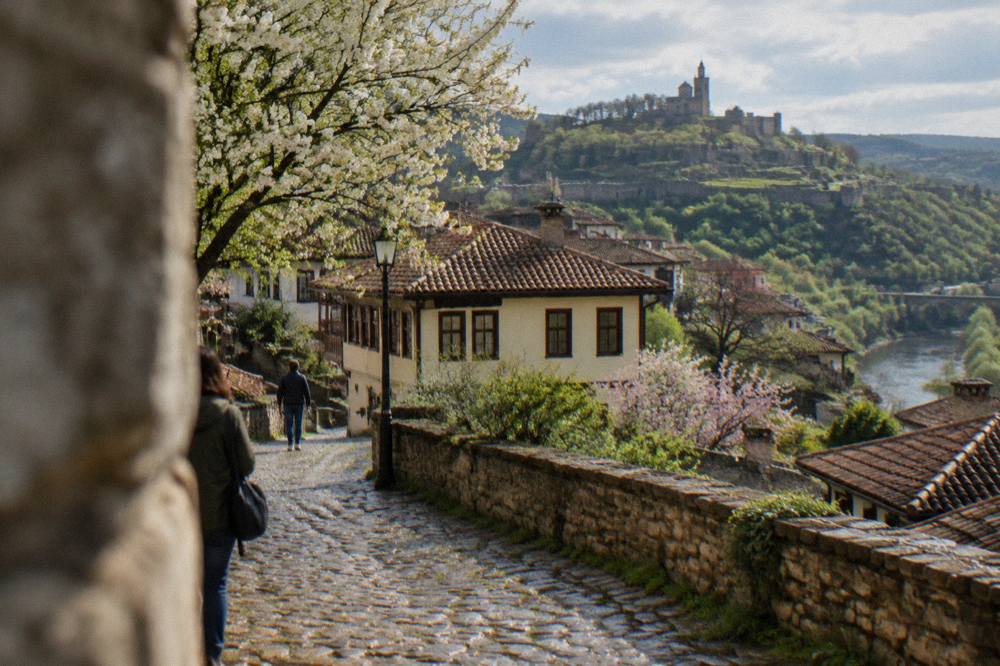
Spring has one further practical advantage: the two-day museum pass is valid from 1 April to 30 November, so a spring or autumn trip can use it while a deep-winter trip cannot. The trade is daylight. Modelled sunshine runs to about 13.0 hours a day in July against about 5.5 hours in December, which is a real difference for a city whose main pleasure is walking between hilltop sights and river viewpoints. The pages on Veliko Tarnovo weather and Veliko Tarnovo in spring and autumn take each season in more detail.
What Is The Weather Like In Veliko Tarnovo Month By Month?
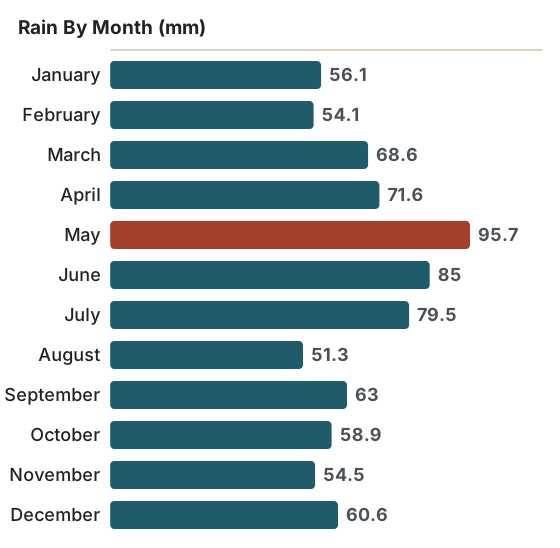
Veliko Tarnovo has a continental climate with a modelled mean daily high of 28.1 C in August and 4.9 C in January, and a modelled mean daily low of minus 3.8 C in January, per the ERA5 reanalysis, 1991-2020. The highest monthly rainfall total in the table is May at 95.7 mm, followed by June at 85.0 mm, and the lowest is August at 51.3 mm.
These are modelled normals for a grid cell near the city centre, not a weather-station record, and the year sums to 798.7 mm of rain.
The table below is the full month-by-month picture from that ERA5 dataset. Read the rainfall column with the temperature columns together: May combines a pleasant mean high of 21.7 C with the highest monthly rain total, which for a walking city means packing for showers rather than avoiding the month.
| Month | Mean daily high | Mean daily low | Rain |
|---|---|---|---|
| January | 4.9 C | -3.8 C | 56.1 mm |
| February | 7.2 C | -2.3 C | 54.1 mm |
| March | 11.5 C | 1.4 C | 68.6 mm |
| April | 16.9 C | 6.0 C | 71.6 mm |
| May | 21.7 C | 11.1 C | 95.7 mm |
| June | 25.4 C | 15.1 C | 85.0 mm |
| July | 27.6 C | 17.2 C | 79.5 mm |
| August | 28.1 C | 17.1 C | 51.3 mm |
| September | 23.3 C | 12.9 C | 63.0 mm |
| October | 17.6 C | 8.0 C | 58.9 mm |
| November | 11.8 C | 3.1 C | 54.5 mm |
| December | 6.1 C | -1.7 C | 60.6 mm |
Three practical readings follow. First, the comfortable shoulder band runs from late April to mid June and from early September to mid October, when the modelled mean high sits between about 17 and 25 C. Second, midwinter is genuinely cold: the modelled mean daily low stays below zero from December through February, and January's is minus 3.8 C. Third, rain is spread across the year rather than concentrated in one season, so no month in the table is dry in absolute terms.
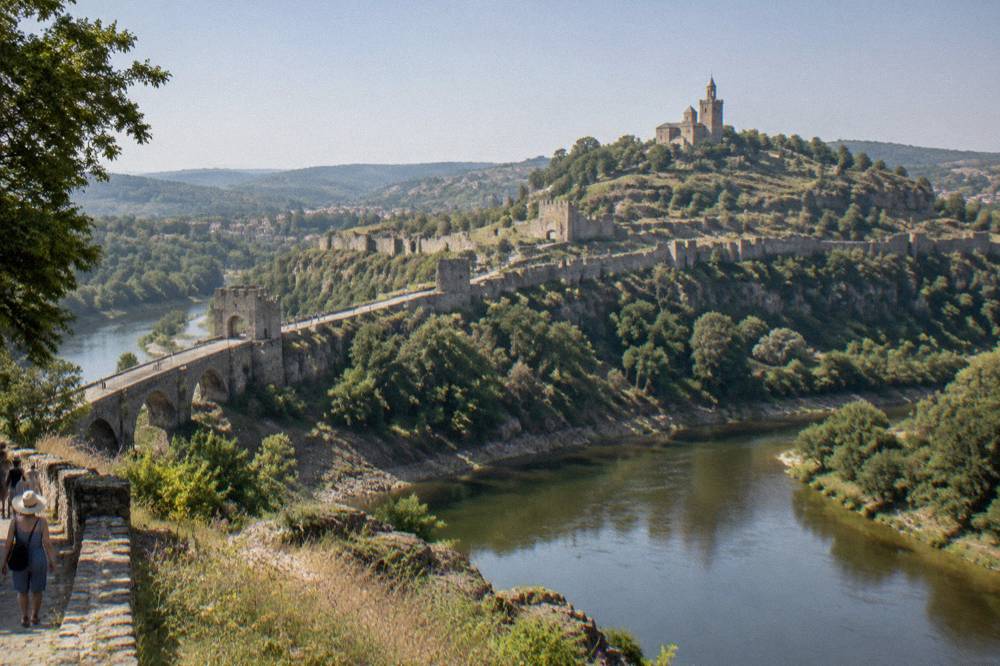
Daylight matters as much as temperature for pacing a visit. The modelled figure is about 13.0 hours of sunshine a day in July against about 5.5 in December, so a December itinerary has room for roughly half the outdoor walking a July one does, and the fortress's early winter closing time, entry until 16:00 from 25 October 2026, lands before dark ends. If you want the panoramic platform views and the riverside walking that define a first visit here, plan for the months when the light lasts past the ticket desks. The broader country-level question is covered at what's the best month to go to Bulgaria.
Self-guided products are the season-proof option, and the roster's Holy Transfiguration Monastery self-guided tour covers a monastery about 6 km from the centre at whatever pace and hour suit the weather, with Check availability if you want it held for a specific date.
When Are The Sights Open, And When Do The Hours Change?
Tsarevets Fortress is open daily with no day off, from 08:00 to 20:00 in April to September with last entry at 19:00, from 09:00 to 18:00 in October, and from 09:00 to 16:00 with closing at 17:00 once winter hours start on 25 October 2026, per the museum's ticket page, which also lists a Tuesday maintenance slot from 09:10 to 11:00. Trapezitsa follows a similar seasonal pattern but closes to visitors entirely from 30 November 2026 to 31 March 2027.
The two-day museum pass is valid only from 1 April to 30 November.
The single most important date on the calendar for sightseeing is therefore 25 October 2026, when the whole Regional Museum of History network, not just the fortress, moves to its winter timetable. The second is 30 November 2026, when Trapezitsa and its funicular season are done for the year: the funicular stops on 31 October 2026 in any case and reopens on 1 May. Anyone planning a December-to-March trip around the medieval core should work from Tsarevets, the Forty Martyrs church and the indoor museums rather than Trapezitsa.
| Site | April to September | October | Winter from 25 October 2026 |
|---|---|---|---|
| Tsarevets Fortress | 08:00 to 20:00, last entry 19:00 | 09:00 to 18:00, last entry 17:00 | Entry 09:00 to 16:00, closes 17:00 |
| Patriarchal Cathedral on Tsarevets | 09:00 to 19:00 | 09:15 to 17:30 | 09:15 to 16:45, Tuesday maintenance 09:15 to 11:00 |
| Trapezitsa | 09:00 to 19:00, last entry 18:00 | 09:00 to 18:00 | Closed from 30 Nov 2026 to 31 Mar 2027 |
| Church of the Holy Forty Martyrs | 09:00 to 18:00, last entry 17:30 | 09:00 to 17:00 | 09:00 to 17:00, last entry 16:30 |
| Archaeological Museum | 09:00 to 18:00, last entry 17:00 | 09:00 to 18:00 | 09:00 to 17:30, last entry 16:30 |
| Church of the Nativity, Arbanasi | 09:00 to 18:00 | 09:00 to 17:00 | Entry 10:00 to 15:30 |
Ticket prices are constant across the year, so the seasons change hours rather than costs. An adult Tsarevets ticket is 7.67 euro and the family ticket, covering parents plus up to three children aged 7 to 18, is 10.23 euro, per the museum's ticket page; confirm before you go. Trapezitsa's adult ticket is 5.11 euro and the Forty Martyrs church charges 5.11 euro with a 7.67 euro family ticket. The two-day pass across ten museum sites is 20.45 euro for an individual and 25.56 euro for a family, valid 1 April to 30 November, which quietly makes late autumn the last window to use it.
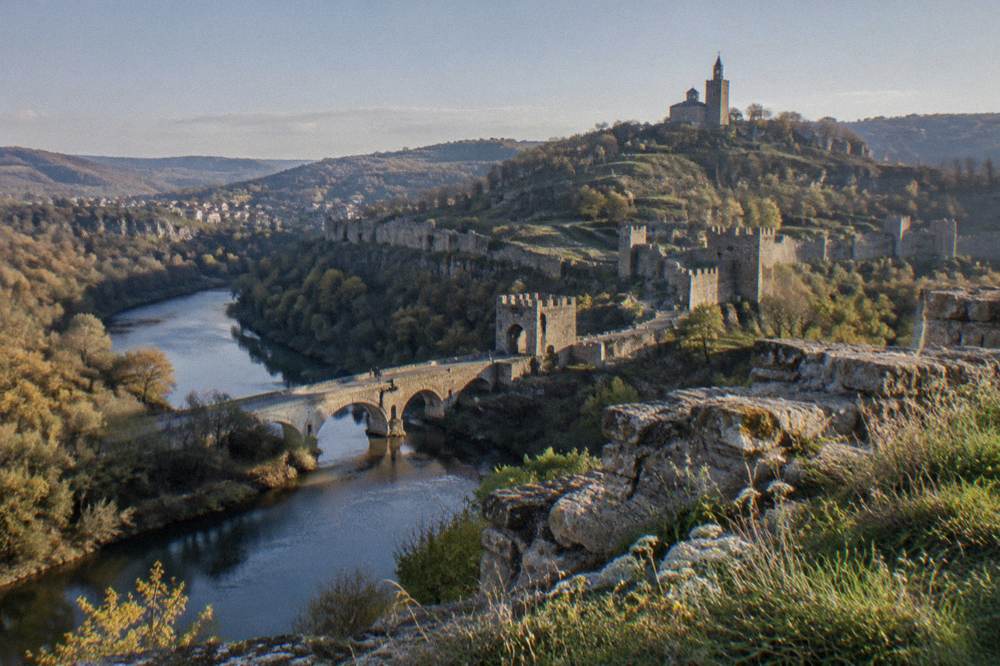
The Sound and Light show follows its own logic: it runs on announced evenings only, with no fixed schedule, and watching it from Tsar Asen I Square is free. Announced 2026 dates clustered around the national holidays in September, so a trip timed to Independence Day on 22 September or the city holiday on 22 March has a built-in chance of a show without a ticket. The paid panoramic-platform seat is a separate product; check the current price and dates on the official page before booking. The dedicated Sound and Light show guide keeps the detail.
What Does Each Month Offer In Veliko Tarnovo?
Each month in Veliko Tarnovo pairs a climate profile with a schedule: April opens the summer hours and the pass season, July carries the folklore festival from 18 to 25 July 2026, September combines warm modelled highs of 23.3 C with Independence Day on 22 September, and the December-to-February stretch trades short hours and closures for the Christmas market period and the lowest ticket queues of the modelled year, none of which requires a car inside the city itself.
The table below compresses the month-by-month argument into one view. Model, hours and events each get a column so the trade-offs sit side by side.
| Month | Modelled mean high | Museum hours in force | Fixed dates and notes |
|---|---|---|---|
| January | 4.9 C | Winter | New Year period; fortress open daily 09:00 to 16:00 entry |
| February | 7.2 C | Winter | Kukeri masquerade events around Sirni Zagovezni, pre-Lent |
| March | 11.5 C | Winter to 31 March | City holiday 22 March; Trapezitsa reopens 31 March 2027 |
| April | 16.9 C | Summer from 1 April | Pass season opens; Arbanasi churches to 09:00-18:00 |
| May | 21.7 C | Summer | Funicular runs from 1 May; May rainfall 95.7 mm, the year's highest monthly total |
| June | 25.4 C | Summer | Arbanasi Summer Music runs 15 to 25 July, next window midsummer |
| July | 27.6 C | Summer | Folklore festival 18 to 25 July 2026; about 13.0 hours of modelled sunshine a day |
| August | 28.1 C | Summer | Lowest monthly rainfall in the table at 51.3 mm |
| September | 23.3 C | Summer | Independence Day 22 September; Unification programme 5 to 6 September 2026 |
| October | 17.6 C | October schedule | Funicular stops 31 October; winter hours start 25 October 2026 |
| November | 11.8 C | Winter | Pass season ends 30 November; Trapezitsa closes 30 November 2026 |
| December | 6.1 C | Winter | Church of the Nativity in Arbanasi free on 25 December 2026 |
Two corrections to common assumptions are worth making here. The folklore festival's 28th edition ran 18 to 25 July 2026, and the Arbanasi Summer Music chamber festival ran 15 to 25 July 2026 in the churches of Sts Archangels and St George: these are annual summer fixtures with 2026 as the latest edition, and the following year's dates are announced in the official events feed closer to the time. The Christmas market in Marno Pole park follows a late-November-to-1-January pattern, and the 2026 dates had not been announced; treat it as a pattern, not a booking.
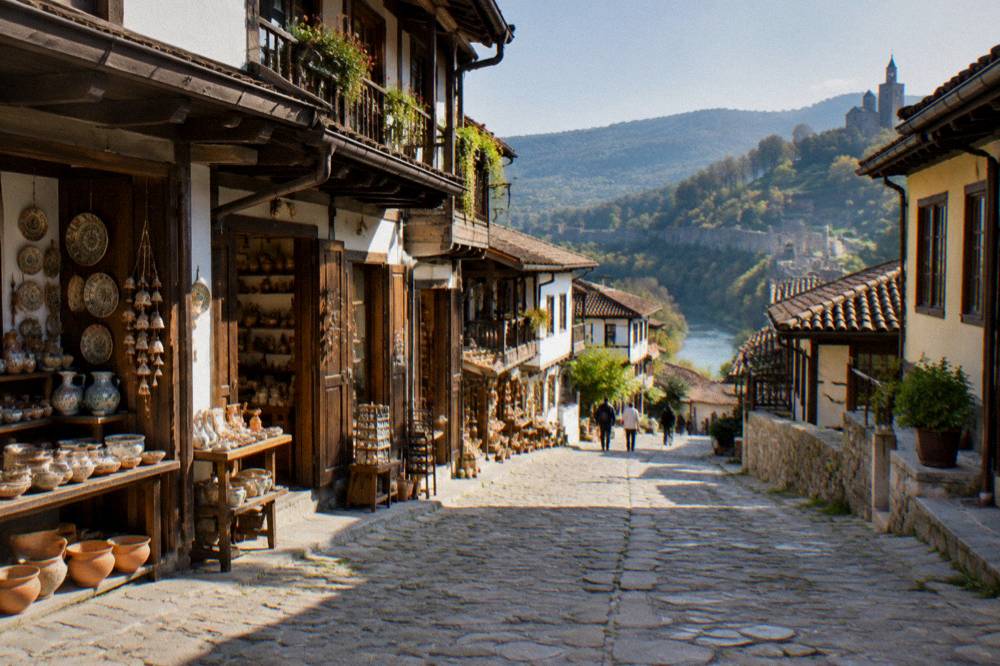
The open public spaces carry no schedule at all. Samovodska Charshiya, General Gurko Street, the Varosha quarter and the Asenevtsi Monument are free and open at all hours, so even a January day has a full free circuit once the fortress ticket desk closes. The Varosha old town guide and the page on Samovodska Charshiya map those walks. For the indoor fallback days, the Illusions museum entry ticket is a rostered product that runs regardless of season, and the depth guide to indoor options sits in the wider things to do in Veliko Tarnovo overview.
When Are The Festivals And Events In Veliko Tarnovo?
The fixed calendar in Veliko Tarnovo runs from the city holiday on 22 March through the Arbanasi Summer Music festival, 15 to 25 July 2026 in its latest edition, the International Folklore Festival, 18 to 25 July 2026, the Unification Day programme on 5 to 6 September and the Independence Day celebrations on 22 September, which include the liturgy at the Church of the Holy Forty Martyrs where Bulgaria's independence was declared on 22 September 1908. The Christmas market closes the year in Marno Pole park.
September is the month the events calendar and the climate line up best. The modelled mean high of 23.3 C sits in the comfortable band, the museum network is still on summer hours with fortress entry to 19:00, the funicular runs until 31 October, and the Independence Day programme brings reenactments and a Sound and Light performance in the evening. The ceremony anchors on the Church of the Holy Forty Martyrs, the same church that holds the marble victory column of Ivan Asen II from 1230 commemorating the Battle of Klokotnitsa.
| Event | When | Notes |
|---|---|---|
| Veliko Tarnovo Day | 22 March, annual | Liturgy, procession, Sound and Light show in the evening |
| Arbanasi Summer Music | 15 to 25 July 2026 | Chamber music in the churches of Sts Archangels and St George, Arbanasi |
| International Folklore Festival | 18 to 25 July 2026 | 28th edition |
| Unification Day programme | 5 to 6 September 2026 | Official events feed |
| Independence Day | 22 September, annual | Liturgy at the Forty Martyrs church, reenactment, Sound and Light |
| Etar crafts fair | 4 to 6 September 2027 | 20th edition, about 53 km away at Etar near Gabrovo |
| Kazanlak Rose Festival culmination | 4 to 6 June 2027 | About 98 km away; rose-picking rituals and parade |
The last two rows are day-trip events rather than city ones, and both dates are reported by the organisers: the Etar International Fair of Traditional Crafts is planned for 4 to 6 September 2027 as its 20th edition, and the Kazanlak Rose Festival culmination is set for 4 to 6 June 2027. A June trip based in Veliko Tarnovo can reach the Rose Valley, and a September trip can reach Etar, with the site distances given in the day-trip section below. The full local listing lives in festivals and events in Veliko Tarnovo, and the winter programme, market included, is in the Christmas market guide.
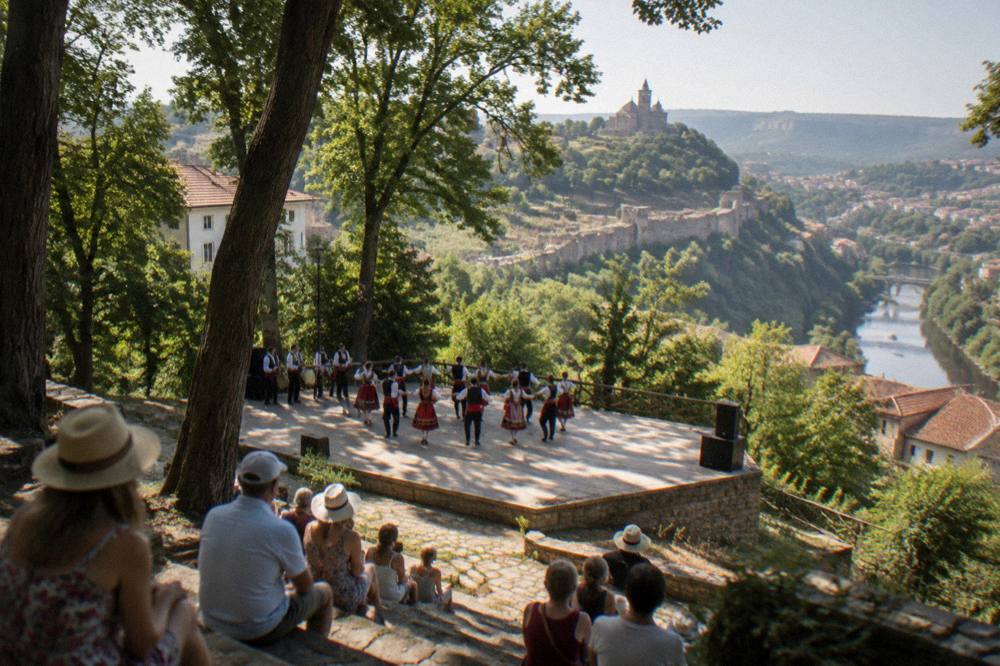
One scheduling caution cuts across all seasons: the Sound and Light show has no fixed weekly slot, so its presence on any given evening is announced rather than assumed. The free viewing point is Tsar Asen I Square, and the announced 2026 examples clustered on holiday weekends. Build the itinerary so a show is a bonus rather than the centrepiece, unless the date you are booking already carries an announcement.
Is Winter A Good Time To Visit Veliko Tarnovo?
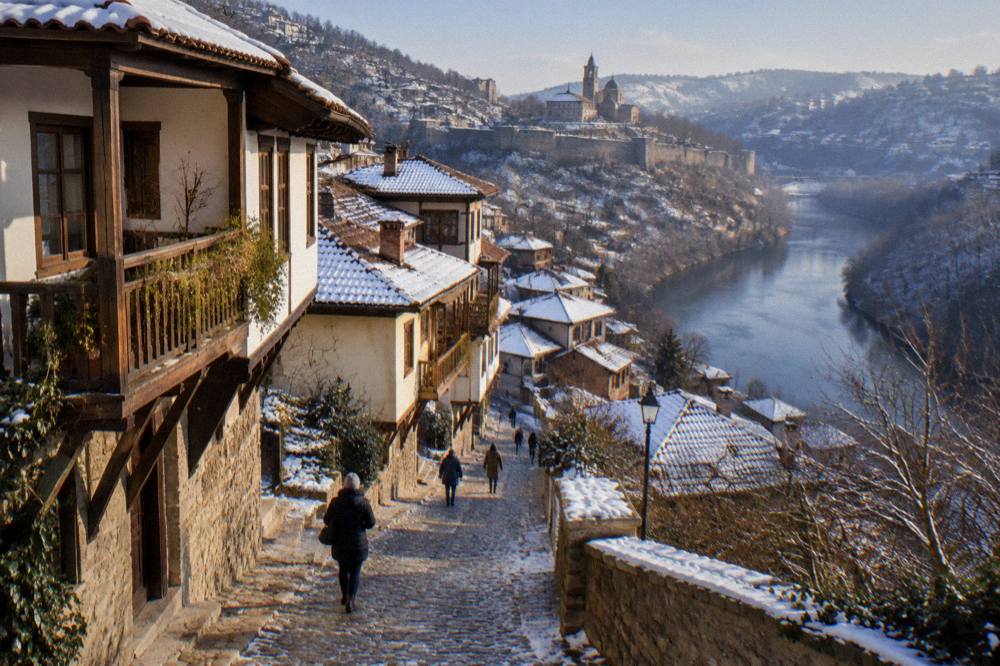
Winter in Veliko Tarnovo works for a short, museum-focused visit, with a modelled mean daily low of minus 3.8 C in January, about 5.5 hours of modelled sunshine a day in December, fortress entry hours of 09:00 to 16:00, and firm closures to plan around: Trapezitsa is closed from 30 November 2026 to 31 March 2027, its funicular stops on 31 October 2026, and the Kilifarevo museum closes from 30 November 2026 to 30 March 2027.
Against those closures, the winter list is still real: Tsarevets and the Patriarchal Cathedral on its hill stay open daily, the Forty Martyrs church keeps 09:00 to 17:00 hours with last entry at 16:30, the Archaeological Museum and the Konak museum stay on winter hours, and the Church of the Nativity in Arbanasi is free on its feast day, 25 December 2026. The Museum of New and Newest History is temporarily not accepting visitors, and the Church of St Dimitar is a prior-request site in season and closed in winter. The detail sits in the winter guide.
| Winter item | Status 2026 to 2027 |
|---|---|
| Trapezitsa | Closed 30 Nov 2026 to 31 Mar 2027 |
| Trapezitsa funicular | Stops 31 Oct 2026, reopens 1 May |
| Konstantsalieva House, Arbanasi | Fri, Sat, Sun only, 10:00 to 16:00, 30 Nov 2026 to 20 Mar 2027 |
| Kilifarevo museum | Closed 30 Nov 2026 to 30 Mar 2027 |
| Museum of New and Newest History | Temporarily not accepting visitors |
| Church of St Dimitar | Closed Nov to Mar |
| Church of the Nativity, Arbanasi | Open, entry 10:00 to 15:30, free 25 Dec 2026 |
| Tsarevets Fortress | Open daily, entry 09:00 to 16:00 |
The case for winter is pace and price structure rather than access. Entry fees do not change with the season, but the two-day pass is off the table after 30 November, so winter visits are single-ticket visits by necessity. The indoor roster fills the short days: the Tsarevgrad Tarnov multimedia visitor centre runs 09:00 to 17:30 into December, and the Illusions museum is an indoor, any-weather option from the tour roster. Christmas market weeks add evening life to Marno Pole park, with the 2026 dates to be confirmed nearer the season.
Getting here does not shut down in winter either, but the schedule thins. The BDZ timetable shows the fastest Sofia connections at 4 h 33 min and 4 h 51 min with a change, on the 17 October 2026 timetable, and Ruse keeps a direct train at 2 h 25 min. Snow can slow the roads, and daylight ends early, so winter arrival planning belongs in how to get to Veliko Tarnovo and the train station guide.
When Is The Best Time For Day Trips From Veliko Tarnovo?
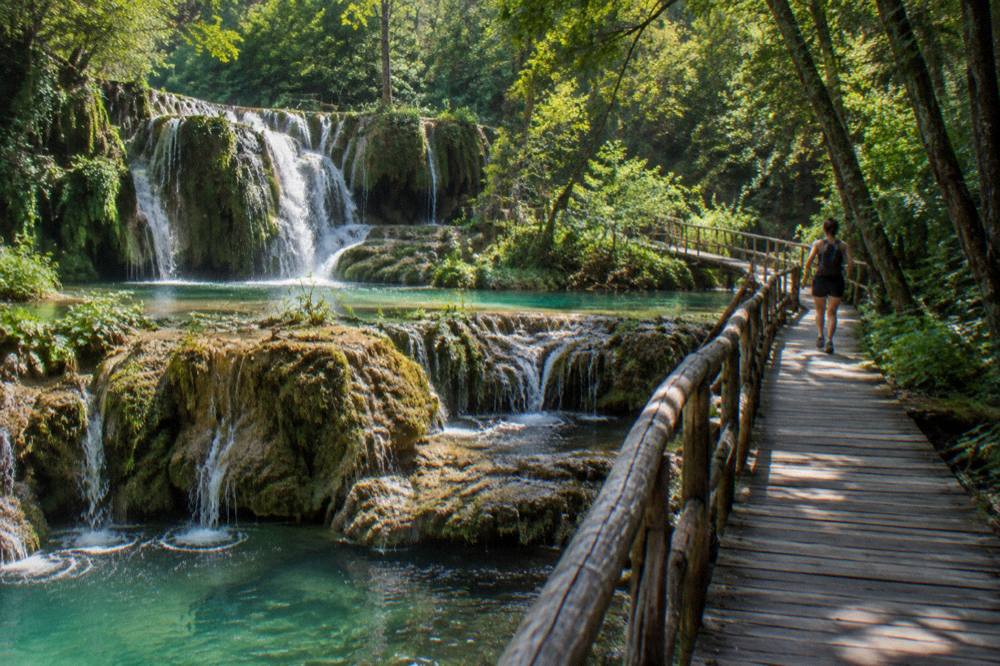
The day-trip season around Veliko Tarnovo runs from April to October, when the modelled mean high moves from 16.9 C to 28.1 C and back down to 17.6 C, and when outdoor sites such as Emen Canyon and the cave and waterfall circuits are reachable in full daylight.
Distances from the centre, computed as about-figures by road, set the frame. Emen Canyon, a gorge of the Negovanka river with cliffs at Lower Boaz listed at 90 m sheer, is about 32 km away; Etar is about 53 km; the Shipka church about 79 km; Krushuna about 79 km; Lovech about 86 km; the Devetashka cave about 89 km; and the Kazanlak tomb about 98 km. Each of those figures is a road distance, not a travel time, and hours and prices for the secondary outdoor sites should be checked locally before a winter or shoulder-season visit.
| Day-trip site | About road km from the centre | Season note |
|---|---|---|
| Preobrazhenski Monastery | 6 km | Open year-round as a monastery |
| Nicopolis ad Istrum | 20 km | Museum site, winter hours 09:00 to 16:30 |
| Emen Canyon | 32 km | Outdoor trail, daylight hours |
| Dryanovo Monastery | 33 km | Monastery grounds open year-round |
| Tryavna | 42 km | Old town, museums seasonal |
| Bozhentsi | 46 km | Architectural reserve |
| Etar | 53 km | Crafts fair reported for 4 to 6 Sep 2027 |
| Krushuna Falls | 79 km | Outdoor site, seasonal |
| Lovech | 86 km | Covered bridge is a public landmark |
| Kazanlak | 98 km | Rose Festival culmination reported for 4 to 6 Jun 2027 |
The waterfalls-and-caves circuit is the clearest summer-only product on the roster: it is a full-day outdoor trip, and the roster's own listing carries the price and schedule. The monastery tours, by contrast, work from spring to autumn, and the churches and monasteries near Veliko Tarnovo guide covers which of them keep winter hours. For movement between them, the getting around guide and the car rental page carry the practical detail.
Which Months Should You Avoid In Veliko Tarnovo?
The one period worth avoiding outright is 30 November to early March if Trapezitsa is on your list, because the reserve is closed and the funicular has stopped for the season; December to February also brings a modelled mean daily low of minus 3.8 C in January and about 5.5 hours of modelled sunshine a day in December. Otherwise no month is a mistake: midsummer keeps every sight open longest, and late October keeps almost everything open while the modelled mean high is still 17.6 C.
The nuance is in the edges of seasons. The last week of October is a cliff-edge on paper: on 25 October 2026 the whole museum network drops to winter hours, on 31 October the funicular stops, and on 30 November Trapezitsa and the Kilifarevo museum close and the two-day pass expires. A visit on 20 October and a visit on 5 November are structurally different trips even though the modelled temperatures are close. Early spring has the mirror problem, with Trapezitsa reopening only on 31 March 2027.
Against that, the months nobody regrets are June and September. June pairs a 25.4 C modelled high with the Arbanasi chamber festival and the Rose Valley day trip within reach; September pairs 23.3 C with Independence Day, the Unification programme and the last weeks of full summer hours. The itinerary pages, one day in Veliko Tarnovo, two days and three days, are built around those hours rather than around fixed dates, so they hold in any of the open months.
Common Questions About The Best Time To Visit Veliko Tarnovo
What is the best time to visit Veliko Tarnovo?
Late May, June and September, when the modelled mean daily high sits between 21.7 and 25.4 C and every museum site is on its April-to-September hours. August is warmer, with a modelled high of 28.1 C and the lowest monthly rainfall total in the ERA5 table at 51.3 mm.
What is the rainiest month in Veliko Tarnovo?
May, per the ERA5 reanalysis, 1991-2020, with a monthly total of 95.7 mm, followed by June at 85.0 mm. August has the lowest total at 51.3 mm. The figures are modelled normals for a grid cell near the city, not a station record.
Is Veliko Tarnovo worth visiting in winter?
Yes, with planning. Tsarevets and the Patriarchal Cathedral stay open daily on winter hours from 25 October 2026, entry 09:00 to 16:00. Trapezitsa is closed 30 November 2026 to 31 March 2027, and Konstantsalieva House in Arbanasi is open Friday to Sunday only in that window.
When does the Sound and Light show run?
On announced evenings only, with no fixed weekly schedule. Watching from Tsar Asen I Square is free. Announced 2026 performances clustered around the national holidays in September; check the current schedule and prices on the official page before planning an evening around it.
When do the museum sites switch to winter hours?
On 25 October 2026, across the Regional Museum of History network. Tsarevets moves from October's 09:00 to 18:00 to entry hours of 09:00 to 16:00 with a 17:00 close. Summer hours, 08:00 to 20:00 with last entry at 19:00, run April to September.
Which month has the best weather for day trips?
June and September, combining modelled highs of 25.4 C and 23.3 C with long daylight and open outdoor sites such as Emen Canyon, about 32 km away, and the waterfall and cave circuits further out. The reported 2027 anchor events, the Rose Festival culmination on 4 to 6 June and the Etar crafts fair on 4 to 6 September, both fall in that window.
Common Questions About Planning A Seasonal Trip
Where you sleep and what you spend barely change with the season here, but where you sleep changes what the season gives you: a room on General Gurko Street puts the free evening circuit of Varosha and the river gorge at the door, which matters most in the short-daylight months. The where to stay guide and the hotels with a view page carry that comparison, and the cost guide sets out the fixed entry prices against which any month can be budgeted, with the currency detail in Bulgaria's euro and money.
The short version, then: pick June or September if the calendar is open, July or August if warmth and festivals come first, late October for the shoulder-season hours, and any winter week for a short, fortress-centred stay planned around the closures listed above. Whatever the month, the two anchors that never move are the hill of Tsarevets, open every day of the year, and the river gorge below it, free to walk at any hour.