Festivals And Events In Veliko Tarnovo Through The Year
Veliko Tarnovo, the medieval capital of Bulgaria on the Yantra river, runs its festival year around a handful of fixed dates the municipal calendar confirms, from the city holiday on 22 March to Independence Day on 22 September, with the Sound and Light show lighting Tsarevets on announced evenings between them.
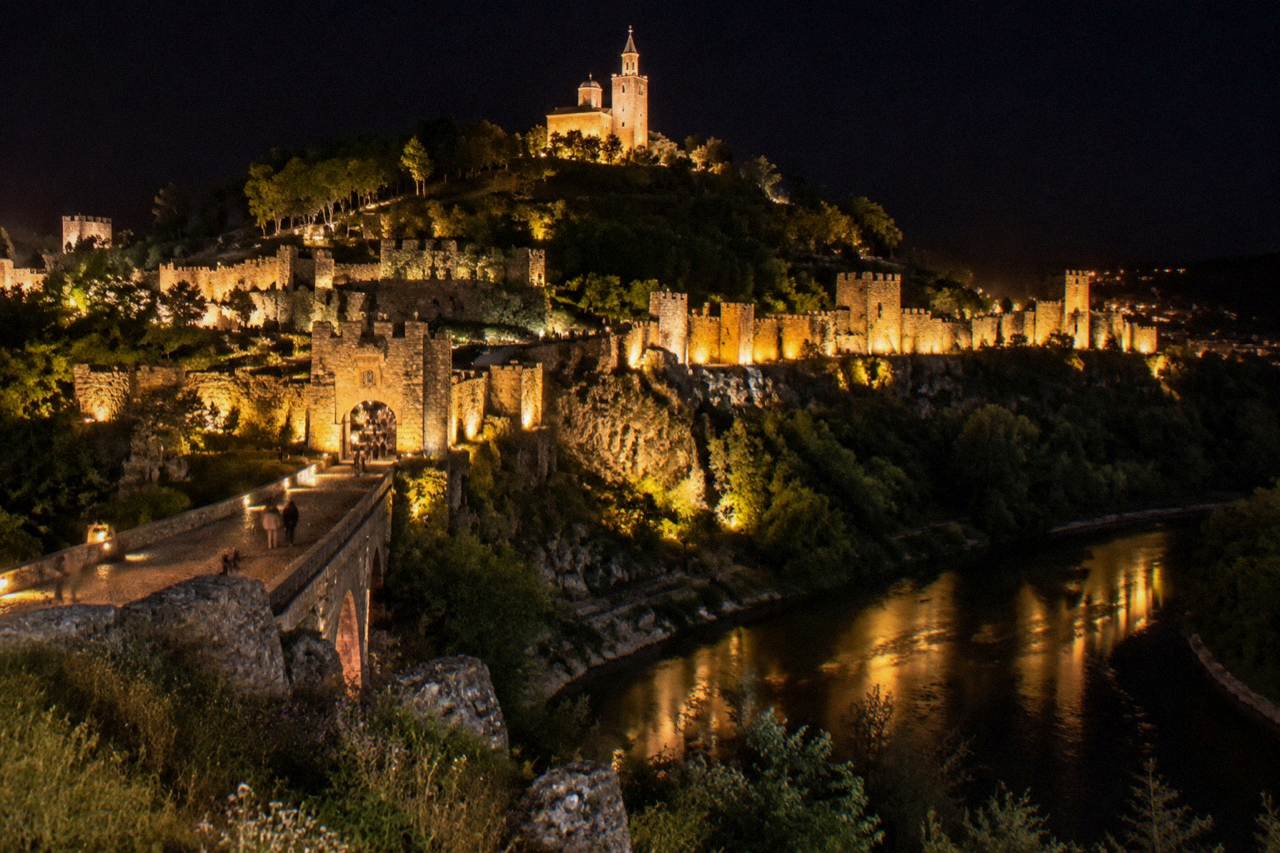
The fixed anchors of the Veliko Tarnovo event year are Veliko Tarnovo Day on 22 March, the International Folklore Festival in late July, Arbanasi Summer Music from 15 to 25 July, the Unification Day programme in early September and the Independence Day celebrations on 22 September. The Sound and Light show on Tsarevets runs on announced evenings only and is free to watch from Tsar Asen I Square.
Veliko Tarnovo, an inland city in Bulgaria on the Yantra river, organises its public year around a small set of fixed dates rather than a rolling festival programme. The city holiday falls on 22 March, Independence Day on 22 September, and between them sit an international folklore festival in late July, a chamber-music series in the churches of Arbanasi, and the Sound and Light audio-visual show on Tsarevets, which lights the fortress hill on announced evenings and costs nothing to watch from Tsar Asen I Square. This page walks the calendar month by month, using only the dates the municipal tourism calendar and the museum's own pages carry, and flags where a 2026 or 2027 date had not been announced.
What Festivals And Events Fill The Veliko Tarnovo Year?
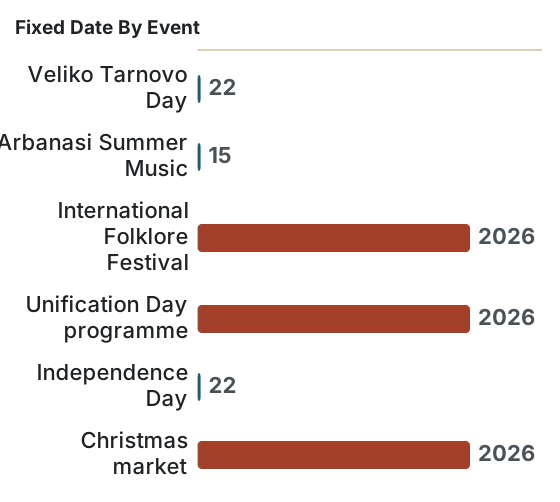
The Veliko Tarnovo event year has five fixed anchors: the city holiday on 22 March, the International Folklore Festival in late July, Arbanasi Summer Music from 15 to 25 July, the Unification Day programme in early September and the Independence Day celebrations on 22 September. Around them, the Sound and Light show runs on Tsarevets on announced evenings, free to watch from Tsar Asen I Square, and a Christmas market fills Marno Pole park in winter.
If your trip lines up with any of these celebrations, book a hotel room.
Each anchor ties to a piece of history the city wears visibly. The 22 March holiday honours the Holy Forty Martyrs and the Battle of Klokotnitsa, whose victory column from 1230 stands in the Church of the Holy Forty Martyrs. Independence Day on 22 September marks the 1908 declaration, read at that same church, and the day is the reason the main state celebrations rotate through Veliko Tarnovo. The municipal tourism calendar at velikoturnovo.info carries the running list, and it is the place to check for exact times once a date approaches.
Two rhythms shape everything else. First, the open public spaces, the Asenevtsi Monument, Samovodska Charshiya, General Gurko Street and the Varosha quarter, host no ticketed events and cost nothing to walk. Second, the museum sites that host or neighbour festivities shift to winter hours from 25 October 2026, which matters for any late-autumn visit. The full sightseeing picture sits on the Veliko Tarnovo Travel Guide homepage, and timing questions are covered in When To Visit Veliko Tarnovo.
| Event | Fixed date | Where it centres |
|---|---|---|
| Veliko Tarnovo Day | 22 March every year | City-wide, liturgy and procession |
| Arbanasi Summer Music | 15 to 25 July (2026 edition) | Churches of Sts Archangels and St George, Arbanasi |
| International Folklore Festival | Late July (2026: 18 to 25 July) | City venues and squares |
| Unification Day programme | Early September (2026: 5 to 6 September) | City squares |
| Independence Day | 22 September every year | Forty Martyrs church and Tsarevets |
| Sound and Light show | Announced evenings only | Tsarevets, watched from Tsar Asen I Square |
| Christmas market | Winter season, 2026 dates unannounced | Marno Pole park |
When Is Veliko Tarnovo Day, And What Happens On 22 March?
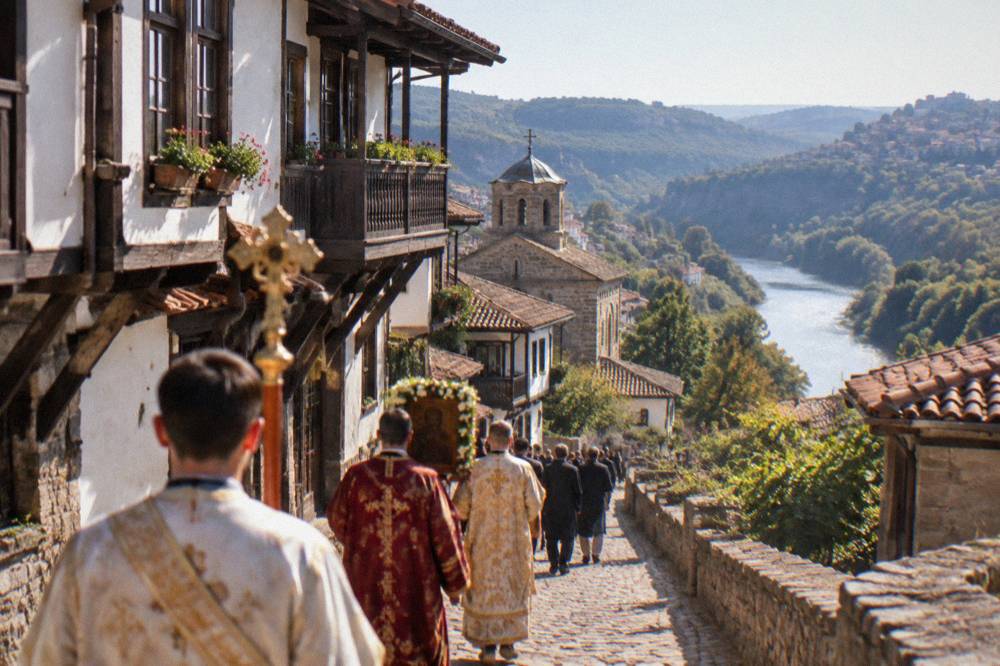
Veliko Tarnovo Day is 22 March every year, a municipal holiday tied to the feast of the Holy Forty Martyrs and the commemoration of the Battle of Klokotnitsa of 1230. The programme includes a liturgy, a procession, and an evening Sound and Light show on Tsarevets, per the municipal announcements for the 2026 edition. The date is fixed, so it can be planned around without waiting for an annual announcement.
The double commemoration is deliberate. The Church of the Holy Forty Martyrs gives the city its feast day, and the same church holds the marble victory column Ivan Asen II raised for the Battle of Klokotnitsa in 1230. So one building ties the religious calendar and the medieval history together, which is why the procession routes itself around it. The church sits within the museum network: the ticket page lists 5.11 euro for an adult and 7.67 euro for a family ticket, with April to September hours of 09:00 to 18:00 and a Monday maintenance slot from 09:00 to 11:00.
March weather is a factor in how the day feels outdoors. The ERA5 reanalysis for Veliko Tarnovo, 1991 to 2020, puts the March mean daily high at 11.5 C, the mean daily low at 1.4 C, and monthly rainfall at 68.6 mm, so layers and a rain layer are the practical reading of those figures. The wider spring picture, including April and May, is covered in Spring And Autumn In Veliko Tarnovo.
A city walk on a festival day needs a framework, and the paid guided options on the roster cover the monuments the processions pass.
What Does Independence Day In Veliko Tarnovo Look Like On 22 September?
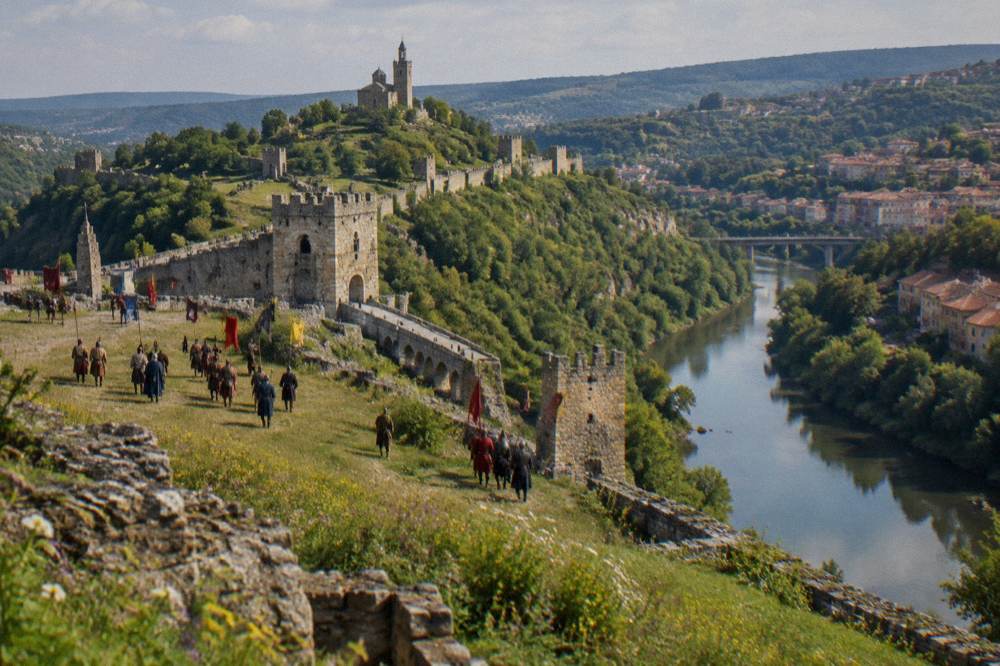
Independence Day on 22 September is the biggest fixed celebration in Veliko Tarnovo, because Bulgaria's independence was declared on 22 September 1908 and the Manifesto was read at the Church of the Holy Forty Martyrs in the city. The 2026 programme, per the national news agency, included a liturgy at that church, a historical reenactment and a flag ritual on Tsarevets, with the Sound and Light show closing the evening.
The city hosted the main state celebrations marking the anniversary in 2026, which is the pattern that makes 22 September the date to build an autumn trip around. The schedule is announced by the municipality and the national organisers in the weeks before, and the liturgy at the Forty Martyrs church is the fixed starting point. The fortress flag ritual and the reenactment follow on Tsarevets itself, where normal admission, 7.67 euro for an adult per the museum's ticket page, applies outside the ceremony programme.
One planning note from the calendar rather than from impressions: Sound and Light performances clustered around the 2026 holiday, and the show is free to watch from Tsar Asen I Square in front of Tsarevets. Paid seats on the panoramic platform exist for announced performances, and the price is on the operator's page for each date.
The Illusions Museum entry ticket covers admission to the exhibits, and Check availability for the date in question.
What Is The Sound And Light Show Schedule In Veliko Tarnovo?
The Sound and Light show on Tsarevets has no fixed schedule: it runs on announced evenings only, and the dates are published by the operator as they are confirmed. An official feed example lists 1 May 2026 at 21:15, and the 2026 Independence Day programme carried shows around 22 September. Watching from Tsar Asen I Square is free, while paid seating on the panoramic platform is sold per performance.
That is the whole operational truth, and it changes how a visit should be planned. There is no nightly performance to catch by chance, and no weekday guarantee. The check is the operator's upcoming-shows page and the municipal Tourist Information Centre feed, both of which list performances as they are scheduled, often tied to national and city holidays such as 22 March, Unification Day on 6 September and Independence Day on 22 September. A fuller treatment of the show itself, including how the viewing positions compare, sits on The Sound And Light Show page.
The free viewing position is a public square, so it needs no ticket, no booking and no arrival logistics beyond being there. The square fronts Tsarevets directly, and the fortress walls and towers above the Yantra river are the canvas. The practical consequence for a festival trip: any of the five fixed anchors on this page is a candidate evening for a show, and the confirmed dates are worth checking before booking travel.
| Sound and Light fact | Detail |
|---|---|
| Schedule | Announced evenings only, no fixed calendar |
| Free viewing | Tsar Asen I Square, in front of Tsarevets |
| Paid viewing | Panoramic platform seating, price on the operator's page |
| Confirmed 2026 example | 1 May 2026, 21:15, per the official events feed |
| Holiday clustering | Around 22 March, 6 September and 22 September |
Which Summer Festivals Run In Veliko Tarnovo And Arbanasi?
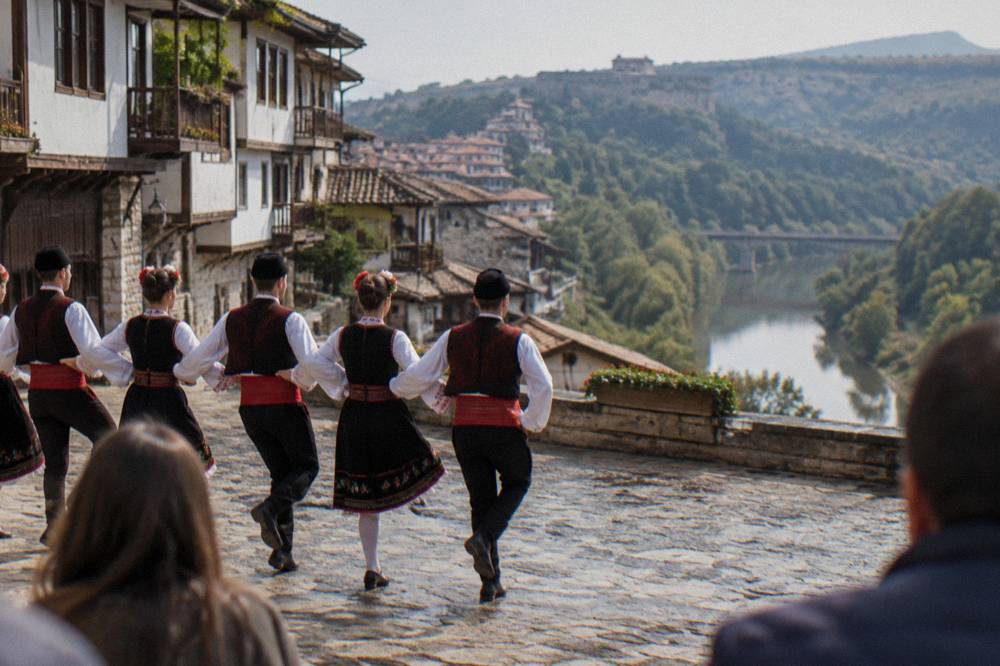
Two festivals carry the Veliko Tarnovo summer: the International Folklore Festival, whose 28th edition ran 18 to 25 July 2026, and Arbanasi Summer Music, a classical chamber-music festival that ran 15 to 25 July 2026 in the churches of Sts Archangels Michael and Gabriel and St George in Arbanasi. Both are annual, and their 2026 dates show the pattern: the last third of July is the festival window.
The folklore festival is the older-facing of the two, an international edition with ensembles from abroad, staged in city venues across the week. The municipal events listing is the source for each edition's participating groups and daily venues. Arbanasi Summer Music is the quieter counterpoint, chamber concerts inside medieval churches in the village about 2.8 km straight-line from the centre, a setting the festival's own announcements emphasise. Arbanasi itself is described in detail on the Arbanasi page.
July weather, from the ERA5 reanalysis 1991 to 2020, averages a mean daily high of 27.6 C with 79.5 mm of rain across the month, and August 28.1 C with 51.3 mm, figures to read when choosing between an open-air folklore evening and a church interior. Between performances, the paid experiences roster includes a tasting of Bulgarian wines in the city, which the Rakia And Bulgarian Wine page sets in context.
What Autumn Events Mark Veliko Tarnovo And Bulgaria?
The autumn sequence runs from the Unification Day programme on 5 to 6 September 2026 through Independence Day on 22 September, with the Etar International Fair of Traditional Crafts reported for 4 to 6 September 2027 as the nearest major craft event outside the city. Unification Day marks 6 September, and the 2026 programme ran across both days, per the official events feed.
Unification Day is the quieter of the two September state holidays, but it carries Sound and Light programming, which the 2026 feed confirmed. A week earlier, the crafts calendar opens: the Etar fair at the architectural open-air museum near Gabrovo, about 53 km away by road, is reported for 4 to 6 September 2027 as its 20th edition, with a focus on blacksmithing. Etar is open year-round with adult admission of 7.16 euro per its own admission page, so the fair is a reason to time a visit rather than the only reason to go. The museum itself is covered on the Etar Architectural-Ethnographic Complex page.
Late autumn has one hard planning edge: winter hours at the museum sites start on 25 October 2026, and the Trapezitsa funicular stops for the season on 31 October 2026. An event trip built around early October sits in the full summer schedule, at 09:00 to 18:00 at Tsarevets per the ticket page; a November trip does not.
What Winter Events And Christmas Traditions Appear In Veliko Tarnovo?
Both are annual traditions the municipality and its agencies announce season by season, so the check is the municipal events calendar closer to the time.
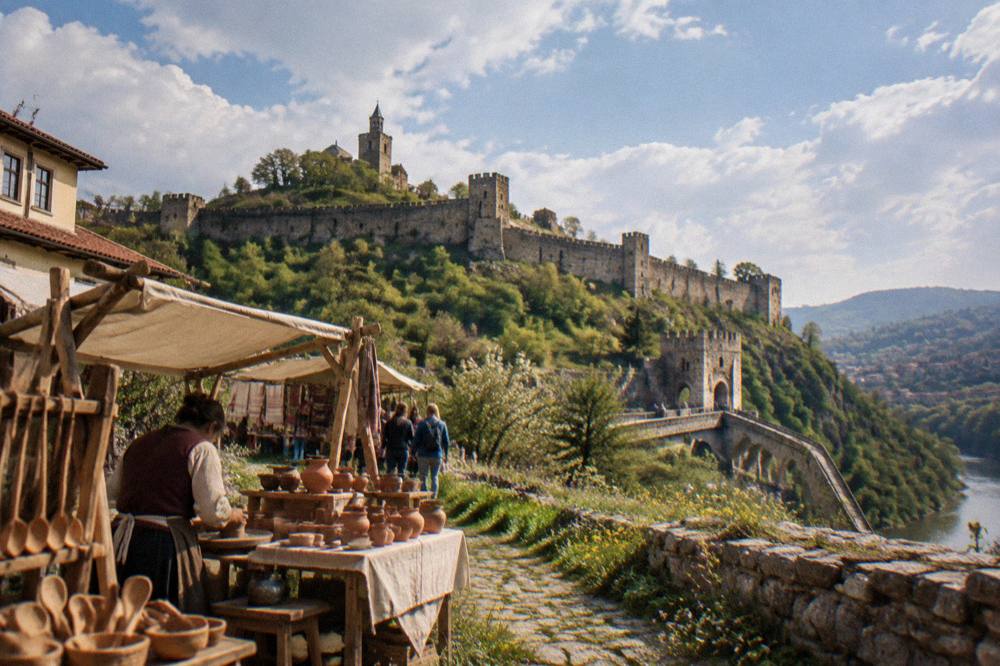
The Christmas market brings crafts, food stalls, concerts and family activities to the park, and the municipal announcements each autumn carry the opening date. The Kukeri tradition, costumed masquerade processions with bells that bless houses and streets ahead of Lent, appears in Arbanasi and Veliko Tarnovo around Sirni Zagovezni; the municipality's own coverage describes the Arbanasi and city processions together, and the date moves with the church calendar each year.
A winter visit runs on the museum winter schedule. From 25 October 2026, Tsarevets takes last entries at 16:00 and closes at 17:00, and the Church of the Nativity in Arbanasi is free on its feast day, 25 December 2026, per the museum's ticket page. The wider winter picture, including what stays open, is on Veliko Tarnovo In Winter.
| Winter item | Status | Source note |
|---|---|---|
| Christmas market, Marno Pole park | Annual, 2026 dates unannounced | Municipal announcement each season |
| Kukeri around Sirni Zagovezni | Annual, no 2027 date | Moves with the church calendar |
| Museum winter hours | Start 25 October 2026 | Museum news page |
| Trapezitsa | Closed 30 November 2026 to 31 March 2027 | Museum winter notice |
| Konstantsalieva House, Arbanasi | Friday to Sunday only, 30 November 2026 to 20 March 2027 | Museum winter notice |
| Church of the Nativity, Arbanasi | Free entry on 25 December 2026 | Museum ticket page |
Which 2027 Festival Dates Are Already Reported Near Veliko Tarnovo?
Two 2027 dates are already reported for the wider region: the Etar International Fair of Traditional Crafts, reported for 4 to 6 September 2027 as its 20th edition, and the culmination of the Kazanlak Rose Festival, reported for 4 to 6 June 2027. Both are reported dates rather than confirmed municipal announcements, and both sit within day-trip range of Veliko Tarnovo.
The rose festival is the bigger draw, and it pairs naturally with the Kazanlak area, whose Thracian Tomb, inscribed by UNESCO in 1979, is one of the two nearest World Heritage Sites to Veliko Tarnovo, the other being the Rock-Hewn Churches of Ivanovo. Kazanlak lies about 98 km away by road. The rose programme's reported culmination covers the rose-picking rituals, the parade and the Rose Queen coronation, with peripheral events spread across a broader period. The Kazanlak And The Rose Valley page covers the destination itself.
For anyone pairing a June rose trip with the city, June's ERA5 reanalysis normals, 1991 to 2020, show a mean daily high of 25.4 C and 85.0 mm of rain, second only to May's 95.7 mm, so early June planning should account for rain. A guided day trip toward Buzludzha and Shipka covers a different slice of the same region's history.
| Reported 2027 event | Reported dates | Distance from Veliko Tarnovo |
|---|---|---|
| Etar International Fair of Traditional Crafts | 4 to 6 September 2027 | About 53 km by road |
| Kazanlak Rose Festival culmination | 4 to 6 June 2027 | About 98 km by road |
How Do Seasonal Closures Shape A Festival Trip To Veliko Tarnovo?
The closures that matter for a festival visit are the winter block at Trapezitsa from 30 November 2026 to 31 March 2027, the funicular stop on 31 October 2026, the weekend-only schedule at Konstantsalieva House in Arbanasi from 30 November 2026 to 20 March 2027, and the winter hours across museum sites from 25 October 2026. A visit built around the March city holiday lands while Trapezitsa is still on its winter closure.
That last point deserves emphasis, because 22 March is one of the two flagship dates on this page and it sits inside the Trapezitsa closure window. Tsarevets itself has no day off: the ticket page lists a Tuesday maintenance slot from 09:10 to 11:00, and winter entries run 09:00 to 16:00. So a March festival trip keeps full access to the fortress and the Forty Martyrs church, which is where the holiday's liturgy and the 1230 column sit, while Trapezitsa waits for 1 April.
Getting to the city for any of these dates is covered on How To Get To Veliko Tarnovo, and the practicalities of moving between venues once there are on Getting Around Veliko Tarnovo. Where to sleep near the squares is the Where To Stay In Veliko Tarnovo question.
What Is The Best Month For Festivals In Veliko Tarnovo?
July is the densest festival month, with the International Folklore Festival and Arbanasi Summer Music overlapping from 18 to 25 July in the 2026 edition, while September carries the most state ceremony across Unification Day and Independence Day on 22 September. March offers the city holiday on the 22nd at the tail of winter. No single month holds everything, so the choice depends on whether the draw is folklore, chamber music or state ceremony.
The climate normals help separate the options. The ERA5 reanalysis for Veliko Tarnovo, 1991 to 2020, gives July a mean daily high of 27.6 C and August 28.1 C, against March's 11.5 C, with May the wettest month at 95.7 mm and August the least rainy at 51.3 mm. Those are modelled figures for a grid cell, not a station record, but they frame the outdoor standing that state ceremonies and square viewing involve.
| Month | Mean daily high (C) | Mean daily low (C) | Rain (mm) | Event reason to go |
|---|---|---|---|---|
| March | 11.5 | 1.4 | 68.6 | Veliko Tarnovo Day, 22 March |
| May | 21.7 | 11.1 | 95.7 | Sound and Light example date, 1 May 2026 |
| June | 25.4 | 15.1 | 85.0 | Reported Rose Festival culmination 2027 |
| July | 27.6 | 17.2 | 79.5 | Folklore festival and Arbanasi Summer Music |
| September | 23.3 | 12.9 | 63.0 | Unification Day and Independence Day |
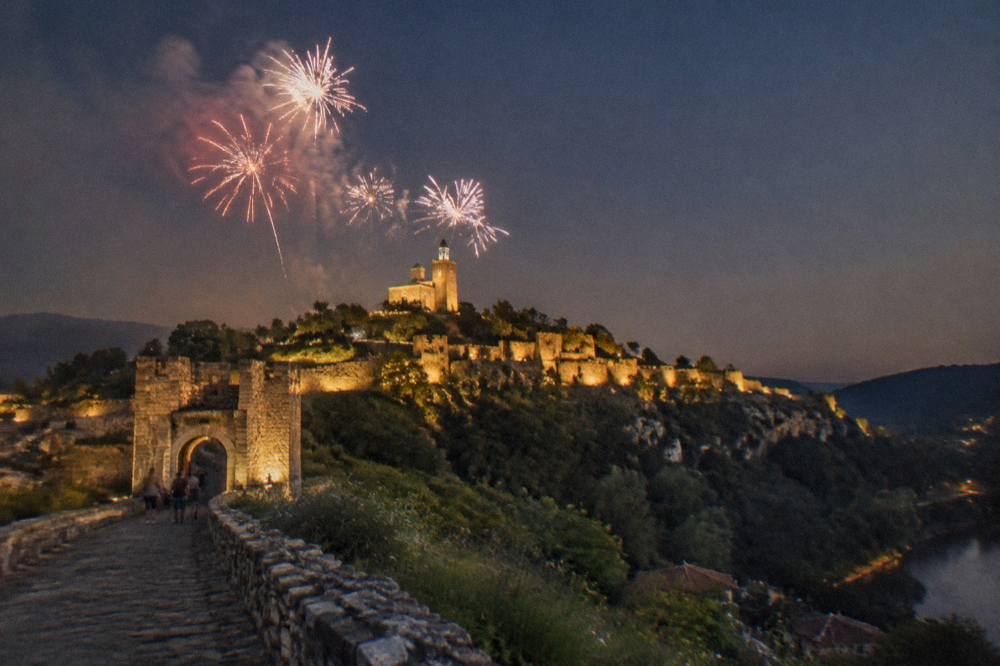
Whichever anchor date wins, the same sequence applies: fix the date, check the municipal events listing for the programme, and confirm the museum hours for that week, because the seasonal blocks above move around the calendar's edges. A city whose year is built on 1230, 1879 and 1908 keeps its celebrations close to those dates, and the fortress stays lit above the river between them.
Common Questions About Festivals And Events In Veliko Tarnovo
What festivals and events fill the Veliko Tarnovo year?
The fixed anchors are Veliko Tarnovo Day on 22 March, the International Folklore Festival in late July, Arbanasi Summer Music from 15 to 25 July, the Unification Day programme in early September and Independence Day on 22 September, with the Sound and Light show on announced evenings and a Christmas market in Marno Pole park in winter.
Does the Sound and Light show run every night in Veliko Tarnovo?
No. It runs on announced evenings only, with no fixed schedule, and the dates are published as they are confirmed, often around national holidays. Watching from Tsar Asen I Square is free.
When is Veliko Tarnovo Day?
Veliko Tarnovo Day is 22 March every year, tied to the feast of the Holy Forty Martyrs and the commemoration of the Battle of Klokotnitsa of 1230. The programme includes a liturgy, a procession and a Sound and Light show.
What happens on Independence Day in Veliko Tarnovo?
The 2026 programme included a liturgy at the Church of the Holy Forty Martyrs, where the 1908 independence declaration was read, a historical reenactment and a flag ritual on Tsarevets, closed by the Sound and Light show.
Are there music festivals near Veliko Tarnovo in summer?
Yes. Arbanasi Summer Music, a classical chamber festival, ran 15 to 25 July 2026 in the churches of Sts Archangels and St George in Arbanasi, and the 28th International Folklore Festival ran 18 to 25 July 2026 in the city.
When is the Veliko Tarnovo Christmas market?
The market fills Marno Pole park with wooden chalets each winter, and the 2026 dates had not been announced. The municipal announcements each autumn carry the opening date.