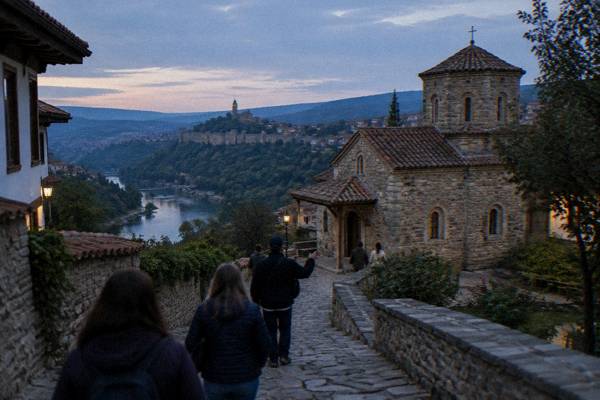
Is Veliko Tarnovo A Good Place To Live?
Is Veliko Tarnovo a good place to live? A factual look at the city's size, climate, university, transport links and sights for anyone considering moving there.
Veliko Tarnovo is an inland city in Bulgaria, built in and around the meanders of the Yantra river, with no sea coast anywhere near it. The municipality held an estimated 77,067 residents on 31 December 2025, and the city itself stands at 220 m elevation. It was the capital of the Second Bulgarian Kingdom for more than two centuries, from the late 12th century to the 14th, and today it combines a university, a museum network run by the Regional Museum of History, and a historic core spread across Tsarevets, Trapezitsa, the Varosha quarter, Samovodska Charshiya and General Gurko Street. Anyone weighing a move here is really weighing a small hill city with a student population and a long tourist season, and the facts below, from population estimates to train times, sketch what that means in practice.
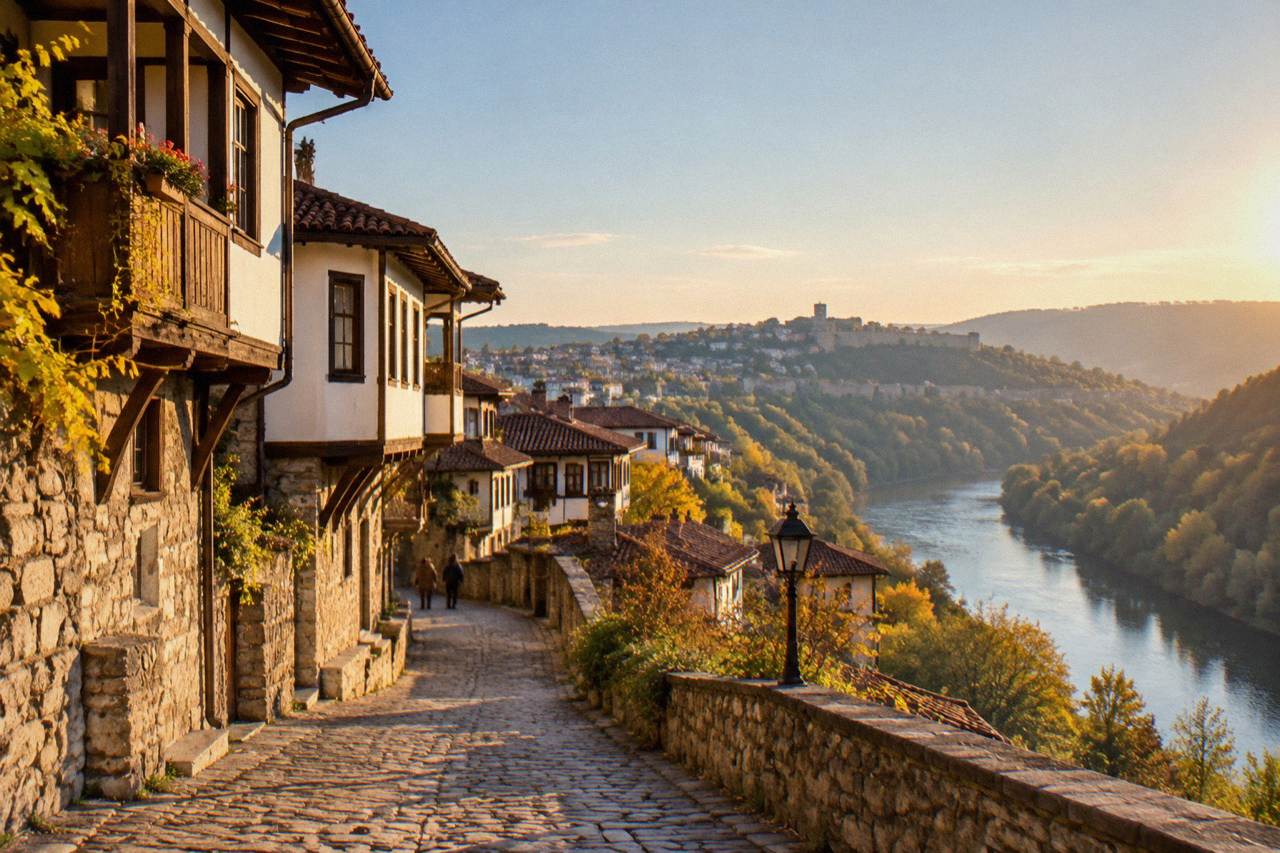
Veliko Tarnovo suits people who want a small inland city with a university, a walkable historic core and no sea coast, at a municipality population of 77,067 as of 31 December 2025. The euro has been the currency since 1 January 2026, Bulgaria has been a full Schengen member since 1 January 2025, and the city's sights, from Tsarevets to Samovodska Charshiya, are public or museum-run rather than industrial attractions.
Whether that adds up to a good place to live depends on what a resident needs. The recorded basics are solid: a single European emergency number, 112, works here as everywhere in the EU; the time zone is EET (UTC+2), with EEST (UTC+3) in summer; and St Cyril and St Methodius University of Veliko Tarnovo anchors the city's academic life. The population has been essentially stable at the municipality level, 76,718 at the 2021 census against 77,067 at the end of 2025, after a longer decline from 88,670 at the 2011 census.
The city's economy and rhythm are tied to two things the facts support: the university and the museum network. The Regional Museum of History runs Tsarevets, Trapezitsa, the Archaeological Museum and a string of churches and houses, and the Sound and Light audio-visual show runs on announced evenings on Tsarevets, free to watch from Tsar Asen I Square. For a fuller argument on the visitor side of the ledger, see is Veliko Tarnovo worth visiting; for the money side, start with is Veliko Tarnovo expensive.
What Does Daily Life In Veliko Tarnovo Look Like?
Daily life in Veliko Tarnovo centres on a compact historic core, with the free public spaces being the Asenevtsi Monument, Samovodska Charshiya, General Gurko Street, the Varosha quarter and free viewing of the Sound and Light show from Tsar Asen I Square. The museum sites charge euro admission, 7.67 euro for an adult at Tsarevets, and winter hours at the museum sites start on 25 October 2026.
The free list is short and exact: the monument, the two historic streets, the Varosha quarter, the square viewing of the show, and the Church of the Nativity in Arbanasi on its feast day, 25 December 2026. Everything else under the museum's umbrella is ticketed, and the two-day pass for 10 museum sites costs 20.45 euro for an individual, valid 1 April to 30 November. A resident who wants the fortress regularly is therefore budgeting for admission or the pass, not a free local perk.
The seasonal calendar matters more here than in a flat coastal town. Trapezitsa closes to visitors entirely from 30 November 2026 to 31 March 2027, its funicular stops for the season on 31 October 2026, and Konstantsalieva House in nearby Arbanasi drops to Friday to Sunday opening over the same winter stretch. The Museum of New and Newest History is temporarily not accepting visitors at all. The city holiday is 22 March, and the Independence Day programme on 22 September brings a liturgy at the Church of the Holy Forty Martyrs, the church where Bulgaria's independence was declared on 22 September 1908.
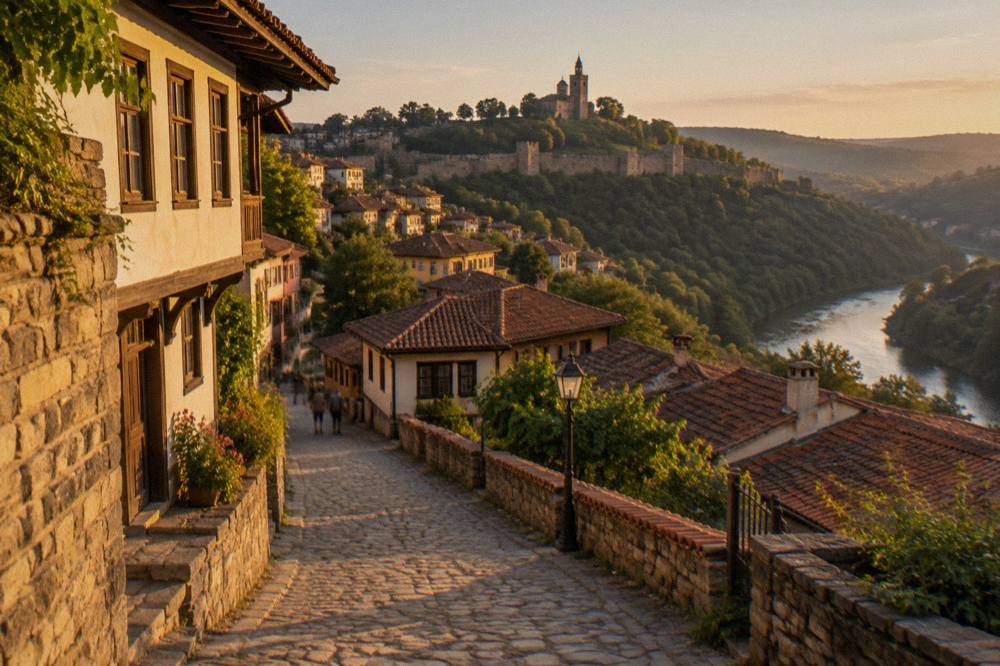
How Well Connected Is Veliko Tarnovo?
Veliko Tarnovo has no airport with scheduled flights, so residents travel through Sofia, about 216 road km away, Varna, about 214 km, or Bucharest Otopeni, about 205 km. By train there is no direct service from Sofia, the fastest connections take 4 h 33 min with a change, usually at Gorna Oryahovitsa, while Varna has one direct train at 3 h 53 min and Ruse one at 2 h 25 min.
The train picture is the single most useful fact for anyone comparing the city with the capital. The BDZ timetable for the Sofia route shows the fastest journeys at 4 h 33 min and 4 h 51 min, with slower options running 6 to 10 hours, always with a change, usually at the Gorna Oryahovitsa junction about 10 km away. Varna has one direct train taking 3 h 53 min, and Ruse a direct one at 2 h 25 min. Buses fill the gaps: direct Sofia coaches run about 3 to 3.5 hours from the Yug station at 74 Hristo Botev Blvd, and direct Bucharest buses take about 3 h 50 min to 4 h 15 min.
Distances from the centre, measured over the road network, shape weekend life too. Arbanasi sits about 2.8 km straight-line to the northeast, the Preobrazhenski Monastery about 6 km, Tryavna about 42 km, Etar about 53 km, and the Kazanlak tomb about 98 km. The nearest inscribed UNESCO sites are the Rock-Hewn Churches of Ivanovo and the Thracian Tomb of Kazanlak, both inscribed in 1979, while Nicopolis ad Istrum, about 20 km north, has sat on the Tentative List since 1984. Nothing inside the city itself is inscribed or tentative.
| Journey | Distance or time | What runs |
|---|---|---|
| Sofia to Veliko Tarnovo by train | fastest 4 h 33 min | changes, usually at Gorna Oryahovitsa |
| Varna to Veliko Tarnovo by train | 3 h 53 min | one direct train daily |
| Ruse to Veliko Tarnovo by train | 2 h 25 min | one direct service |
| Sofia by road | about 216 km | direct buses about 3 to 3.5 h |
| Bucharest Otopeni by road | about 205 km | cross-border, Schengen internal |
What Is The Weather Like Year-Round In Veliko Tarnovo?
The climate is continental, with an ERA5 reanalysis mean daily high of 28.1 C in August and 4.9 C in January, and a mean daily low of -3.8 C in January. May carries the highest monthly rainfall at 95.7 mm and August the lowest at 51.3 mm, on the ERA5 reanalysis for 1991 to 2020, which is a modelled grid cell rather than a weather station record.
In practical terms, that means real winters with below-freezing nights from December through February, and warm summers where July and August both average above 27 C in daytime highs. Rain falls year-round, peaking in late spring, and the annual total comes to 798.7 mm. There is no Mediterranean dry season and no coastal moderation; the city sits at 220 m in a river valley in the Balkan hinterland, and the weather behaves accordingly.
| Month | Mean daily high | Mean daily low | Rain |
|---|---|---|---|
| January | 4.9 C | -3.8 C | 56.1 mm |
| April | 16.9 C | 6.0 C | 71.6 mm |
| July | 27.6 C | 17.2 C | 79.5 mm |
| August | 28.1 C | 17.1 C | 51.3 mm |
| October | 17.6 C | 8.0 C | 58.9 mm |
For residents, the seasonal rhythm of the museums matches the weather: long summer hours at Tsarevets, 08:00 to 20:00 from April to September, then October hours of 09:00 to 18:00, then the winter block from 25 October 2026 with entry until 16:00. The details sit in the Veliko Tarnovo weather and seasons picture, and anyone planning a first visit before a move can follow how many days you need in Veliko Tarnovo.
Who Is The City A Good Fit For?
Veliko Tarnovo is a documented fit for students, since St Cyril and St Methodius University of Veliko Tarnovo operates in the city, and for residents who value a historic, mid-sized inland setting over a coast or a metropolis. The municipality population of 77,067 makes it a fraction of Sofia's size, and the nearest sea coast is hours away by road, at Varna about 214 km distant.
The university gives the city a steadier population base than a purely tourist town would have, and the museum network gives it cultural infrastructure out of proportion to its size: an archaeological museum, a prison museum, revival-era houses such as Sarafkina House, built 1861, and the Konak of 1872. English-language coverage of practical moving questions, from language to safety, continues in can I speak English in Bulgaria and is Veliko Tarnovo safe.
What the city does not offer is equally clear from the map. There is no airport with scheduled flights, no direct train from Sofia, and no coastline. Bulgaria's euro membership since 1 January 2026 and full Schengen membership since 1 January 2025 simplify banking and cross-border life for EU residents, and the Entry/Exit System has run at all external borders since 10 April 2026, but those are national facts rather than local advantages. For more context, the Veliko Tarnovo Travel Guide covers the city sight by sight.
For anyone wanting to test the city at walking pace before committing, the private or self-guided option described on the Discover Veliko Tarnovo at Your Pace tour page covers the core on foot: Check availability.
Common Questions About Living In Veliko Tarnovo
Is Veliko Tarnovo A Good Place To Live?
For a resident who wants a small, historic inland city with a university, free public quarters such as Samovodska Charshiya and the Varosha quarter, and euro-zone convenience since 1 January 2026, the recorded facts support it. Anyone needing a coast, an airport with scheduled flights or a direct Sofia train should look elsewhere.
How big is Veliko Tarnovo?
The municipality had an estimated 77,067 residents on 31 December 2025, against a census count of 76,718 in 2021. A town-only figure of about 60,067 is reported. The city stands at 220 m elevation on the Yantra river.
Does it snow in Veliko Tarnovo?
Winters are continental: the ERA5 reanalysis for 1991 to 2020 gives a January mean daily low of -3.8 C and a mean daily high of 4.9 C, with 56.1 mm of January rain. Freezing nights run through the winter months.
Can you fly into Veliko Tarnovo?
No. No airport with scheduled flights serves the city. Arrivals run through Sofia, about 216 road km, Varna, about 214 km, or Bucharest Otopeni, about 205 km, and then by train or bus.
Is there a direct train from Sofia to Veliko Tarnovo?
There is not. Trains change, usually at Gorna Oryahovitsa, and the fastest journeys on the current timetable take 4 h 33 min and 4 h 51 min, with slower options from 6 to 10 hours. Direct buses take about 3 to 3.5 hours.
What currency does Veliko Tarnovo use?
The euro, since 1 January 2026, at a fixed conversion of 1.95583 lev per euro. Museum tickets are printed in euro, for example 7.67 euro for an adult at Tsarevets Fortress.