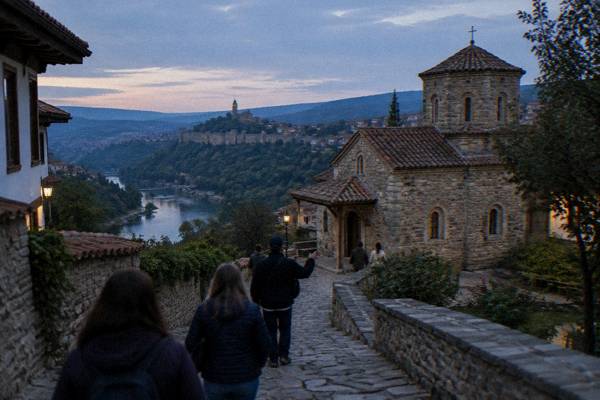
Is Veliko Tarnovo Safe?
Is Veliko Tarnovo safe? A practical safety briefing for Bulgaria's medieval capital on the Yantra river: entry rules, the euro, emergency numbers, seasonal site closures and street-level basics.
Veliko Tarnovo is an inland city in Bulgaria, built in the bends of the Yantra river, with no sea coast and a municipality population estimated at 77,067 on 31 December 2025. It was the capital of the Second Bulgarian Kingdom from the late 12th century to the 14th, and its hills, fortress walls and steep old streets are the reason travellers come. For a wider view of the country, see is it safe for Americans to travel to Bulgaria right now.
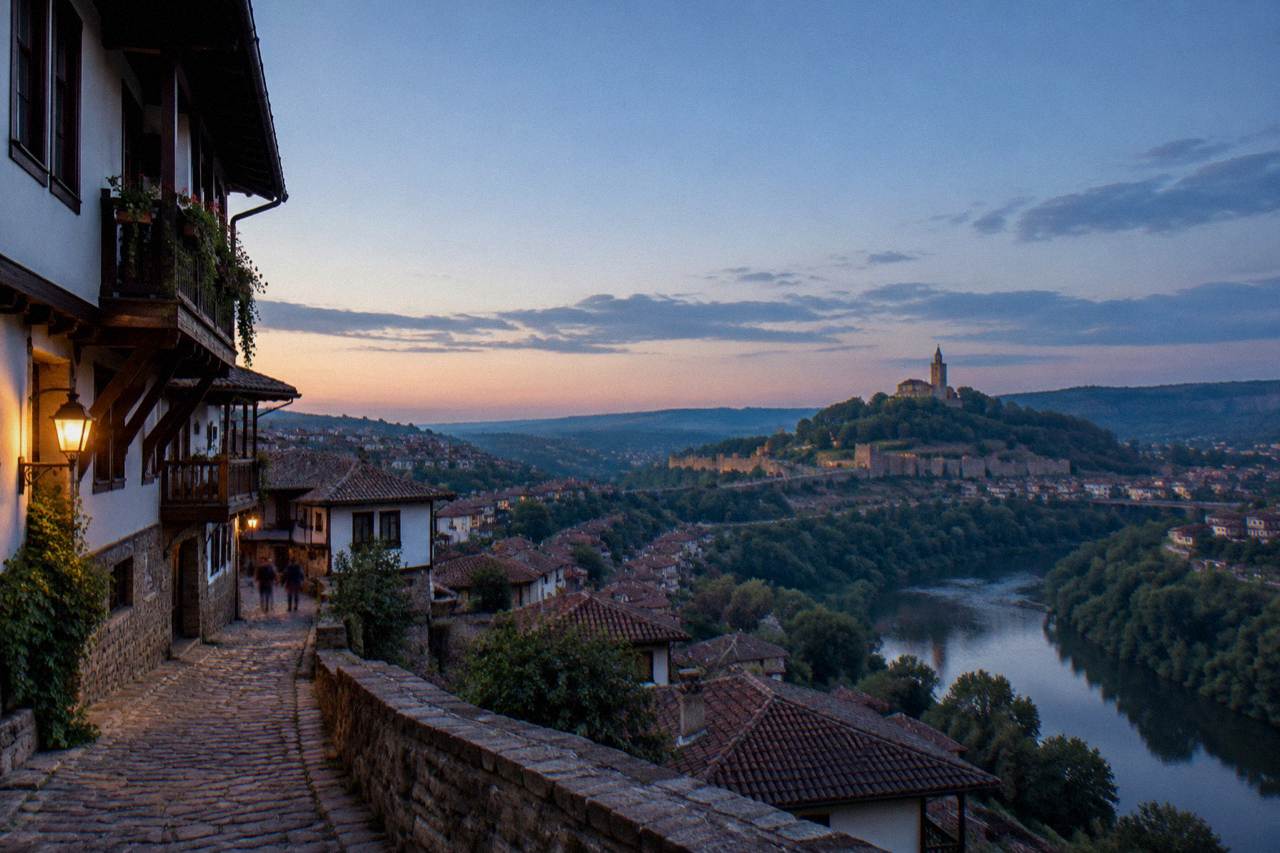
Yes, in the everyday sense of a Bulgarian regional capital: the risks worth planning for are steep cobbled streets, winter ice and dated seasonal closures, while the free EU-wide 112 emergency number, euro since 1 January 2026 and Schengen membership handle the rest.
What follows expands that answer into the parts a traveller actually books around. The city's geography matters more than any advisory: Veliko Tarnovo is built on hills above a river meander, the municipality seat stands at 220 m, and the old quarters of Varosha and the streets around General Gurko Street run steeply down toward the Yantra. Cobbled gradients and uneven pavements are the everyday physical reality of the place, so footwear and daylight matter in a way they do not on a flat capital's boulevards. The ERA5 reanalysis, 1991-2020, puts the mean daily low in January at -3.8 C with a mean daily high of 4.9 C, and in July a mean daily high of 27.6 C; winter ice on stone steps and summer heat on exposed fortress hill are the two conditions worth planning for. The climate data is modelled, from a reanalysis grid cell, not a station record, but it frames the year well.
The institutional basics are straightforward. Bulgaria has used the euro since 1 January 2026, as the 21st euro area member, at a fixed conversion of 1.95583 lev per euro; the lev is no longer the currency in circulation, and the museum ticket pages quote euro figures such as 7.67 euro for Tsarevets. Schengen membership since 1 January 2025 means visitors from within the area move without routine border checks, while the Entry/Exit System has been deployed at all Schengen external borders as of 10 April 2026, registering biometrics instead of stamping passports. US, UK, Canadian and Australian citizens are reported to travel visa-free for 90 days in any 180, though that status should be confirmed with official sources before travel, and no ETIAS start date exists to rely on yet.
For orientation on arrival, the monuments walking tour of Veliko Tarnovo is a paid guided product that covers the city's principal sites, useful on day one for anyone who wants the layout explained rather than deciphered alone.
What Are The Everyday Risks In Veliko Tarnovo?
The risks that can be planned for from the record are terrain and season, not crime: steep cobbled streets in the old quarters, a mean January daily low of -3.8 C and a mean July daily high of 27.6 C per the ERA5 reanalysis 1991-2020, and a set of dated seasonal closures at the museum sites, including winter hours from 25 October 2026, Trapezitsa shut from 30 November 2026 to 31 March 2027 and its funicular stopping on 31 October 2026.
None of that is a warning against going; it is a packing list and a calendar. The steep terrain is the city's character as much as its hazard. Varosha, Samovodska Charshiya and General Gurko Street are public spaces, free and open at all hours, and they are perfectly walkable, but the gradients between the river and the plateau are real. In winter, ice on stone is the single most likely cause of a bruised hip in this city, and in July the exposed climb to the Patriarchal Cathedral on Tsarevets is best made with water. The Sound and Light show runs on announced evenings only, with no fixed schedule, and watching it from Tsar Asen I Square is free, so an evening on the square in October means the mean daily low of 8.0 C, not a summer night.
The seasonal closure list deserves its own table, because it is dated fact and it changes what a winter visit looks like:
| Site or service | Winter 2026 to 2027 status | Source basis |
|---|---|---|
| Tsarevets Fortress | winter hours from 25 October 2026, no day off | the museum's ticket page |
| Trapezitsa | closed to visitors 30 November 2026 to 31 March 2027 | the museum's winter notice |
| Trapezitsa funicular | stops for the season on 31 October 2026 | the museum's winter notice |
| Museum of New and Newest History | temporarily not accepting visitors | the museum's catalogue |
| Konstantsalieva House, Arbanasi | Friday to Sunday only from 30 November 2026 to 20 March 2027 | the museum's winter notice |
The Tsarevets Fortress ticket page lists a Tuesday maintenance slot from 09:10 to 11:00, worth knowing if that is the morning of a visit. The Asenevtsi Monument, Samovodska Charshiya, Gurko Street and the Varosha quarter remain free public spaces year-round, and the Church of the Nativity in Arbanasi is free on its feast day, 25 December 2026. Anyone weighing a winter trip against a shoulder-season one can compare the closures above with the fuller picture in Veliko Tarnovo in winter planning.
How Do Emergencies And Health Care Work In The City?
The single European emergency number 112 works across Bulgaria, is free to call, and covers ambulance, fire and police; Bulgaria's full Schengen membership since 1 January 2025 and euro adoption on 1 January 2026 remove currency and border frictions that used to complicate incidents, and the Entry/Exit System deployed on 10 April 2026 handles registration at external borders with biometrics rather than stamps.
That is the institutional layer. Dial 112 for anything urgent, from a fall on an icy lane to a lost passport; the number is EU-wide and free. What can be said is structural: the city is a university seat, St Cyril and St Methodius University of Veliko Tarnovo is the local institution, and the municipality's estimated 77,067 residents as of 31 December 2025 live with the ordinary public services of a Bulgarian regional capital.
Practical readiness is the same as anywhere in the euro area. Carry the European Health Insurance Card if entitled to one, travel insurance for everything else, and note that the euro is the only currency in circulation, so the old advice about changing lev is obsolete. The city's time zone is EET, UTC+2, with EEST in summer, useful when calling an insurer at home. For the money mechanics in detail, Bulgaria's euro and money explained covers the changeover and what prices look like now. On the question of whether the destination repays the planning, is Veliko Tarnovo worth visiting answers it from the record of what the city holds.
Is Veliko Tarnovo Safe At Night And For Solo Travellers?
Nights in Veliko Tarnovo pose no specific risk: the free public spaces, including Tsar Asen I Square where the Sound and Light show is watched at no charge, are open at all hours, the show itself runs only on announced evenings, and the practical constraints of a night out are the terrain, the October mean daily low of 8.0 C and the January mean daily low of -3.8 C, all per the ERA5 reanalysis 1991-2020.
Night in this city is quiet by design. The headline evening event, the Sound and Light audiovisual show on Tsarevets, has no fixed weekly schedule and runs on announced dates only, so an evening plan depends on checking the current listings rather than assuming a performance. Watching from Tsar Asen I Square in front of Tsarevets is free, and the square is a normal public space of a city of this size. A solo traveller's sensible baseline is the baseline for any hilly European town: know your route back to your bed, keep a charged phone with 112 saved, and treat steep lanes in the dark with the respect they demand in daylight. Other pages covering the same trip are gathered on Veliko Tarnovo Travel Guide.
Families and school groups have a specific allowance worth knowing: children under 7 enter the Regional Museum of History sites free, as do people with permanent disabilities together with an assistant, and organised school groups from the municipality visit free by written request, per the museum's price page. Those concessions say something about how the city's flagship sites position themselves for mixed-age visitors. Visitors weighing the city against a longer Balkan itinerary can read how many days you need in Veliko Tarnovo before committing.
What Should Visitors Know About Getting Around Safely?
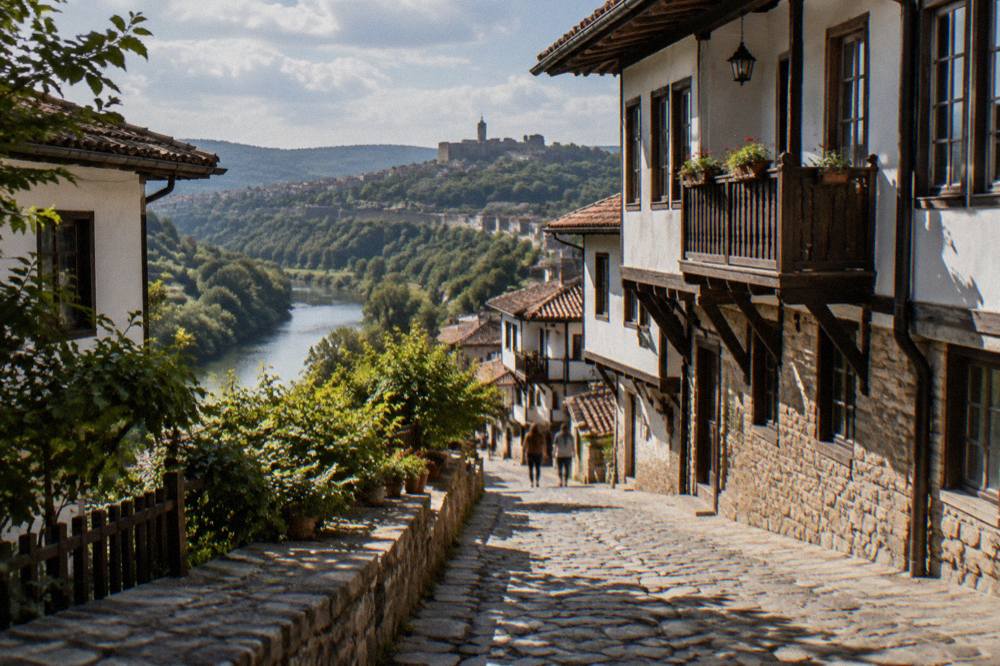
Arrival runs through Sofia, Varna or Bucharest Otopeni airports, none of them in the city, with Sofia about 216 road km, Varna about 214 and Otopeni about 205; there is no direct train from Sofia, with the fastest connections changing at Gorna Oryahovitsa station, about 10 km away, at 4 h 33 min or 4 h 51 min on the timetable, and the emergency number 112 applies wherever the journey ends.
Those transport facts are safety facts in a practical sense, because a missed connection or a misread timetable is the likeliest way a smooth trip goes wrong. The BDZ timetable shows the fastest Sofia services at 4 h 33 min and 4 h 51 min, with slower options between 6 and 10 hours, all involving a change. Varna has one direct train at 3 h 53 min, and Ruse a direct one at 2 h 25 min. Buses from Sofia take about 3 to 3.5 hours and arrive at the Yug station on Hristo Botev Boulevard near the centre, while regional services use the Zapad station.
The distances that matter for day trips, all about road kilometres from the centre, are set out below, and they are also the honest answer to "how ambitious can one day be" on roads that cross the Balkan range:
| Destination | Distance from the centre |
|---|---|
| Arbanasi | about 2.8 km straight-line |
| Preobrazhenski Monastery | about 6 km |
| Nicopolis ad Istrum | about 20 km |
| Emen Canyon | about 32 km |
| Tryavna | about 42 km |
| Etar | about 53 km |
| Shipka church | about 79 km |
| Ruse | about 105 km |
Arbanasi itself, about 2.8 km straight-line north-east of the centre, holds two ticketed churches and the Konstantsalieva House under the museum network, each 7.67 euro with a family ticket at 12.78 euro. The Two-day pass at 20.45 euro individual or 25.56 euro family, valid 1 April to 30 November, exists for multi-site visits. Guided products cover the wider region for anyone who prefers not to self-drive the mountain roads.
Is Veliko Tarnovo Safe For A First Trip To Bulgaria?
For a first visit to Bulgaria, Veliko Tarnovo is a manageable entry point on the basics: the euro, adopted on 1 January 2026, ends currency friction, Schengen membership since 1 January 2025 simplifies movement, 112 covers emergencies, the language is Bulgarian written in Cyrillic, and the city's core sights are run by a single museum operator with published hours and euro prices quoted exactly, such as 7.67 euro for Tsarevets and 5.11 euro for Trapezitsa.
The Cyrillic alphabet is the one adjustment that catches unprepared arrivals; signs, menus and tickets are written in it, and a handful of learned words changes the experience. English coverage across Bulgaria is a question with its own answer at can I speak English in Bulgaria. The medieval core of the country's history is here too: Veliko Tarnovo was the capital of the Second Bulgarian Kingdom from the late 12th century to the 14th, and the question what was the old capital of Bulgaria tells that story directly.
Nothing in the city is a UNESCO World Heritage Site or on the Tentative List, a point worth making precisely because claims to the contrary circulate; the nearest inscribed sites are the Rock-Hewn Churches of Ivanovo and the Thracian Tomb of Kazanlak, both 1979, and Nicopolis ad Istrum, about 20 road km north, has been on the Tentative List since 1984. Setting that record straight is part of a trustworthy safety-and-facts briefing. The place of detail on the fortress itself lives at Tsarevets Fortress.
Common Questions About Safety In Veliko Tarnovo
Is Veliko Tarnovo Safe?
On every practical measure, yes: it is a small inland municipality of an estimated 77,067 residents on the Yantra river, the 112 emergency number applies, Bulgaria is in Schengen and the euro, and the things to plan around are steep terrain, seasonal cold and dated sight closures. No crime statistic or safety ranking for the city is quoted here, because none appears in a primary source.
Is Veliko Tarnovo Safe At Night?
The public spaces, including Tsar Asen I Square where the Sound and Light show is watched free, are open at all hours, and the show runs only on announced evenings. The record supports no specific claim about nightlife, lighting or policing, so ordinary caution on steep, cobbled lanes after dark is the sensible baseline.
What Is The Emergency Number In Veliko Tarnovo?
112, the single European emergency number, free to call, covering ambulance, fire and police across Bulgaria.
Is It Safe To Walk Around The Old Town?
Varosha, Samovodska Charshiya and General Gurko Street are free public spaces open at all hours. The practical caution is physical: the old quarters sit on steep gradients, and per the ERA5 reanalysis 1991-2020 the mean daily low reaches -3.8 C in January, when ice on stone is the main hazard.
Do I Need To Worry About Money Or Pickpockets?
No scam or theft claim for Veliko Tarnovo is printed on this page, because none is in the record. The money fact that matters is simple: Bulgaria adopted the euro on 1 January 2026, at a fixed rate of 1.95583 lev per euro, so the lev is no longer in circulation.
Are The Sights Open Year-Round?
Not all. Winter hours at the museum sites start on 25 October 2026, Trapezitsa closes to visitors from 30 November 2026 to 31 March 2027, its funicular stops on 31 October 2026, the Museum of New and Newest History is temporarily closed, and Konstantsalieva House in Arbanasi is Friday to Sunday only through the winter. The Asenevtsi Monument, Samovodska Charshiya, Gurko Street and Varosha remain free and open.
The short version: bring sound shoes, check the seasonal closure dates against your travel window, save 112, and spend your euro the way you would at home. Veliko Tarnovo's hazards are the honest ones of a hilly medieval city, and the planning in the full things to do in Veliko Tarnovo guide covers the rest of the visit.