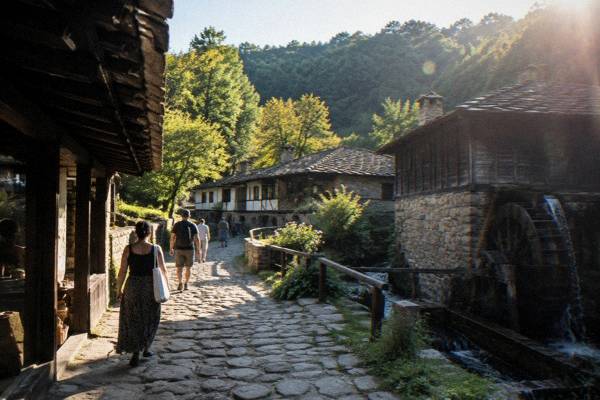
Tryavna: Woodcarving Town In The Balkan Foothills
Tryavna sits about 42 km from Veliko Tarnovo, a town of Revival-era houses and a woodcarving school whose work fills churches across Bulgaria. It is one of the closest and easiest day trips from the medieval capital.
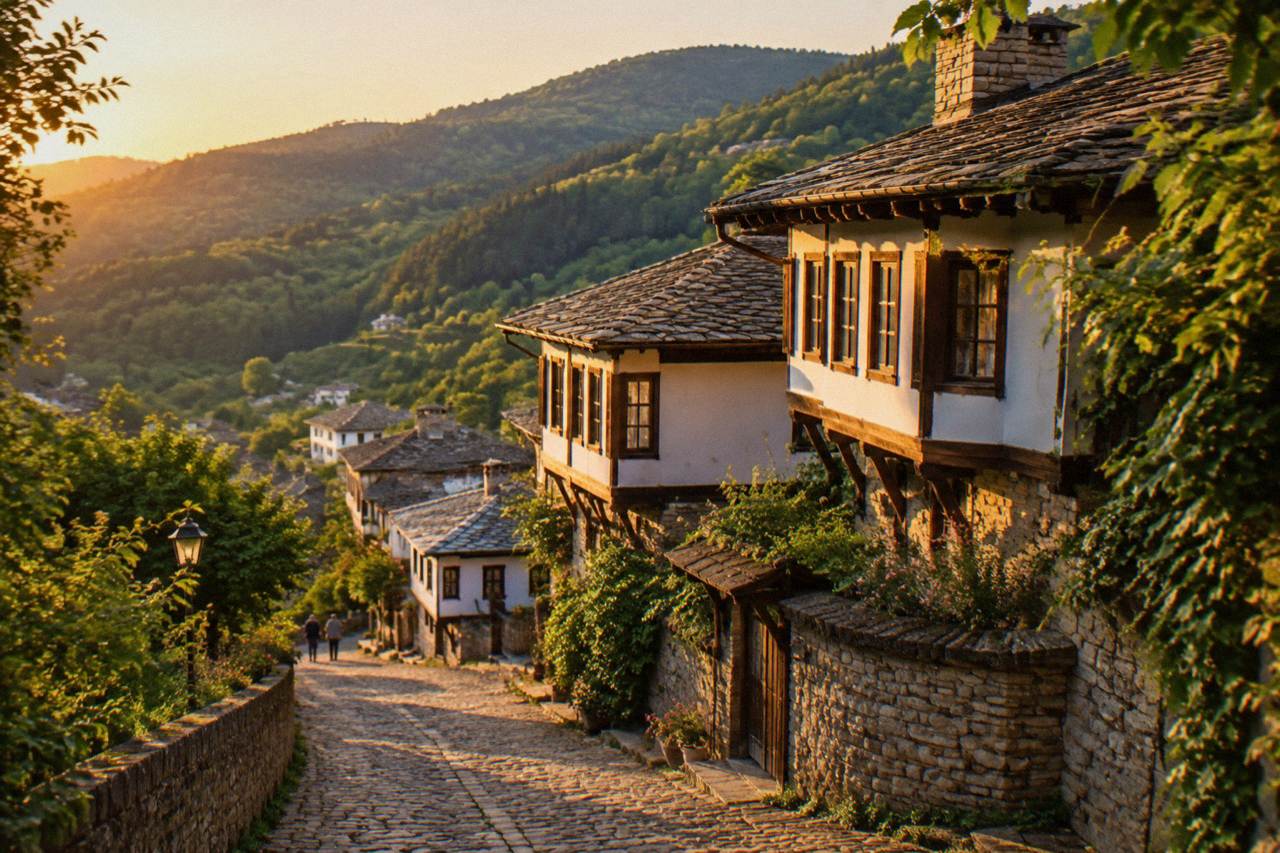
Tryavna is about 42 km by road from central Veliko Tarnovo, a small town in the Balkan foothills known for its National Revival architecture and its woodcarving and icon-painting school. The town has no fortress and no ticketed fortress-style reserve; it is a walkable old quarter of houses, a museum and workshops, reached by bus or car from Veliko Tarnovo.
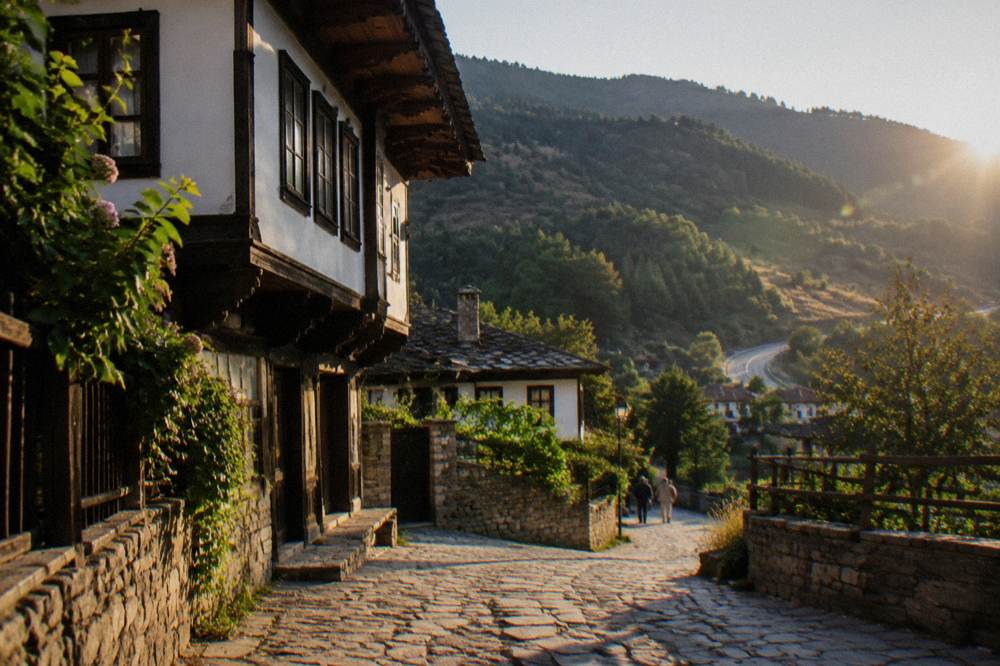
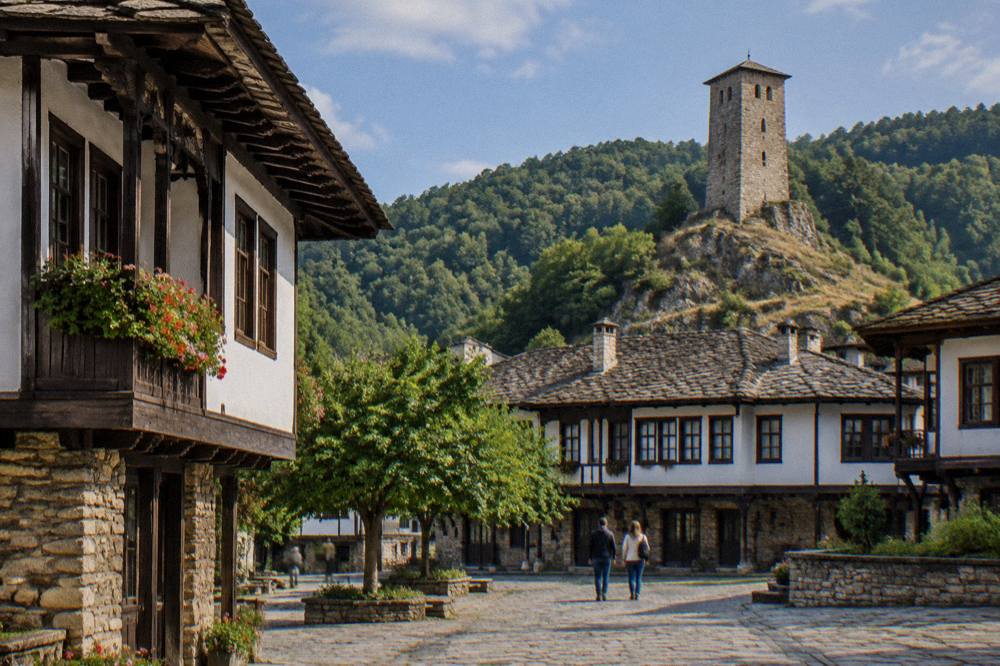
Tryavna is a small town in the central Balkan foothills of Bulgaria, about 42 km by road from Veliko Tarnovo, the onetime capital of the Second Bulgarian Kingdom on the Yantra river. Where Veliko Tarnovo is defined by Tsarevets Fortress, Trapezitsa and the Sound and Light show on announced evenings, Tryavna is defined by wood. The town gave its name to a school of woodcarving and icon painting whose work spread through Bulgaria before the Tarnovo Constitution of 1879, and its old quarter is a compact string of Revival-era houses in a valley of the Tryavna river. For a traveller basing themselves in Veliko Tarnovo, it is one of the nearest and most rewarding day trips on the map, close enough to combine with other stops and far enough to feel like a change of scene.
Where Is Tryavna And Why Does It Pair With Veliko Tarnovo?
Tryavna lies about 42 km by road south of central Veliko Tarnovo, in the northern foothills of the Balkan range, and it makes a natural second act to a stay in the medieval capital because the two towns tell different halves of the same Bulgarian story. Veliko Tarnovo carries the Second Bulgarian Kingdom, from the late 12th century to the 14th, while Tryavna carries the National Revival, the crafts and schools that grew up before the Tarnovo Constitution of 1879 and independence in 1908.
The pairing works geographically as much as historically. Veliko Tarnovo itself is an inland city on the Yantra river with an estimated 77,067 municipality residents as of 31 December 2025, and it sits at the centre of a dense web of day-trip destinations: Preobrazhenski Monastery at about 6 km, Nicopolis ad Istrum at about 20 km, Dryanovo Monastery at about 33 km, and then Tryavna at about 42 km. Beyond it, in the same general direction, lie Bozhentsi at about 46 km, Etar at about 53 km and, further afield, Buzludzha at about 73 km and Shipka church at about 79 km. A visitor with three or more days can build a loop that takes in several of these in one sweep, and the three days in Veliko Tarnovo itinerary is a good skeleton for exactly that kind of plan.
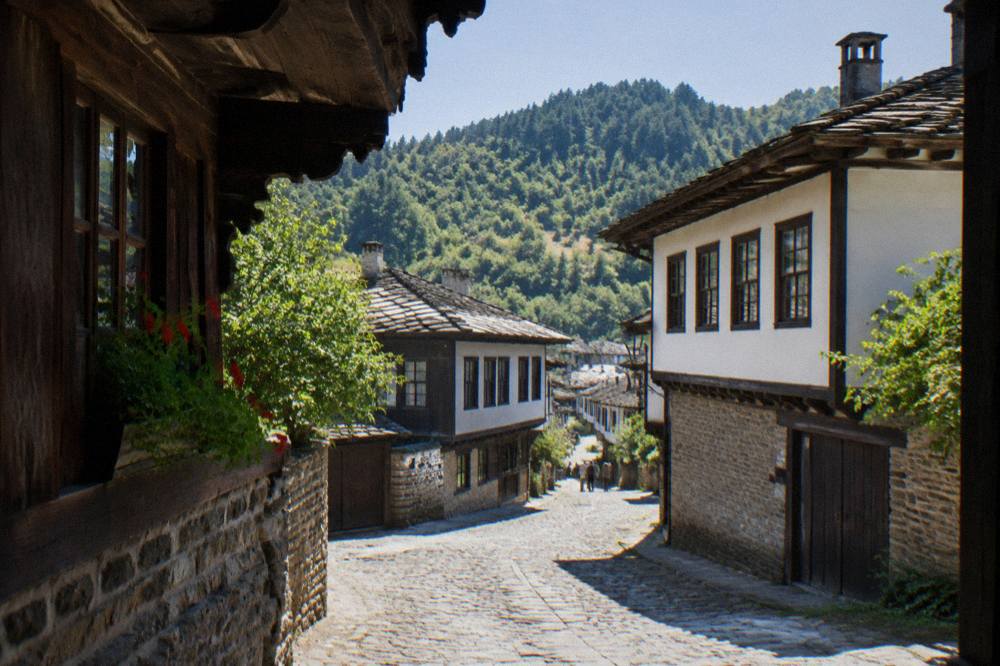
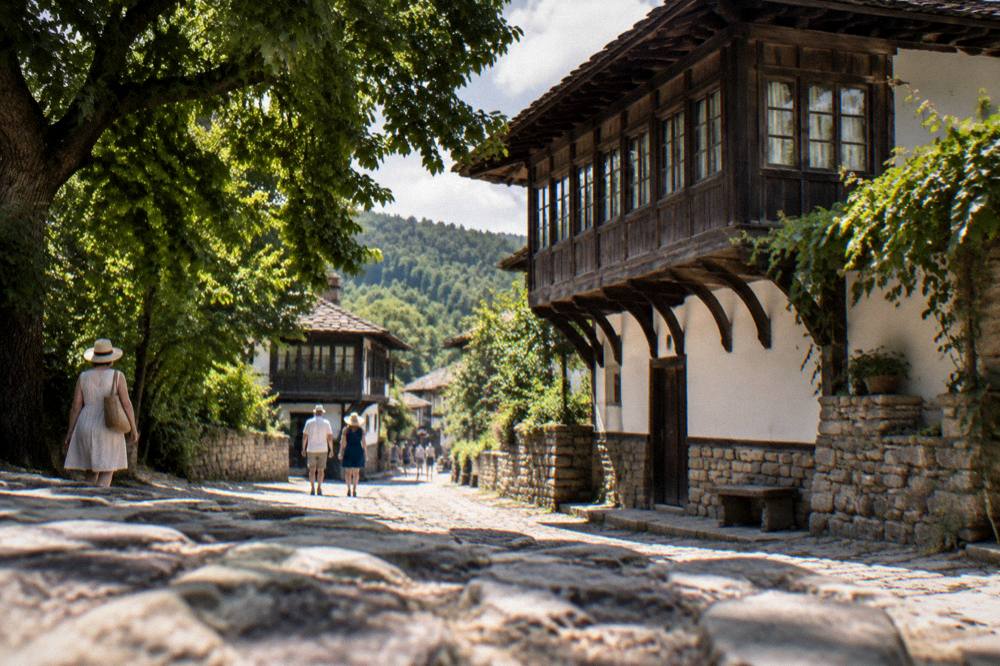
What distinguishes Tryavna from the others is its craft identity. The town's carvers and icon painters worked on commissions far beyond the valley, and the legacy is preserved in the museum quarter around the old centre. The atmosphere is quieter than Veliko Tarnovo's fortress hill: there is no citadel, no panoramic light show, and no museum reserve with a gate and a tariff in the same way. The town is instead a place for slow looking, at ceilings and doors and the interiors of houses that have become museums. For a guide to the full set of options in the region, the things to do in Veliko Tarnovo overview lists both the in-city sights and the trips out.
What Can You See In Tryavna On A Day Trip From Veliko Tarnovo?
The core of a Tryavna visit is the old town itself, the museum quarter with the Daskalov House and its woodcarving collection, the main square with its clock tower, and the workshops and bridges that connect them, all walkable without transport once you arrive. The town's sights are managed by a local museum network, and specific opening hours and ticket prices should be checked directly before setting out, since Tryavna's own figures are not published on the primary pages this site reports from.
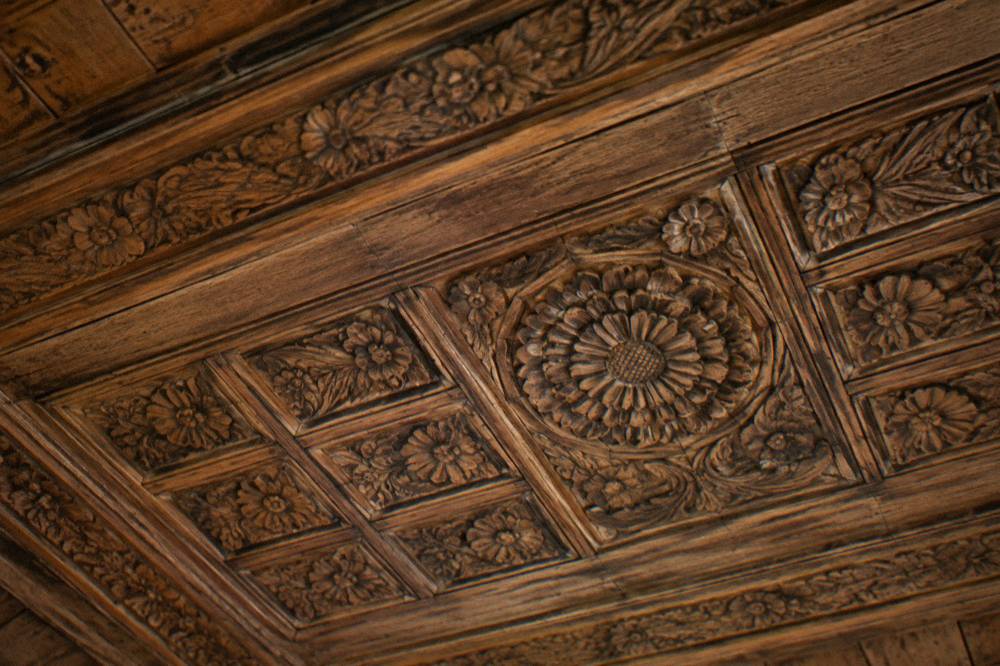
The Daskalov House is the anchor. It houses the woodcarving museum and holds carved ceilings that are the town's signature work. Around it stand further museum houses and a church or two within the old quarter. The square, with its clock tower, is the natural midpoint for a pause. None of this demands a schedule: Tryavna rewards wandering, and a half day is a realistic frame for the old centre, with more time if the museum houses draw you in. The town also sits in hill country, and the surrounding slopes give it a setting that changes character completely between the green of June and the snow of January.
For travellers who prefer structure over self-direction, guided products cover the region. One option that leaves from Veliko Tarnovo itself is the full day waterfalls and caves tour around Veliko Tarnovo, which heads into the gorges and cave systems of the surrounding area: Check availability. It is a nature-first day rather than a crafts day, so it pairs well with a self-guided Tryavna visit on a different day of the same trip.
A practical note on season: this corner of Bulgaria has a fully continental climate, and the difference between months is sharp. The table below shows the modelled picture for Veliko Tarnovo, which applies broadly to Tryavna's hills as well.
| Month | Mean daily high | Mean daily low | Rain |
|---|---|---|---|
| January | 4.9 C | -3.8 C | 56.1 mm |
| April | 16.9 C | 6.0 C | 71.6 mm |
| July | 27.6 C | 17.2 C | 79.5 mm |
| October | 17.6 C | 8.0 C | 58.9 mm |
Figures are ERA5 reanalysis, 1991 to 2020, a modelled grid cell rather than a station record. May carries the highest monthly rain total of the year at 95.7 mm and August the lowest at 51.3 mm; August also has the highest mean daily high at 28.1 C and January the lowest mean daily low at -3.8 C. Read those numbers as a planning frame, not a forecast.
How Do You Get From Veliko Tarnovo To Tryavna?
The distance is about 42 km by road from the centre of Veliko Tarnovo, and the practical options are a regional bus, a train on the local line, or a self-drive day with parking in the town. Veliko Tarnovo's own rail connections run through the Gorna Oryahovitsa junction, where trains from Sofia change, and regional services continue into the Balkan foothills; for exact departures on any travel day, the BDZ timetable is the reference.
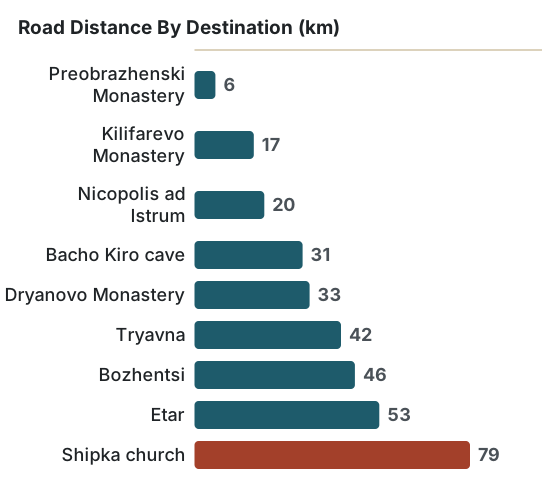
The road route south out of Veliko Tarnovo is shared with several of the region's other day trips: Dryanovo Monastery lies at about 33 km, Tryavna at about 42 km, Bozhentsi at about 46 km and Etar at about 53 km. That clustering is the reason a single day out of the city can cover two towns if the timing works, and it is also the reason Tryavna is the natural turn-around point for anyone who does not want a long drive. Allow a relaxed morning and check the timetable before committing to a train.
| Destination from central Veliko Tarnovo | About, by road |
|---|---|
| Preobrazhenski Monastery | 6 km |
| Kilifarevo Monastery | 17 km |
| Nicopolis ad Istrum | 20 km |
| Bacho Kiro cave | 31 km |
| Dryanovo Monastery | 33 km |
| Tryavna | 42 km |
| Bozhentsi | 46 km |
| Etar | 53 km |
| Shipka church | 79 km |
Distances are computed road kilometres from the centre of Veliko Tarnovo, stated as "about". For anyone weighing Tryavna against a bigger loop, the same list extends to Lovech at about 86 km, Devetashka Cave at about 89 km and the Kazanlak tomb at about 98 km, though those are full-day commitments on their own.
How Does Tryavna Compare With Etar, Bozhentsi And Gabrovo?
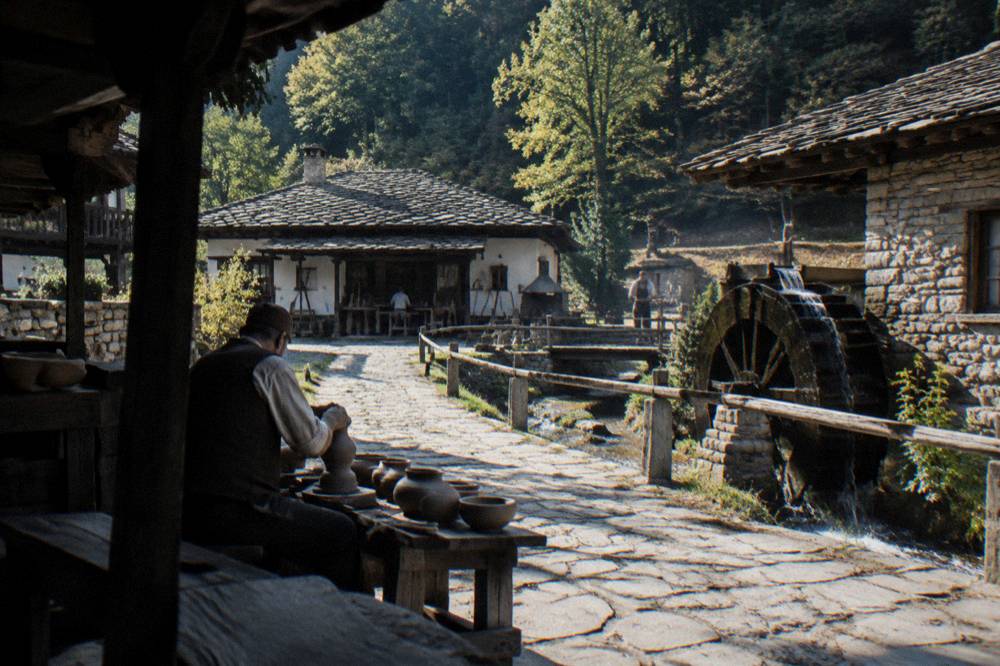
Tryavna is a living town with a museum quarter inside it; Etar, about 53 km from Veliko Tarnovo, is a purpose-built open-air museum of traditional crafts with a published tariff; Bozhentsi, about 46 km, is a protected architectural reserve of houses in a hamlet setting; and Gabrovo is the working city that anchors all three. The choice between them is a choice between a craft demonstration, a historic streetscape and a town you can eat and linger in.
Etar is the one with firmly published figures: the Architectural-Ethnographic Complex is open year-round with no days off, and its ticket page lists an adult ticket at 7.16 euro, with a pupil and student rate of 3.07 euro and a pensioner rate of 4.09 euro, while children under 7 enter free. Tryavna's and Bozhentsi's equivalents do not carry the same primary-source pricing, so check the current price on the official ticket page before booking or setting out. Everything else covered here is indexed on Veliko Tarnovo Travel Guide.
| Town or site | About, by road from Veliko Tarnovo | Character | Published entry figure |
|---|---|---|---|
| Tryavna | 42 km | Revival town, woodcarving museums | Check locally before visiting |
| Bozhentsi | 46 km | Architectural reserve, hamlet scale | Check locally before visiting |
| Etar | 53 km | Open-air craft museum | 7.16 euro adult, 3.07 euro student |
| Gabrovo | 45 km | Working city, transport and services hub | Not a single-ticket site |
The honest frame for a decision: if you want crafts shown in action, Etar is the strongest single stop and its figures are on the record in the Etar architectural-ethnographic complex guide. If you want a streetscape to photograph and a quiet hour, Bozhentsi, covered in its own Bozhentsi page, is the smallest of the three. If you want a town with cafes and shops and a full museum quarter to browse at your own pace, Tryavna is the pick, and it can absorb a whole day if the weather cooperates. The Gabrovo overview covers the city that ties the region together.
When Is The Best Time Of Year To Visit Tryavna?
Late spring through early autumn is the comfortable window, on the modelled climate for the region: mean daily highs run from 21.7 C in May to 28.1 C in August, with July and August the driest pair of months at 79.5 mm and 51.3 mm of rain respectively, while winter brings mean daily lows of -3.8 C in January and short days in the hills. Any month can work, but the old town's streets are an outdoor experience first.
The seasonal traps that matter for a Tryavna day trip are the ones in Veliko Tarnovo itself, since that is where the trip starts. Winter hours at the museum sites in the city begin on 25 October 2026, Trapezitsa is closed to visitors from 30 November 2026 to 31 March 2027, the funicular stops for the season on 31 October 2026, and the Museum of New and Newest History is temporarily not accepting visitors. If Tryavna is part of a first or last day in the city, plan around those dates rather than against them. The Sound and Light show in the city runs on announced evenings only, free to watch from Tsar Asen I Square, so check the programme if an evening show is part of the plan.
| Season | Modelled conditions (ERA5 reanalysis, 1991-2020) | What it means for Tryavna |
|---|---|---|
| Spring (Mar to May) | Highs 11.5 to 21.7 C, rain rising to 95.7 mm in May | Green hills, the wettest month of the year |
| Summer (Jun to Aug) | Highs 25.4 to 28.1 C | Warmest and driest stretch, August at 51.3 mm |
| Autumn (Sep to Nov) | Highs falling 23.3 to 11.8 C | Mild in September, colder by November |
| Winter (Dec to Feb) | Lows -3.8 to -2.3 C | Snow possible, short daylight in the valley |
One cultural marker worth knowing: the region's calendar has its own rhythms, and the Etar International Fair of Traditional Crafts, at Etar rather than Tryavna, ran in early September in its latest edition, with a 2027 edition reported for 4 to 6 September. Dates like these are announced by the organisers, so confirm before building a trip around them.
Can You Combine Tryavna With Dryanovo Monastery Or Elena?
Yes, and the geography encourages it: Dryanovo Monastery and Bacho Kiro cave sit at about 33 km from Veliko Tarnovo, on the way to Tryavna, so a single southbound day can pair the monastery valley with the woodcarving town; Elena, to the east, is a separate direction and works better as its own trip. The constraint is time and opening status, not distance.
Dryanovo Monastery and the Bacho Kiro cave are covered together in the Dryanovo Monastery and Bacho Kiro cave guide. Their hours and ticket prices are not published on a primary page this site reports from, so check locally before counting on them; the same applies to Tryavna's museum houses. The pairing logic is simple: the monastery is the closest of the foothill stops, Tryavna is the next, and the road between them passes through the landscape both are known for. A morning at one and an afternoon at the other is a full and varied day out of the city.
Elena, by contrast, lies east of Veliko Tarnovo and is better treated as its own excursion, described in the Elena day-trip page. Cramming Elena and Tryavna into one day means backtracking through the Veliko Tarnovo area twice, which eats the afternoon. The same reasoning applies to the northern cluster: Emen Canyon, about 20 km west, and the caves around it are a different day entirely, and the Emen Canyon guide covers that route.
What Should A Woodcarving Day Look Like In Practice?
A sensible shape is an early start from Veliko Tarnovo, the old town of Tryavna through the middle of the day including the Daskalov House museum and the clock tower square, and either a return to the city for the evening or a stop at Dryanovo Monastery on the way back, with the whole route staying under 50 km from the centre in each direction. Budget a full day and keep the museum stops flexible, since hours are the one thing to confirm rather than assume.
The day begins and ends in a city that rewards the return. Veliko Tarnovo's own sights, from Tsarevets, which charges 7.67 euro for an adult and 10.23 euro for a family ticket per the Regional Museum of History's ticket page, to the free public spaces of Samovodska Charshiya, General Gurko Street and the Varosha quarter, are the reason the trip exists at all. A Tryavna day uses the city purely as a base, and the evening can end with the Sound and Light show if the announced schedule happens to include one, watched at no cost from Tsar Asen I Square.
For travellers arriving in the region from further away, day tours from the capital and from Bucharest fold Veliko Tarnovo into a single long day, and the Veliko Tarnovo and Arbanasi day tour from Sofia with pickup is the variant that adds the Arbanasi village above the city. Those products cover the city and Arbanasi rather than Tryavna, so treat them as arrival-day options and keep Tryavna for the independent leg of the trip.
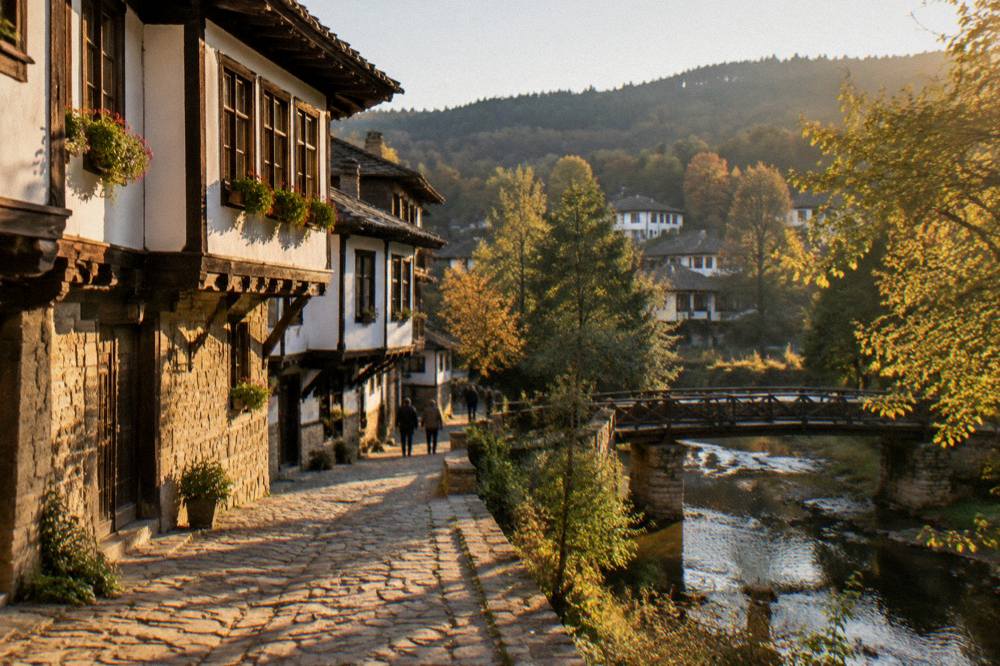
Two final practical points. First, money: Bulgaria has used the euro since 1 January 2026, at the fixed rate of 1.95583 lev per euro, so no currency conversion is needed for tickets, food or parking in the foothills. Second, emergencies anywhere in the country dial 112, the single European number. With those two basics settled, a Tryavna day needs nothing more than a timetable check the night before and weather-appropriate shoes for the cobbles.
Common Questions About Tryavna
How far is Tryavna from Veliko Tarnovo?
About 42 km by road from the centre of Veliko Tarnovo, computed on the public routing network. No drive time is printed for the route; check the bus or train timetable for the day you travel.
Can you visit Tryavna and Etar on the same day?
Yes, in distance terms: Tryavna is about 42 km from Veliko Tarnovo and Etar about 53 km, with Bozhentsi at about 46 km between them. Whether the museum hours allow both in one comfortable day depends on the season, so confirm opening times at each before committing.
What is Tryavna famous for?
Woodcarving and icon painting. The town gave its name to a school of carvers and painters whose work spread through Bulgaria before the Tarnovo Constitution of 1879, and the museum quarter, including the Daskalov House, preserves carved ceilings and related pieces from that tradition.
Is Tryavna a UNESCO World Heritage Site?
No. Nothing in Tryavna, and nothing in Veliko Tarnovo itself, is inscribed or on the Tentative List. The nearest inscribed sites in the region are the Rock-Hewn Churches of Ivanovo and the Thracian Tomb of Kazanlak, both from 1979, while Nicopolis ad Istrum, about 20 km from Veliko Tarnovo, has been on the Tentative List since 1984.
Are there trains from Veliko Tarnovo to Tryavna?
Regional trains serve the line through the foothills. Veliko Tarnovo's main rail connections run via the Gorna Oryahovitsa junction, where trains from Sofia change, and the BDZ timetable is the reference for exact departures on any travel day.
What does Tryavna cost to visit?
The town's streets and square are public space. Museum houses such as the Daskalov House charge admission, but their current hours and prices are not published on a primary page this site reports from, so check the current price on the official ticket page before booking.