Is Ruse, Bulgaria Worth Visiting?
An answer-page comparing Ruse with Veliko Tarnovo as a Bulgarian stop: distances, trains from Gorna Oryahovitsa, and what the medieval capital offers instead.
Veliko Tarnovo, the inland medieval capital of Bulgaria on the Yantra river, gets compared with Ruse whenever a route threads through northern Bulgaria toward or from the Danube. Ruse lies about 105 road km north of Veliko Tarnovo, and the two cities connect by a direct train of 2 h 25 min, so the question "Is Ruse, Bulgaria Worth Visiting?" is really a question about how the two stops fit one trip. This page lays out what the timetables, the museum's ticket pages and the municipal tourism site state about each leg, then looks at what Veliko Tarnovo itself puts on the table, from Tsarevets Fortress to the Sound and Light show on its announced evenings.
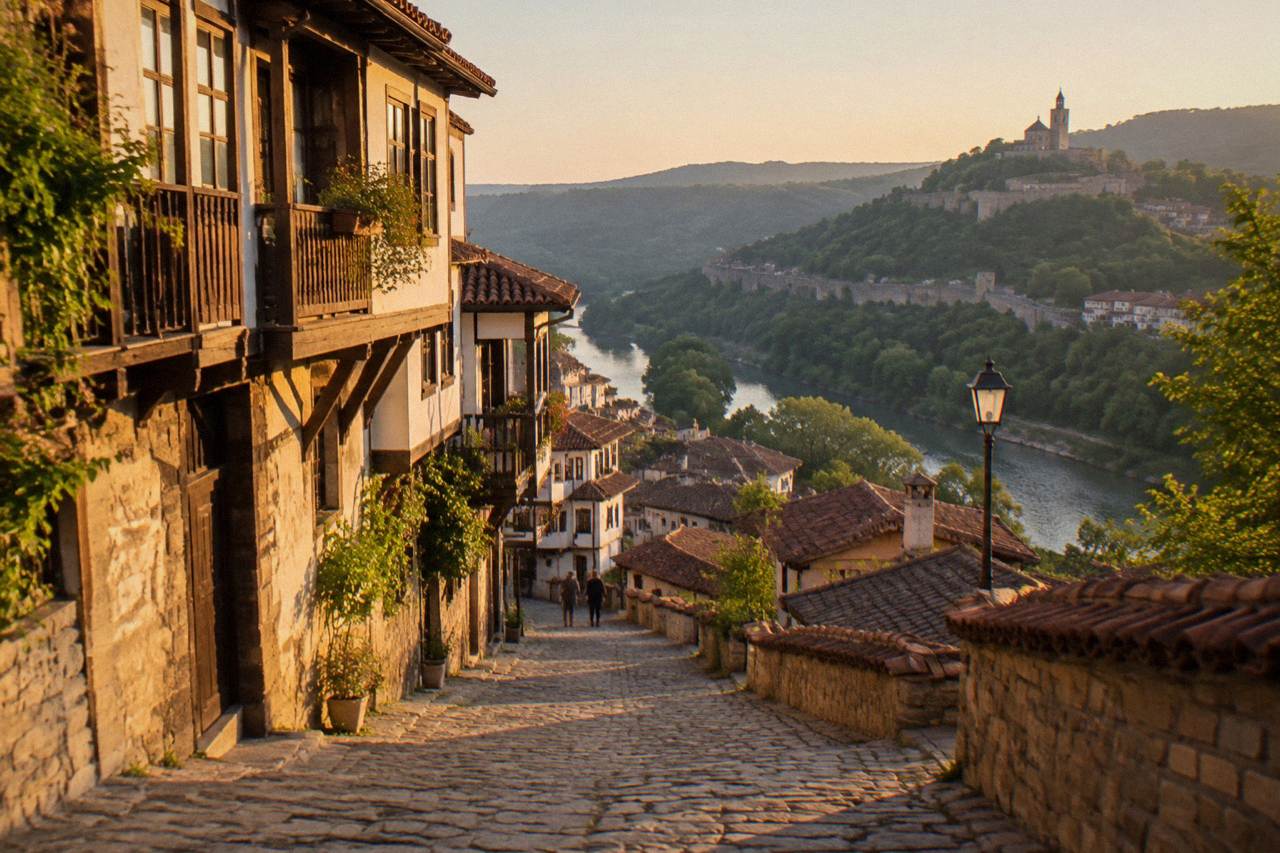
Ruse is a Danube city about 105 road km north of Veliko Tarnovo, joined to it by a direct train of 2 h 25 min on the BDZ timetable, which makes it a practical pairing for a northern Bulgaria route rather than a rival stop. The verdict that suits which trip: Ruse fits a river-and-border itinerary, while Veliko Tarnovo carries the medieval-capital sights, Tsarevets Fortress with its Patriarchal Cathedral, Trapezitsa and the Sound and Light show, that give a Bulgaria trip its historical spine.
Nothing in either comparison changes the distances, so the decision rests on which of those two draws matters more to the trip being planned.
Only the travel facts about Ruse carry a source on this site: the road distance of about 105 km from the centre of Veliko Tarnovo, computed on the OSM route, and the rail times from the BDZ timetable of 17 October 2026. The timetable lists a direct train from Ruse at 04:49 taking 2 h 25 min, and a connection via the Gorna Oryahovitsa junction at 06:20 taking 2 h 33 min. Gorna Oryahovitsa station sits about 10 km from the centre of Veliko Tarnovo and is the junction where trains from Sofia and Varna change for the city.
The rest of this page therefore builds the Veliko Tarnovo side of the comparison, sight by sight and figure by figure, because that is where the ticket pages and the municipal tourism site supply real numbers. For a wider view of the city's draws, the things to do in Veliko Tarnovo overview lists the core sights, and the question is Veliko Tarnovo worth visiting takes the same verdict style for the medieval capital on its own.
How Far Is Ruse From Veliko Tarnovo, And How Do The Trains Run?
Ruse lies about 105 road km north of Veliko Tarnovo, and the BDZ timetable of 17 October 2026 lists one direct train taking 2 h 25 min from Ruse at 04:49, plus a connection via Gorna Oryahovitsa at 06:20 taking 2 h 33 min. Gorna Oryahovitsa junction is about 10 km from the city centre and is the same junction where Sofia and Varna trains change. Times change with the timetable, so the BDZ schedule page is the reference to check before booking anything around a specific date.
For travellers building a two-city route, the useful comparison is how each leg of northern Bulgaria connects. The table below gathers the rail times the timetable read supplies for Veliko Tarnovo, with the Ruse row in context. The Sofia row matters because there is no direct train from Sofia: every trip changes, usually at Gorna Oryahovitsa, and the fastest runs take 4 h 33 min and 4 h 51 min while the rest run 6 to 10 hours.
| Route to Veliko Tarnovo | Fastest train | Notes from the timetable |
|---|---|---|
| From Ruse | 2 h 25 min | Direct, 04:49 departure |
| From Ruse via Gorna Oryahitsa | 2 h 33 min | 06:20 departure, one change |
| From Varna | 3 h 53 min | One direct train, 05:00; others change at Gorna Oryahovitsa and take 4 h 36 min or longer |
| From Sofia | 4 h 33 min | No direct train; fastest runs 4 h 33 min and 4 h 51 min, others 6 to 10 hours |
Road distances from the centre of Veliko Tarnovo, computed on the OSM route and always "about": Ruse 105 km, Bucharest 179 km, Plovdiv 208 km, Sofia 223 km. On the day-trip ring, Nicopolis ad Istrum sits about 20 km out on the Ruse-facing side of the map, an archaeological reserve on the UNESCO Tentative List since 1984 with a 5.11 euro ticket per the museum's price page, while the Rock-Hewn Churches of Ivanovo, inscribed in 1979, lie over 100 km away toward Ruse and the Danube.
A private option covers the pairing in one booking: the tour below links Ruse and Veliko Tarnovo with a driver-guide structure.
What Does Veliko Tarnovo Offer That A Danube Stop Does Not?
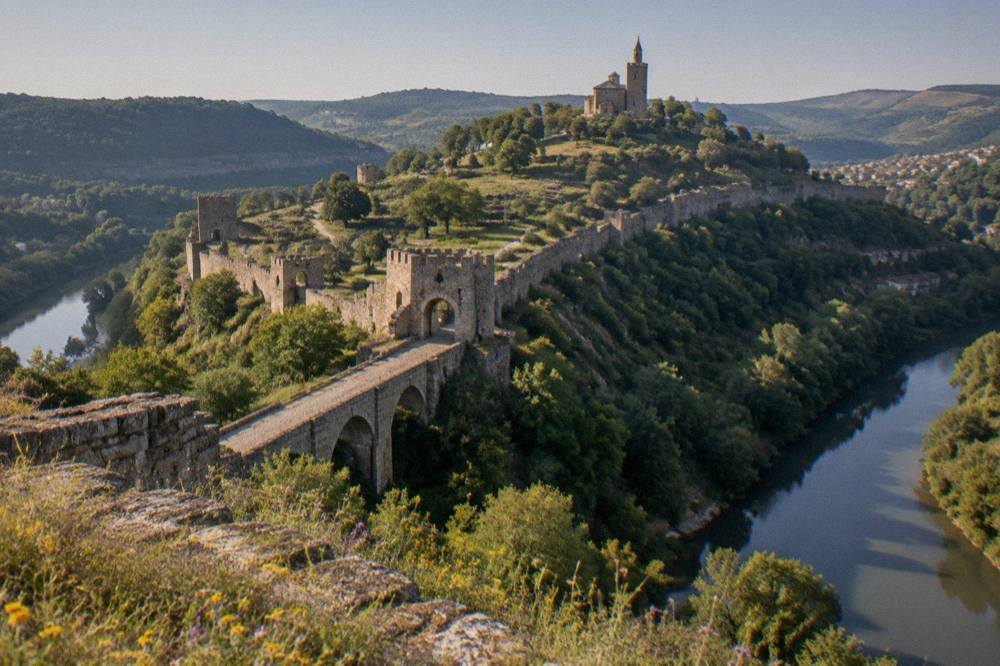
Veliko Tarnovo was the capital of the Second Bulgarian Kingdom for more than two centuries from the late 12th century, and its core sights are Tsarevets Fortress with the Patriarchal Cathedral, Trapezitsa, Samovodska Charshiya, General Gurko Street, the Varosha quarter and Arbanasi village. The Regional Museum of History's ticket page lists an adult Tsarevets entry of 7.67 euro, and the Sound and Light show runs on announced evenings, free to watch from Tsar Asen I Square.
A Danube stop answers a different brief: river, border and grid streets, not a fortified hill capital.
The Tsarevets figures come straight from the museum's ticket page. April to September the site opens daily 08:00 to 20:00 with last entry at 19:00; October runs 09:00 to 18:00 with last entry 17:00; winter hours start on 25 October 2026 with entry 09:00 to 16:00 and closing at 17:00. There is no day off, though a Tuesday maintenance slot of 09:10 to 11:00 is listed. The adult ticket is 7.67 euro, the family ticket for parents plus up to 3 children aged 7 to 18 is 10.23 euro, and a guided talk costs 15.34 euro in Bulgarian, 20.45 euro translated and 25.56 euro in a foreign language. Children under 7 enter free. Confirm before you go, since these are the museum's own printed figures.
Trapezitsa, the second fortified hill, carries its own season trap worth checking against travel dates: the reserve is open April to September 09:00 to 19:00 and October 09:00 to 18:00, but it closes to visitors entirely from 30 November 2026 to 31 March 2027. Its funicular runs 1 May to 31 October, 09:00 to 16:00 with a 12:00 to 13:00 lunch break, and stops for the season on 31 October 2026. A return ride costs 5.11 euro, one way 2.56 euro, family return 10.23 euro, per the museum's price page, and the site ticket itself is 5.11 euro with a family ticket at 7.67 euro.
| Veliko Tarnovo sight | Season note | Ticket figure |
|---|---|---|
| Tsarevets Fortress | Daily, no day off; winter hours from 25 October 2026 | 7.67 euro adult, 10.23 euro family |
| Trapezitsa | Closed 30 November 2026 to 31 March 2027 | 5.11 euro adult, 7.67 euro family |
| Trapezitsa funicular | Runs 1 May to 31 October, stops 31 October 2026 | 5.11 euro return, 10.23 euro family return |
| Church of the Holy Forty Martyrs | Open April to September 09:00 to 18:00 | 5.11 euro adult, 7.67 euro family |
| Nicopolis ad Istrum | About 20 km out; winter 2025/26 by appointment | 5.11 euro |
The show itself runs on announced evenings only, with no fixed nightly schedule; one example in the official Tourist Information Centre feed lists 1 May 2026 at 21:15. The walking tours on the roster are paid products, and the open public spaces are free to walk on your own. For depth on the medieval story, the question what was the old capital of Bulgaria covers the capital years, and how many days you need in Veliko Tarnovo sizes the stop.
Is Veliko Tarnovo Or Ruse Better For A Day Trip From Bucharest?
Bucharest Otopeni airport lies about 205 road km from Veliko Tarnovo, Bucharest itself about 179 road km, and direct buses of about 3 h 50 min to 4 h 15 min run the capital-to-city leg. Ruse sits on the road and rail line between Bucharest and Veliko Tarnovo, about 105 km short of the medieval capital, so a Bucharest day trip can thread Ruse as a waypoint or head straight for Tsarevets.
Which suits which trip depends on whether the draw is a Danube river stop or a fortified hill capital.
The practical figures for the Bucharest side: direct buses take about 3 h 50 min to 4 h 15 min, arriving at the Yug bus station at 74 Hristo Botev Blvd in the centre, which also serves Sofia and Varna routes. The Zapad station on Nikola Gabrovski Blvd handles regional routes. From Ruse, the direct train of 2 h 25 min lands travellers at the Veliko Tarnovo station for the final leg, or the Gorna Oryahovitsa junction about 10 km from the centre for connections toward Sofia and Varna.
For a trip that starts or ends in Ruse, the featured private tour below covers Veliko Tarnovo and Arbanasi in one booked day.
Starting or ending the route in Ruse. Book a private day trip.
Arbanasi itself sits about 2.8 km straight-line from the centre, and its ticketed sights carry their own figures: the Church of the Nativity at 7.67 euro with a family ticket of 12.78 euro, the Church of Sts Archangels Michael and Gabriel at the same prices, and Konstantsalieva House at 7.67 euro with a family ticket of 12.78 euro. Konstantsalieva House opens Friday to Sunday only, 10:00 to 16:00, from 30 November 2026 to 20 March 2027. The Church of the Nativity is free on its feast day, 25 December 2026. Anyone weighing the pairing against a different northern stop can also read which part of Bulgaria is best to stay in for the regional split.
When Is The Best Time To Visit Veliko Tarnovo On A Two-City Route?
The ERA5 reanalysis for Veliko Tarnovo, 1991 to 2020, shows a mean daily high of 28.1 C in August against 4.9 C in January, with a mean daily low of -3.8 C in January, and May carries the highest monthly rainfall at 95.7 mm while August sits at 51.3 mm. Those modelled normals shape the two-city route more than any calendar event, because the fortress hours, the Trapezitsa closure window and the funicular season all pivot on late October and the winter block.
A visit between April and September catches the long fortress hours, 08:00 to 20:00, that the museum's ticket page lists.
The autumn cut-off is the sharpest planning edge on the calendar. Winter hours at the museum sites start on 25 October 2026, the Trapezitsa funicular stops on 31 October 2026, and Trapezitsa itself closes from 30 November 2026 to 31 March 2027. The Museum of New and Newest History is temporarily not accepting visitors. None of this touches the free sights: the Asenevtsi Monument, Samovodska Charshiya, Gurko Street and the Varosha quarter stay open at all hours as public spaces.
The emergency number is 112. The question of what Veliko Tarnovo is famous for unpacks the medieval-capital identity in more depth.
Whether the answer to "Is Ruse, Bulgaria Worth Visiting?" is yes for a given trip, the two-city pairing itself is hard to argue against on the transport facts alone: 105 road km, one direct train, and a medieval capital at the end of the line.
Common Questions About Ruse And Veliko Tarnovo
These are the questions that come up when a northern Bulgaria route pairs the Danube city with the medieval capital, answered with the timetable, ticket-page and distance figures. Each answer stands alone, so the pairing can be planned one leg at a time.
Is Ruse, Bulgaria Worth Visiting?
Ruse lies about 105 road km north of Veliko Tarnovo with a direct train of 2 h 25 min, so it pairs naturally with the medieval capital on a northern route. The verdict suits the trip's brief: a river and border stop against Tsarevets Fortress, Trapezitsa and the Sound and Light show.
How Do You Get From Ruse To Veliko Tarnovo?
The BDZ timetable lists a direct train of 2 h 25 min from Ruse at 04:49, and a connection via Gorna Oryahovitsa at 06:20 taking 2 h 33 min. Times change, so check the BDZ timetable for the travel date.
Is There A Direct Train From Sofia To Veliko Tarnovo?
No. Every trip changes, usually at Gorna Oryahovitsa; the fastest runs take 4 h 33 min and 4 h 51 min, others 6 to 10 hours, per the timetable of 17 October 2026.
What Does Tsarevets Fortress Cost?
The Regional Museum of History's ticket page lists 7.67 euro for an adult and 10.23 euro for a family ticket covering parents plus up to 3 children aged 7 to 18. Children under 7 enter free.
Can You Watch The Sound And Light Show For Free?
Yes, from Tsar Asen I Square in front of Tsarevets. The show runs on announced evenings only, with no fixed nightly schedule.
How Many Days Does Veliko Tarnovo Need?
The city pairs a full fortress day with Arbanasi, the Varosha quarter and the museum sites, so the dedicated answer page sizes it against a traveller's pace.
The two cities sit two and a half rail hours apart, and the Veliko Tarnovo Travel Guide covers the medieval-capital end of that line in full, from the winter closure calendar to the Check availability link for the private pairing that starts from Ruse.