Car Rental In Veliko Tarnovo And Driving In Bulgaria
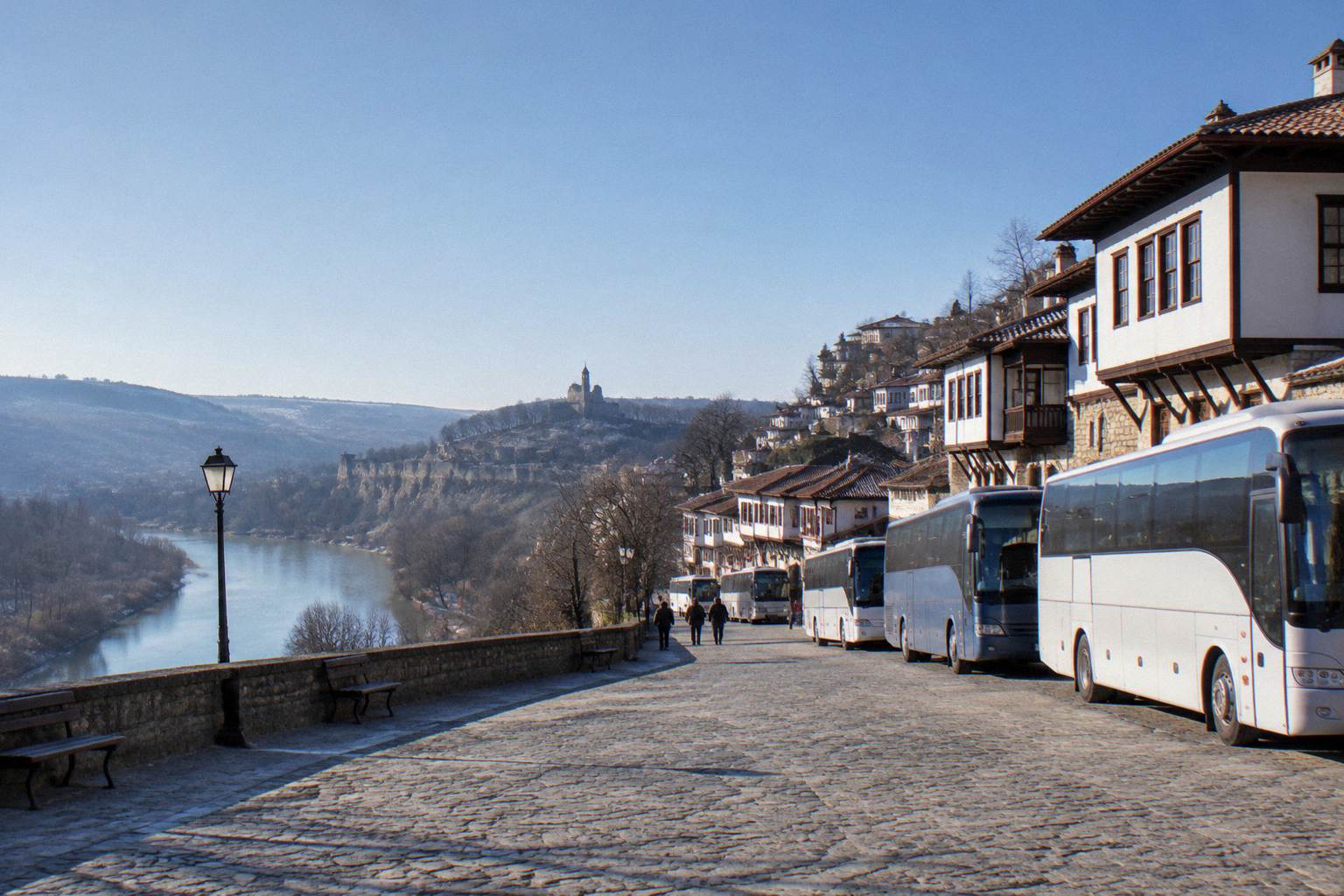
Veliko Tarnovo is an inland city on the Yantra river in Bulgaria, and the decision to rent a car there comes down to one thing: the hills of the old town are for walking, while the monasteries, caves and revival towns around it are for driving.
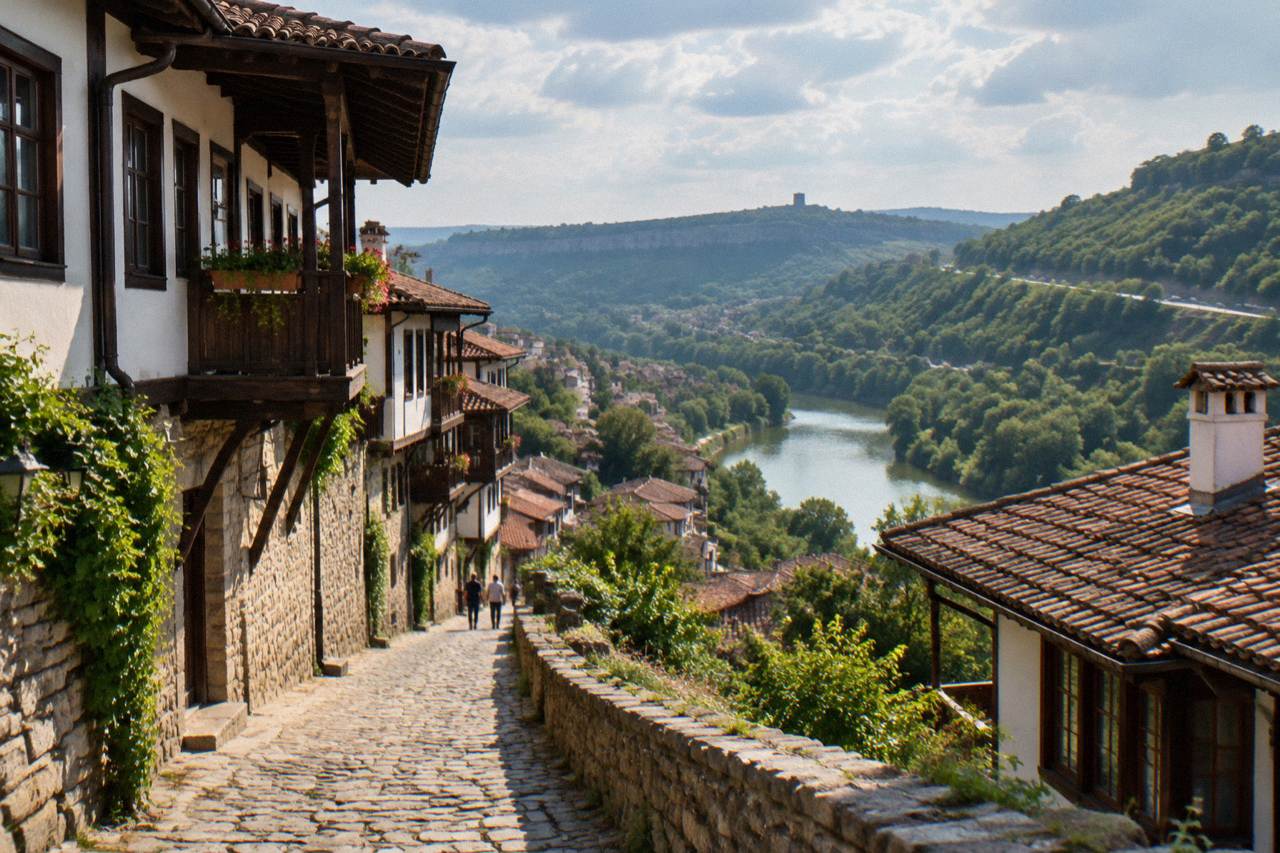
Rent a car in Veliko Tarnovo if your plans reach beyond the city: Etar sits about 53 km away, Tryavna about 42 km and the Dryanovo Monastery about 33 km, all road distances from the centre. Skip the car if your trip stays inside the city, because the old quarters sit on hills and are best done on foot, and the museum core between Tsarevets and Samovodska Charshiya needs no vehicle at all.
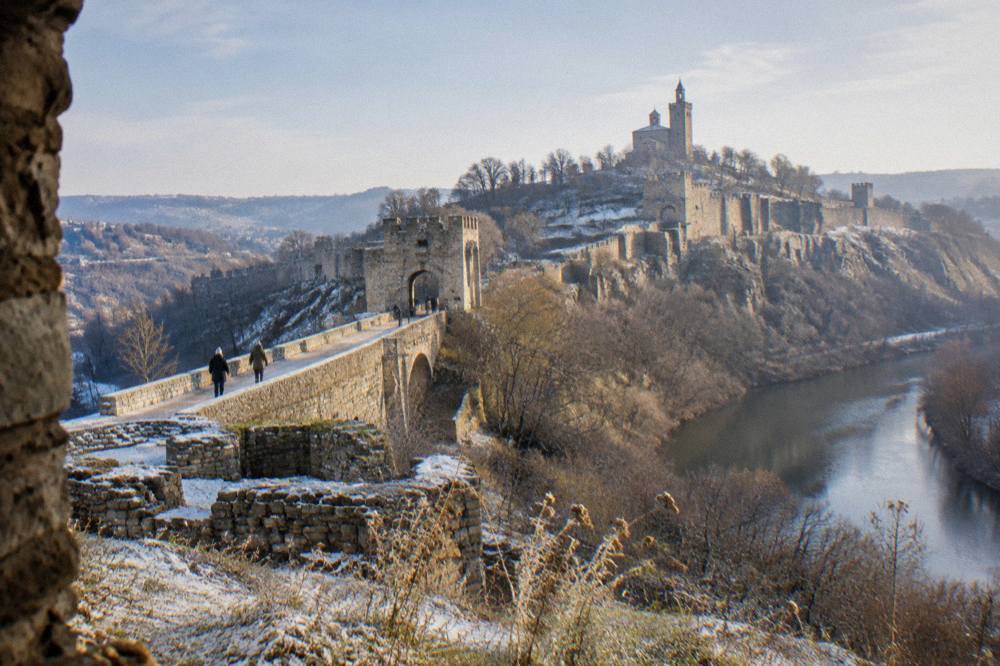
Veliko Tarnovo sits inland on the Yantra river in northern Bulgaria, with no sea coast and no airport of its own, and that geography shapes the whole car question. The municipality counted an estimated 77,067 residents on 31 December 2025, the city was the capital of the Second Bulgarian Kingdom from the late 12th century to the 14th, and its sights, Tsarevets Fortress, Trapezitsa, Samovodska Charshiya, General Gurko Street and Arbanasi, cluster tightly on hill after hill. Within that cluster a car is close to useless. Beyond it, at distances the things to do in and around the city page only hints at, the roads lead to monasteries, caves, waterfalls and revival towns that public transport serves thinly or not at all. This page lays out where a rental car earns its keep around Veliko Tarnovo, what driving in Bulgaria involves, and where the train beats the wheel.
Do You Need A Rental Car In Veliko Tarnovo?
No car is needed for the city itself, because Tsarevets Fortress, Trapezitsa, the Varosha quarter, Samovodska Charshiya and General Gurko Street are all walkable public or museum spaces on adjoining hills, and a car earns its keep only when the itinerary leaves town for Etar at about 53 road km or Tryavna at about 42 km. The old quarters sit on steep hills and are best done on foot, so the split is simple: walk the city, drive the region.
The Asenevtsi Monument, Samovodska Charshiya, General Gurko Street and the Varosha quarter are public spaces with no ticket and no need for a vehicle. The paid core, Tsarevets at 7.67 euro for an adult and the Patriarchal Cathedral on the same ticket, per the Regional Museum of History's ticket page, sits at the end of a walk rather than a drive. Arbanasi village lies about 2.8 km straight-line from the centre, close enough that a day of city sightseeing plus Arbanasi needs no more than a taxi or a short drive if a car is already in hand.
The calculus flips when the plan stretches to the day-trip ring around the city. Public transport covers the big towns but thins out at exactly the places a visitor wants: the monasteries, the caves and the small museum villages. A rental car converts a day trip from a scheduling exercise into a free-form loop. It also solves the arrival problem in reverse, since the city has no scheduled-flight airport and every journey in starts from Sofia at about 216 road km, Varna at about 214 or Bucharest Otopeni at about 205.
When your plans stretch beyond the big towns, book a rental car.
For anyone who would rather not drive at all, the alternatives are real. The train and bus options into the city are workable, and a paid guided day trip covers the same countryside with a driver at the wheel. The Veliko Tarnovo and Arbanasi tour from Sofia is one such product, running the Sofia to Veliko Tarnovo and Arbanasi route as a single booked day; Check availability if a driver-led day sounds better than a steering wheel.
Where Do You Pick Up A Rental Car For Veliko Tarnovo?
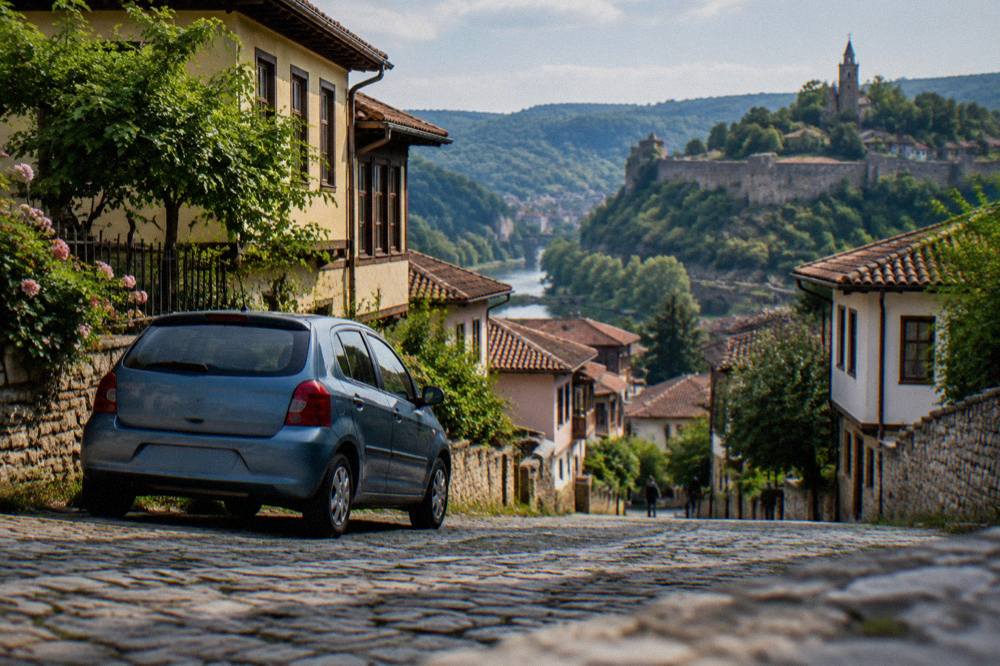
Rental cars for Veliko Tarnovo are picked up either in the city itself, from local offices arranged before arrival, or at the three airports that actually serve the region: Sofia at about 216 road km, Varna at about 214 and Bucharest Otopeni at about 205, since no scheduled-flight airport serves the city and the Gorna Oryahovitsa airfield has no regular scheduled flights. The right pickup point depends on whether the car is a tool for day trips or for the whole Bulgarian journey.
A car collected in Veliko Tarnovo itself makes sense for a traveller who arrives by train or bus and wants wheels only for the middle days of the stay. The city is compact, so a single pickup and return at the accommodation's doorstep covers everything. Confirm parking arrangements with the accommodation before booking the car, because the old quarters sit on hills and the parking picture around the centre is best checked street by street with the hotel or guesthouse rather than assumed.
A car collected at an airport suits the loop traveller: Sofia in, Veliko Tarnovo and the revival towns in the middle, and the same airport out. The nearest airport options all sit at similar road distances, roughly 205 to 216 km, so the flight price and schedule, not the drive, should decide the gateway. Cross-border rental between Bulgaria and Romania is a matter for the rental company's own terms, so confirm it at booking if a Bucharest pickup and a Bulgarian itinerary are planned together.
| Gateway | Road distance to Veliko Tarnovo | Flights |
|---|---|---|
| Sofia (SOF) | about 216 km | scheduled international |
| Varna (VAR) | about 214 km | scheduled international |
| Bucharest Otopeni (OTP) | about 205 km | scheduled international |
| Gorna Oryahovitsa airfield | about 10 km to the station | no regular scheduled flights |
No rental price belongs on this page: rates move with season, car class and company, and the booking platforms quote them live at the moment of search. The same goes for fuel and tolls. What can be stated is the currency itself, since Bulgaria has used the euro since 1 January 2026, at a fixed rate of 1.95583 lev per euro, so every price a driver meets at the pump, the museum ticket office or the hotel bill is in euro. The money and euro guide covers the changeover in detail.
Which Day Trips From Veliko Tarnovo Are Easiest By Car?
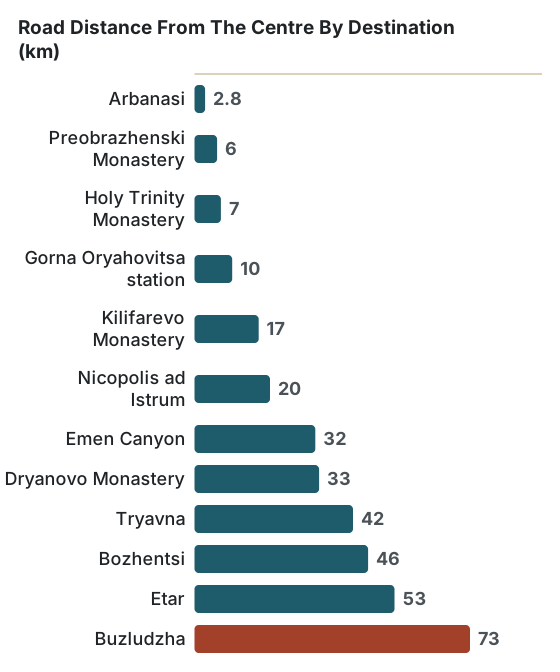
The day trips that justify a rental car are the ones public transport serves thinly: Etar at about 53 road km, Tryavna at about 42 km, Bozhentsi at about 46 km, the Dryanovo Monastery at about 33 km, Emen Canyon at about 32 km by road and Krushuna Falls at about 79 km, all from the centre. The monasteries closest to town, Preobrazhenski at about 6 km and the Holy Trinity Monastery at about 7 km, are near enough for a taxi.
The road-distances table below is the planning backbone for a driving stay. Every figure is a road distance from the centre, stated with "about" because route planners differ by a few kilometres. The rest of the planning pages sit on Veliko Tarnovo Travel Guide.
| Destination | About road km from the centre |
|---|---|
| Arbanasi | 2.8 straight-line |
| Preobrazhenski Monastery | 6 |
| Holy Trinity Monastery | 7 |
| Gorna Oryahovitsa station | 10 |
| Kilifarevo Monastery | 17 |
| Nicopolis ad Istrum | 20 |
| Emen Canyon | 32 |
| Dryanovo Monastery | 33 |
| Tryavna | 42 |
| Bozhentsi | 46 |
| Etar | 53 |
| Buzludzha | 73 |
| Krushuna Falls | 79 |
| Shipka church | 79 |
| Lovech | 86 |
| Kazanlak tomb | 98 |
| Ruse | 105 |
| Sofia | 223 |
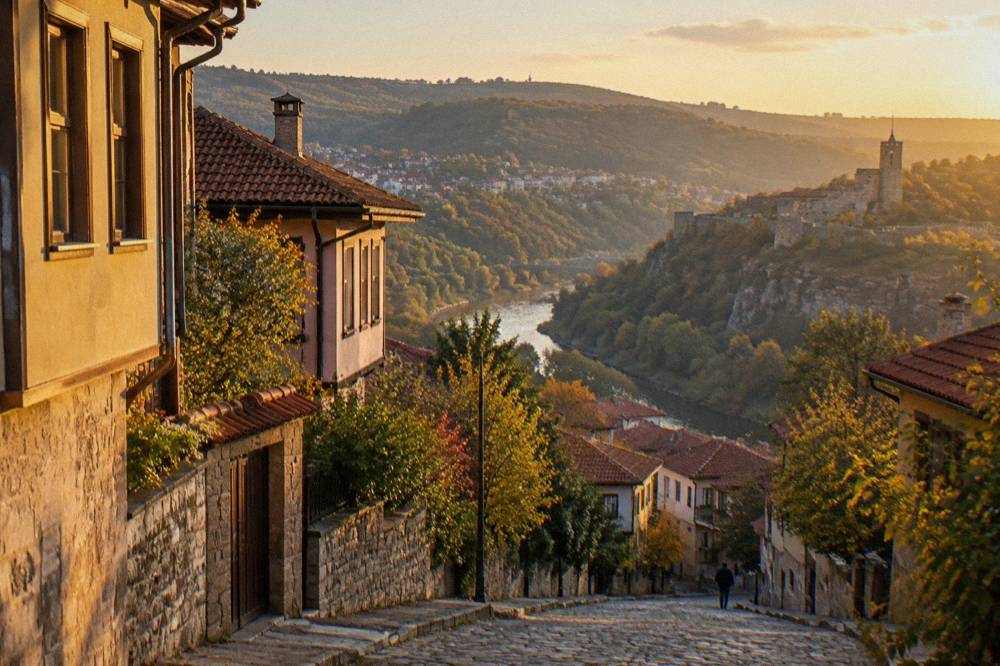
Two of these loops deserve a car above all others. The Gabrovo loop, Etar, Tryavna and Bozhentsi in one arc, strings three revival-era destinations along about 42 to 53 km of road, and the Etar Architectural-Ethnographic Complex at least is fully documented: open all year with no days off, an adult ticket at 7.16 euro, per the complex's own admission page. Hours and prices for Tryavna and Bozhentsi should be confirmed locally before the drive, and the Etar guide covers the complex itself.
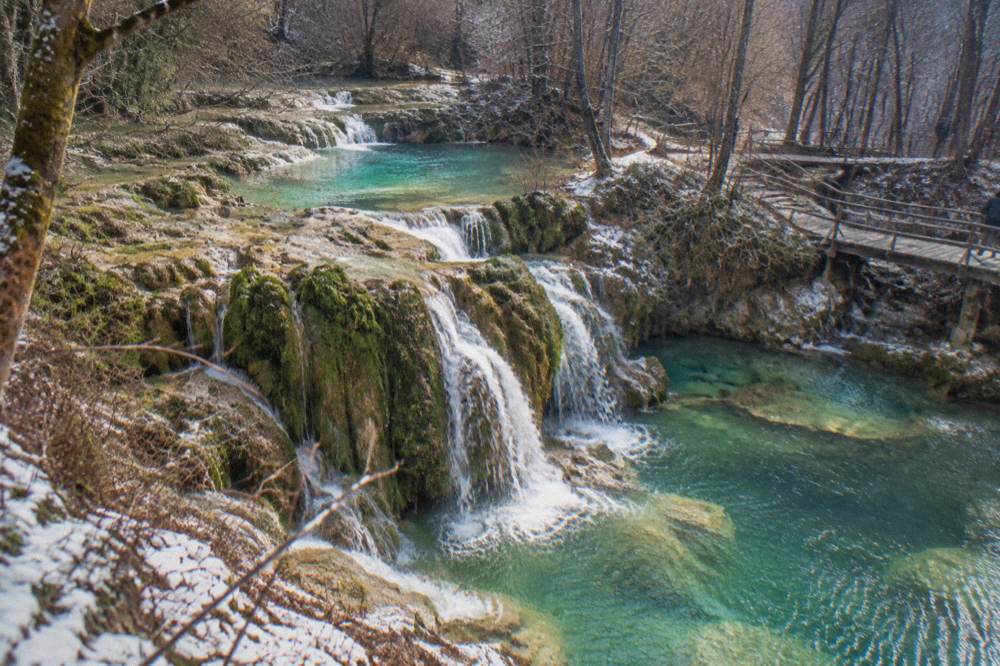
The nature loop is the other one. Emen Canyon, the gorge of the Negovanka river, lies about 20 km west of the city per the municipal tourism site, about 32 km by road, and its Lower Boaz has 90 m sheer cliffs. Krushuna Falls and Devetashka Cave stretch the loop out to about 79 and 89 km respectively. A paid alternative exists for travellers without a car: the waterfalls and caves day trip around Veliko Tarnovo is a bookable product that covers this same cave-and-waterfall country with a driver.
A third option pairs the city with a monastery. The monasteries and churches near the city, covered in their own guide, include Preobrazhenski and Kilifarevo within about 6 to 17 km of the centre, and a short drive stitches them into a half day. The bookable monasteries and waterfalls tour runs the same idea with a driver, for visitors who would rather not plan the route themselves.
Along any of these loops, the paid sights the Regional Museum of History operates carry fixed euro prices, printed on the museum's own ticket pages. The table below gathers the ones a driver is likeliest to pass.
| Sight | Adult ticket | Hours (April to September) |
|---|---|---|
| Tsarevets Fortress | 7.67 euro | daily 08:00 to 20:00, last entry 19:00 |
| Trapezitsa | 5.11 euro | daily 09:00 to 19:00, last entry 18:00 |
| Church of the Holy Forty Martyrs | 5.11 euro | daily 09:00 to 18:00, last entry 17:30 |
| Nicopolis ad Istrum | 5.11 euro | daily 09:00 to 18:00 |
| Etar complex | 7.16 euro | 09:00 to 19:00, reported |
What Does Driving In Bulgaria Involve?
Bulgaria drives on the right, uses the euro since 1 January 2026, has been a full Schengen member since 1 January 2025, and has run the Entry/Exit System at all external Schengen borders since 10 April 2026, all of which matters to a driver crossing from Romania or beyond. The single European emergency number is 112. Rental terms, vignettes and fuel prices vary by company and date, so those belong to the booking confirmation, not to a guide page.
The Schengen point matters most for the Bucharest loop. A driver coming from Romania crosses an internal Schengen border with no systematic passport checks, and a driver from outside the bloc meets the Entry/Exit System at the external border instead. Travellers planning the trip can read the wider picture in the Bulgaria travel tips guide. The currency point matters everywhere else: at 1.95583 lev fixed per euro, the lev survives only as an arithmetic memory, and every roadside expense from a museum ticket to a tank of fuel is priced in euro.
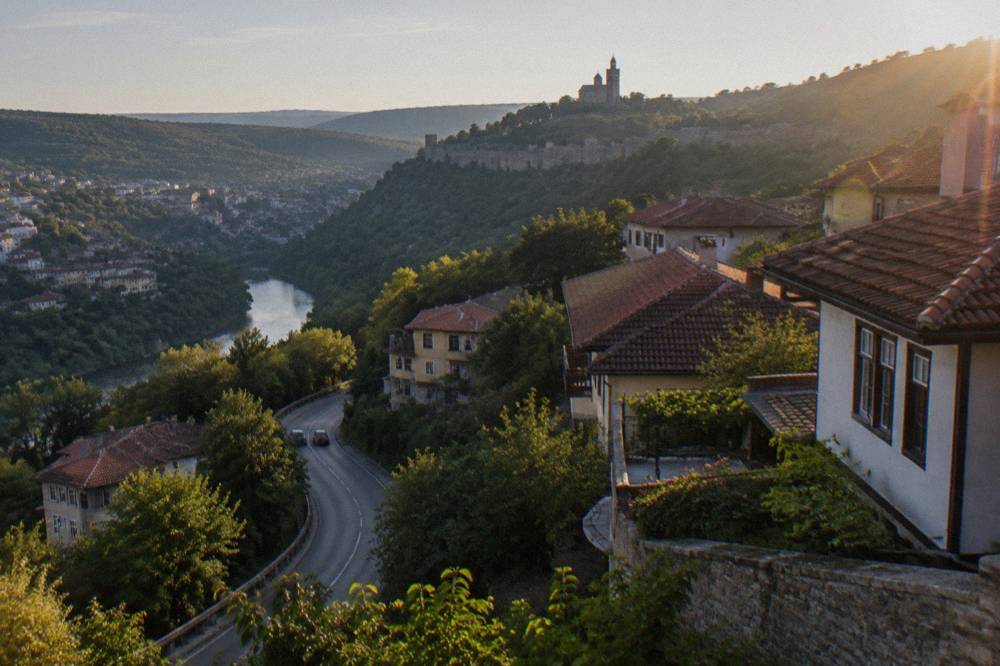
Within Veliko Tarnovo itself, the driving advice is short. The old quarters sit on hills and are best done on foot. Confirm parking with the accommodation, since no parking tariff, zone map or old-town restriction can be stated as fact here. The practical pattern that works is to park once at the hotel or guesthouse, choosing from where to stay in the city, and treat the city days as walking days, saving the car for the loops.
Road quality on the day-trip network is a mixed picture of motorway, main road and village lane, and no figure on this page should be read as a promise about any specific stretch. The distances above are what the route data supports, and nothing more. The same restraint applies to the Buzludzha monument at about 73 km: its interior is generally described as closed, so the drive there is for the exterior view, and its details belong to the Buzludzha guide rather than to the road.
When Is The Best Season To Drive Around Veliko Tarnovo?
The ERA5 reanalysis for Veliko Tarnovo, 1991 to 2020, shows a mean daily high of 28.1 C in August, 27.6 C in July and 4.9 C in January, with a mean daily low of -3.8 C in January and monthly rainfall peaking at 95.7 mm in May against 51.3 mm in August, so summer driving means heat and spring means rain, while winter means freezing nights on hill roads. There is no wrong season, only different ones.
The full monthly picture, all figures from the ERA5 reanalysis for the 1991 to 2020 period:
| Month | Mean daily high | Mean daily low | Rain |
|---|---|---|---|
| January | 4.9 C | -3.8 C | 56.1 mm |
| February | 7.2 C | -2.3 C | 54.1 mm |
| March | 11.5 C | 1.4 C | 68.6 mm |
| April | 16.9 C | 6.0 C | 71.6 mm |
| May | 21.7 C | 11.1 C | 95.7 mm |
| June | 25.4 C | 15.1 C | 85.0 mm |
| July | 27.6 C | 17.2 C | 79.5 mm |
| August | 28.1 C | 17.1 C | 51.3 mm |
| September | 23.3 C | 12.9 C | 63.0 mm |
| October | 17.6 C | 8.0 C | 58.9 mm |
| November | 11.8 C | 3.1 C | 54.5 mm |
| December | 6.1 C | -1.7 C | 60.6 mm |
What the numbers mean for a driver is plain. January nights average -3.8 C, which puts frost on the hill roads around the city most winter mornings. May carries the heaviest monthly rain total in the table at 95.7 mm, and August the lightest at 51.3 mm alongside the highest mean daily high. The shoulder months, laid out in the spring and autumn guide and in the best time to visit overview, sit in the middle of both ranges. The full weather breakdown carries the month-by-month detail.
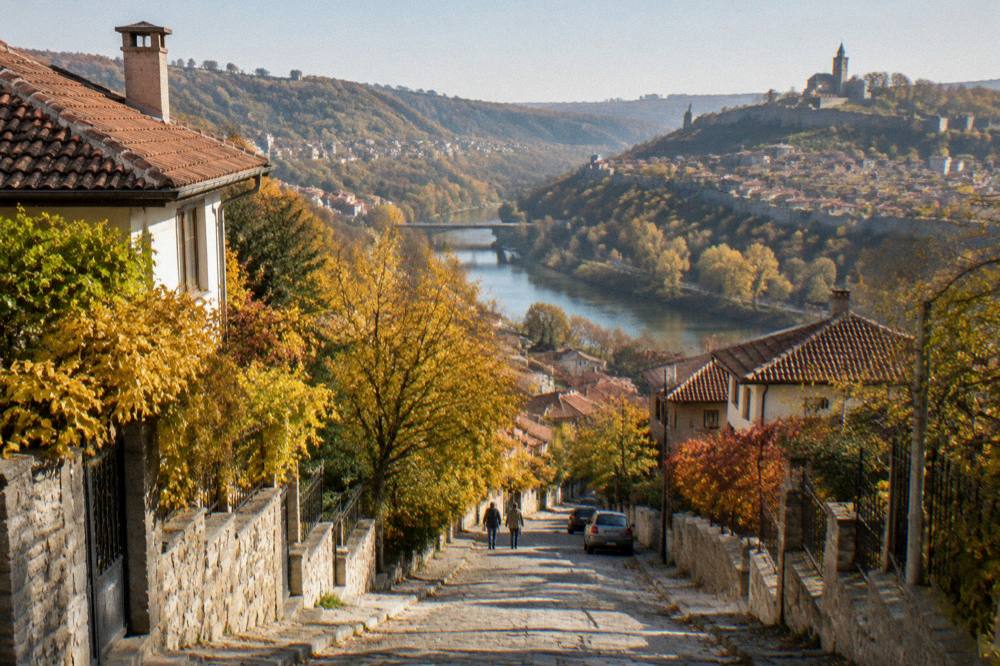
One seasonal event rewards a calendar check. The Sound and Light audiovisual show on Tsarevets runs on announced evenings only, with no fixed nightly schedule, and watching it from Tsar Asen I Square is free. A driver whose evening ends with the show from the square gets the city's two best experiences, the fortress by day and the lights by night, without moving the car at all. The announced dates appear on the show's own site as they are set.
What Winter Closures Change A Driving Itinerary?
Winter rewrites the day-trip map: Trapezitsa is closed to visitors from 30 November 2026 to 31 March 2027, its funicular stops for the season on 31 October 2026, the Kilifarevo museum is closed from 30 November 2026 to 30 March 2027, Konstantsalieva House in Arbanasi opens Friday to Sunday only from 30 November 2026 to 20 March 2027, and winter hours at the museum sites start on 25 October 2026. A winter driver plans around the list, not around it.
The museum network announces these blocks each autumn, and the 2026 to 2027 season is already fixed. The table gathers every closure that touches a driving plan.
| Site | Winter status 2026 to 2027 |
|---|---|
| Trapezitsa | closed to visitors 30 Nov 2026 to 31 Mar 2027 |
| Trapezitsa funicular | stops for the season 31 Oct 2026, returns 1 May |
| Kilifarevo history museum | closed 30 Nov 2026 to 30 Mar 2027 |
| Konstantsalieva House, Arbanasi | Fri, Sat, Sun only, 10:00 to 16:00, from 30 Nov 2026 to 20 Mar 2027 |
| Museum of New and Newest History | temporarily not accepting visitors |
| Museum sites generally | winter hours start 25 Oct 2026 |
| Church of the Nativity, Arbanasi | winter entry 10:00 to 15:30, free on the feast day 25 Dec 2026 |
Tsarevets itself keeps going: the fortress has no closing day, and winter entry runs 09:00 to 16:00 with the site closing at 17:00, though the ticket page lists a Tuesday maintenance slot from 09:10 to 11:00. The Church of St Dimitar of Thessaloniki opens April to October by prior request only, telephone 0885 144 622, and stays closed November to March. Nicopolis ad Istrum, about 20 km out on the day-trip ring, runs November to March at 09:00 to 16:30 and in the 2025 to 2026 winter asked for appointments, so a winter driver should call ahead on that one. The wider winter picture, market included, sits in the city's winter coverage.
Car Or Train: Which Is Better For Reaching Veliko Tarnovo?
The train beats the car for one specific arrival, Ruse, where a direct train covers the distance in 2 h 25 min, and it nearly matches it from Varna with a direct 3 h 53 min service, but from Sofia there is no direct train at all, every service changes, usually at Gorna Oryahovitsa, and the fastest connections run 4 h 33 min and 4 h 51 min on the current timetable, which makes the road or a booked day tour the simpler choice from the capital.
The rail picture, from the BDZ timetable as read on 17 October 2026:
| Route | Direct train | Fastest time |
|---|---|---|
| Ruse to Veliko Tarnovo | yes | 2 h 25 min |
| Varna to Veliko Tarnovo | one direct service | 3 h 53 min |
| Sofia to Veliko Tarnovo | no, change at Gorna Oryahovitsa | 4 h 33 min |
Timetables change, so the live BDZ pages settle any specific date, and the city train station guide plus the bus station guide carry the arrival detail. The pattern that emerges is simple. Coming from Ruse or Varna, the train competes honestly with the road. Coming from Sofia, the absence of a direct service tilts the choice toward the bus, at roughly 3 to 3.5 hours with several operators, or toward a car, or toward a booked day tour that folds the transfer into the itinerary.
That last option deserves its own paragraph, because it answers the car question from the other side. A traveller staying in Sofia can reach the city, Arbanasi and the countryside on a single booked day without ever sitting behind a wheel, and the Bucharest market has the same products aimed at visitors based there. For a one-visit itinerary built around how many days the city deserves, a tour can replace the rental entirely; for a week with Etar, Tryavna, the monasteries and the caves on the list, the car wins on freedom alone.
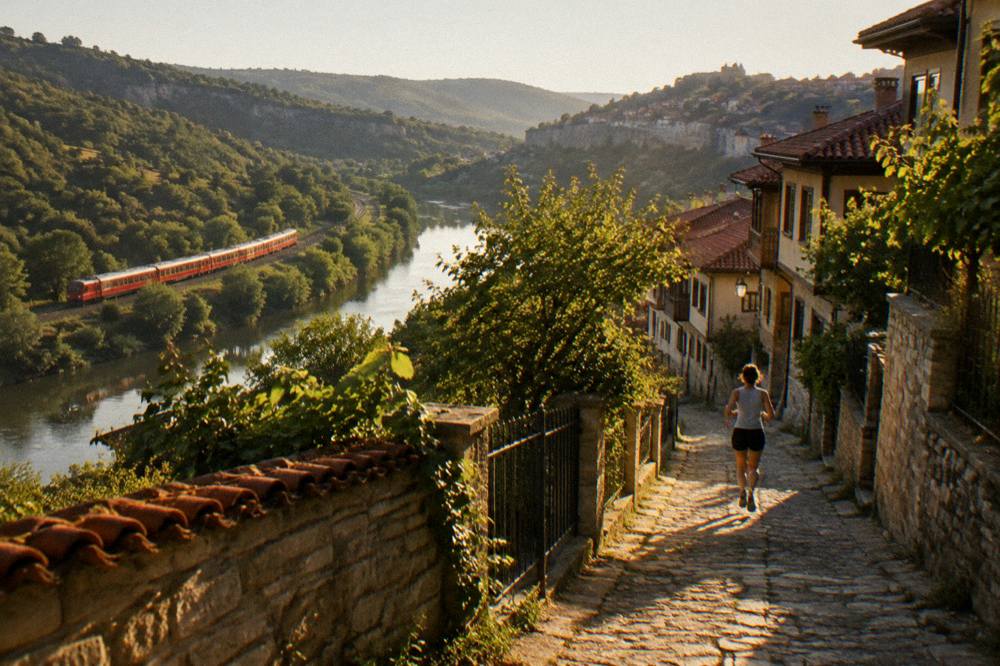
The closing rule of thumb, then: walk the hills of Veliko Tarnovo, drive the ring around them, and let the railway handle Ruse and Varna if the itinerary starts there. A rental car collected in the city or at the Sofia, Varna or Bucharest airport turns the monasteries at 6 and 17 km, the canyon at 32, the revival towns at 42 to 53 and the waterfalls at 79 into a single week's map, with every museum ticket priced in euro and every winter closure listed above planned around in advance.
Common Questions About Car Rental In Veliko Tarnovo
Is It Worth Renting A Car In Veliko Tarnovo?
Only for the region, not the city. The old quarters sit on hills and are best done on foot, and the walkable core from Tsarevets to Samovodska Charshiya needs no vehicle. A car pays off for Etar at about 53 road km, Tryavna at about 42 km, the Dryanovo Monastery at about 33 km, Emen Canyon at about 32 km and the wider day-trip ring.
Can You Fly Into Veliko Tarnovo And Rent A Car There?
No scheduled-flight airport serves the city, and the Gorna Oryahovitsa airfield has no regular scheduled flights. Rental cars for the region are collected either in the city itself or at Sofia, about 216 road km away, Varna, about 214, or Bucharest Otopeni, about 205.
Do You Need A Vignette To Drive In Bulgaria?
No toll or vignette figure can be stated as fact here, and pricing belongs to the rental company and the road operator. Confirm the current requirement and cost with the rental company at booking before driving on any motorway.
Is Parking Difficult In Veliko Tarnovo?
The old quarters sit on hills and are best done on foot, and the practical advice is to confirm parking with the accommodation before booking either the room or the car. No zone, tariff or restriction detail is stated on this page; the place to get it is the hotel or guesthouse itself.
What Currency Do You Pay Roadside Costs In?
The euro. Bulgaria adopted the euro on 1 January 2026 at a fixed rate of 1.95583 lev per euro, so fuel, museum tickets such as the 7.67 euro Tsarevets entry and the 7.16 euro Etar ticket, and any parking charge are all priced in euro.
Is Driving To Veliko Tarnovo From Bucharest Straightforward?
The road distance is about 205 km from Bucharest Otopeni, and Bulgaria has been a full Schengen member since 1 January 2025, so the Romanian border is an internal Schengen crossing. Cross-border rental terms are set by the rental company, so confirm the car may enter Bulgaria at booking.