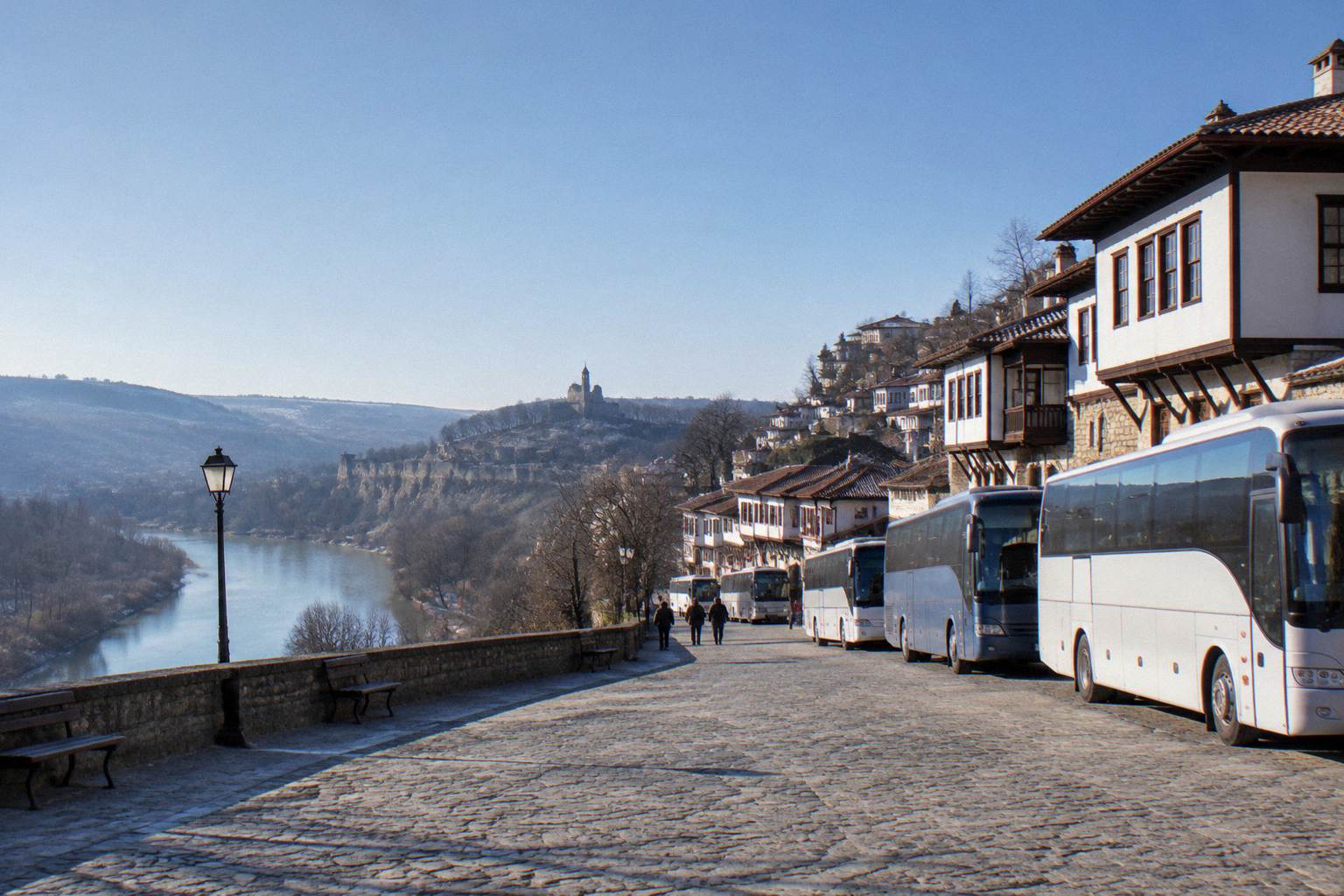
Parking In Veliko Tarnovo: Blue Zones And Old Town Access
Veliko Tarnovo is built on hills above the Yantra river, and its old quarters are pedestrian territory first. Here is what that means for a car, where a car helps, and how to manage without one.
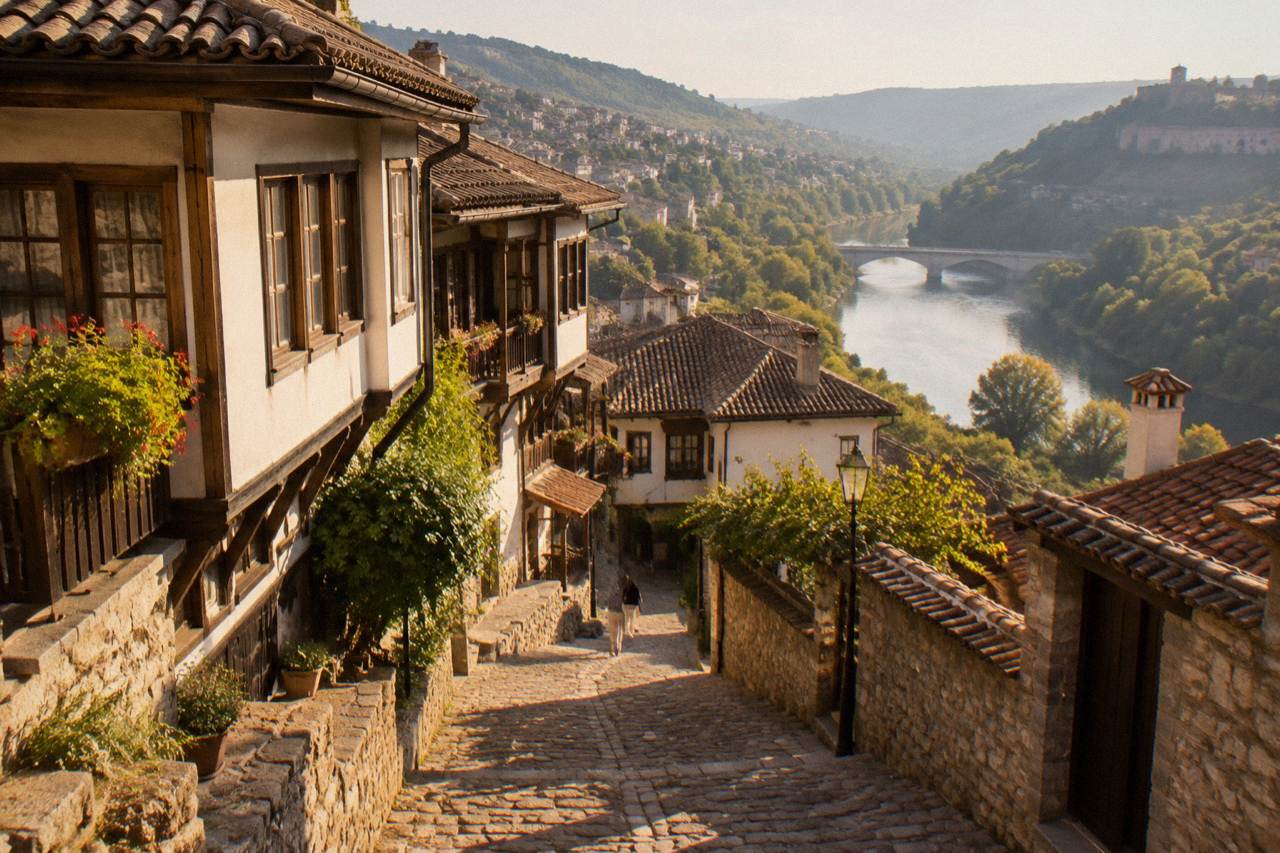
The old quarters of Veliko Tarnovo sit on hills and are best explored on foot; confirm parking arrangements with your accommodation before arriving, and hire a car mainly for the Etar, Tryavna, Dryanovo and Emen day trips.
Veliko Tarnovo, an inland city in Bulgaria on the Yantra river, was the capital of the Second Bulgarian Kingdom for more than two centuries, and its historic core still follows the medieval logic of the terrain: ridges, slopes and a river bend rather than a grid. That layout is the single most important fact about bringing a car here. The fortress hill of Tsarevets, the Varosha old quarter, General Gurko Street and Samovodska Charshiya are places you move through slowly, on foot, and the practical question for a driver is where to leave the car while you do that. This guide works through the question in order: whether you need a car at all, what to sort out with your accommodation, which sights cluster together once you are parked, and which day trips from the city genuinely justify four wheels.
Do You Need A Car In Veliko Tarnovo?
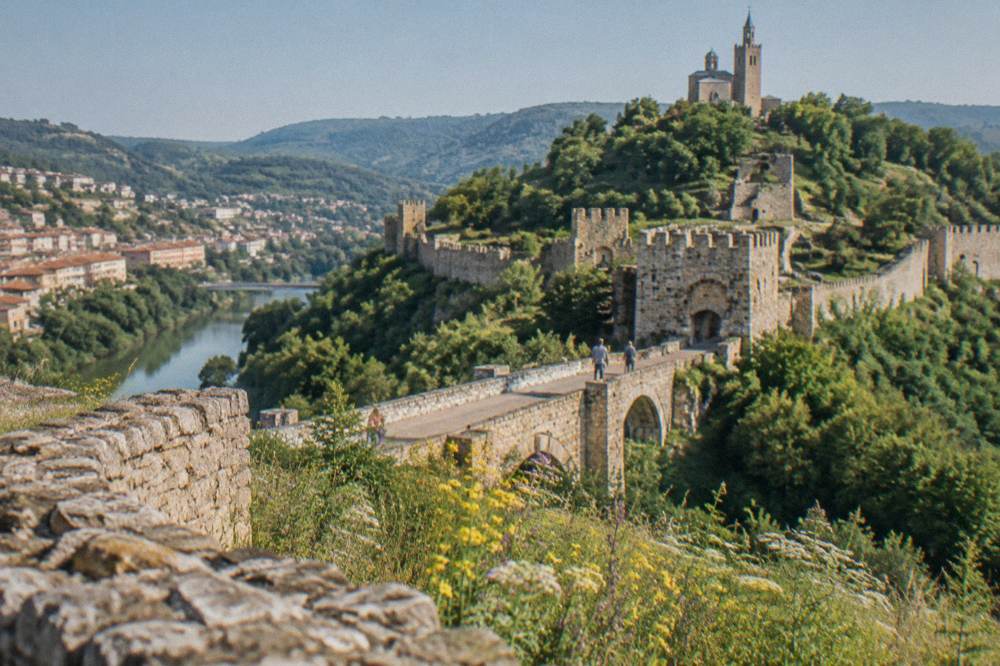
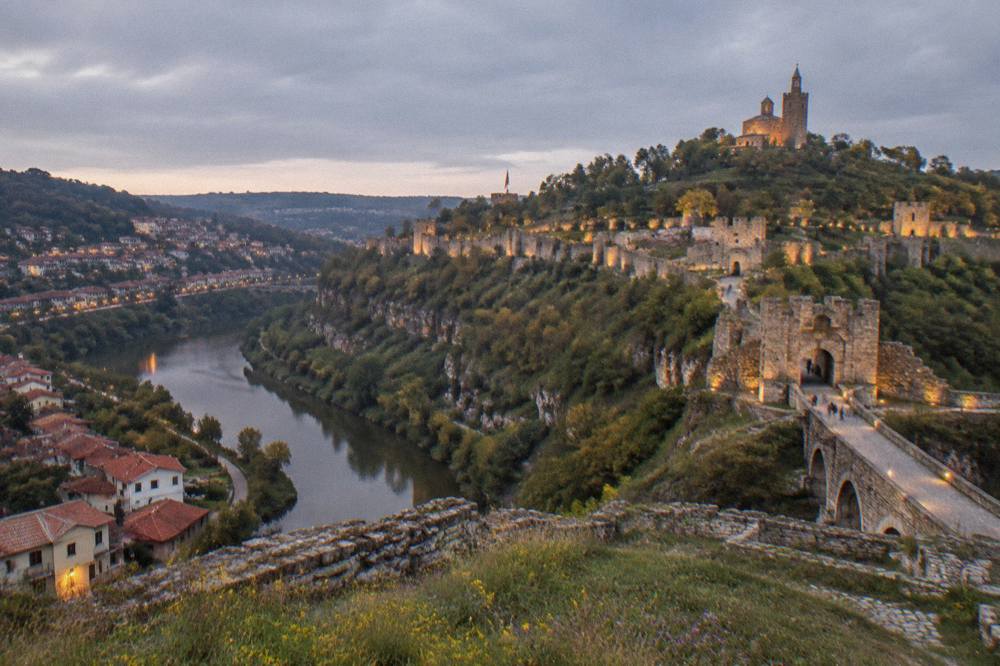
For the city itself you do not need a car, because the sights that define a visit to Veliko Tarnovo sit close together on and around the hills above the Yantra, and the open public spaces are free and open at all hours. The Asenevtsi Monument, Samovodska Charshiya, General Gurko Street and the Varosha old quarter are public spaces with no ticket and no gate. Tsarevets, Trapezitsa and the Forty Martyrs church are ticketed museum sites within easy reach of the centre. A car adds nothing to that circuit, and on the narrow lanes of the old quarters it mostly adds friction.
The municipal tourism site presents the city exactly that way, as a compact historic core on the river rather than a spread-out destination. The municipality had an estimated 77,067 residents on 31 December 2025, and the town itself is small enough that the fortress, the old streets and the central square form one continuous walkable zone. The practical pages on getting around Veliko Tarnovo cover the car-free options in detail, and the consensus of every official description of the city is the same: the old quarters sit on hills and are best done on foot.
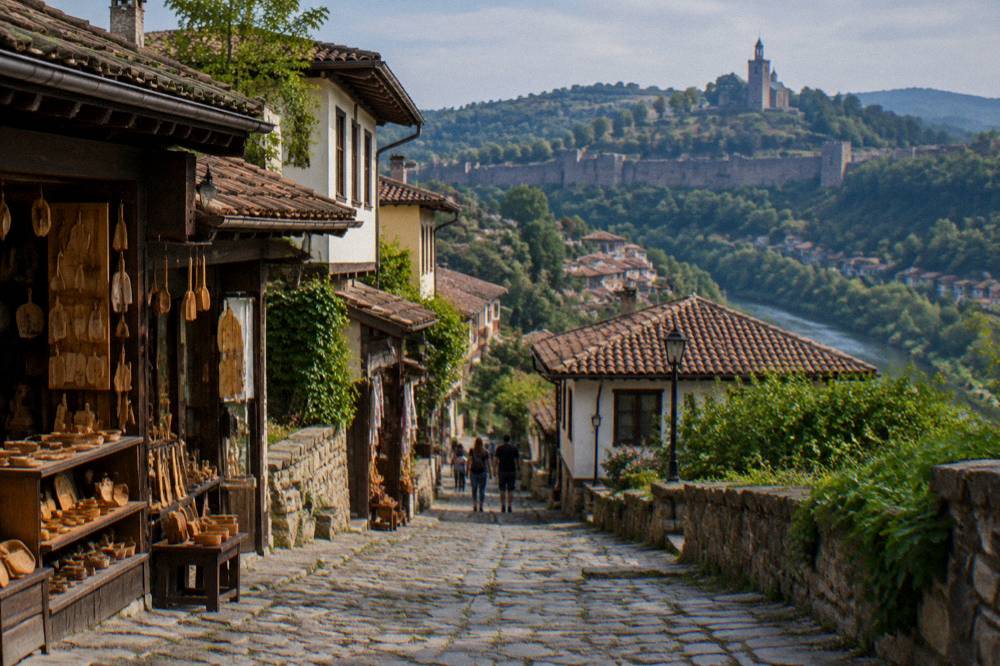
That is not a limitation but the point of the place. The Varosha quarter and Gurko Street are lanes of revived houses, and the Asenevtsi Monument stands where the river bend is at its most photographed. None of it rewards a windshield. If your base is in the centre, plan to arrive, park, and not touch the car again until a day trip calls for it.
| Public space | Ticket | Access |
|---|---|---|
| Asenevtsi Monument | free | open public space, all hours |
| Samovodska Charshiya | free | open public space, all hours |
| General Gurko Street | free | open public space, all hours |
| Varosha old quarter | free | open public space, all hours |
| Sound and Light, viewed from Tsar Asen I Square | free | on announced evenings only |
The Sound and Light show deserves its own note in this table: it runs on announced evenings only, with no fixed nightly schedule, and watching it from Tsar Asen I Square in front of Tsarevets costs nothing. Check the show's own announcements for dates rather than assuming a nightly performance.
Where Should You Leave A Car When Staying In Veliko Tarnovo?
The short answer is to confirm parking directly with your accommodation before you arrive, because the old quarters are hillside streets where hotel parking is arranged property by property rather than by a single citywide scheme a guide can quote. Every hotel, guesthouse and family hotel in the centre handles arrivals differently, and the reservation is the place to settle it. Ask two questions when booking: whether the property has its own parking, and how close a car can actually get to the door on the old lanes. If you are staying outside the centre, ask the same questions there, since the hills do not stop at the edge of Varosha.
The reason no page can hand you a tariff card is straightforward: the old town is a living quarter on steep terrain, not a purpose-built car park. What can be stated plainly is the practical geometry. The centre, the fortress entrance, the Asenevtsi Monument and the walk into Varosha all sit within one continuous zone, so a single secure parking arrangement at your base covers the whole visit. Once the car is settled, the one day in Veliko Tarnovo circuit needs nothing with an engine.
For visitors combining the city with the wider region, the same rule applies in Arbanasi, the village about 2.8 km straight-line northeast of the centre. Confirm with your host there too. The churches of Arbanasi are ticketed museum sites with their own hours, and arriving on foot from village accommodation is far simpler than circling lanes looking for a space.
Once the car is parked and the day belongs to the city, the paid products that suit a car-free visit are the compact ones. A self-guided audio tour covers the fortress and the city at your own pace, the Illusions museum adds an indoor stop, and a combined Etar open-air museum trip waits for a later driving day.
Is The Old Town Of Veliko Tarnovo Closed To Cars?
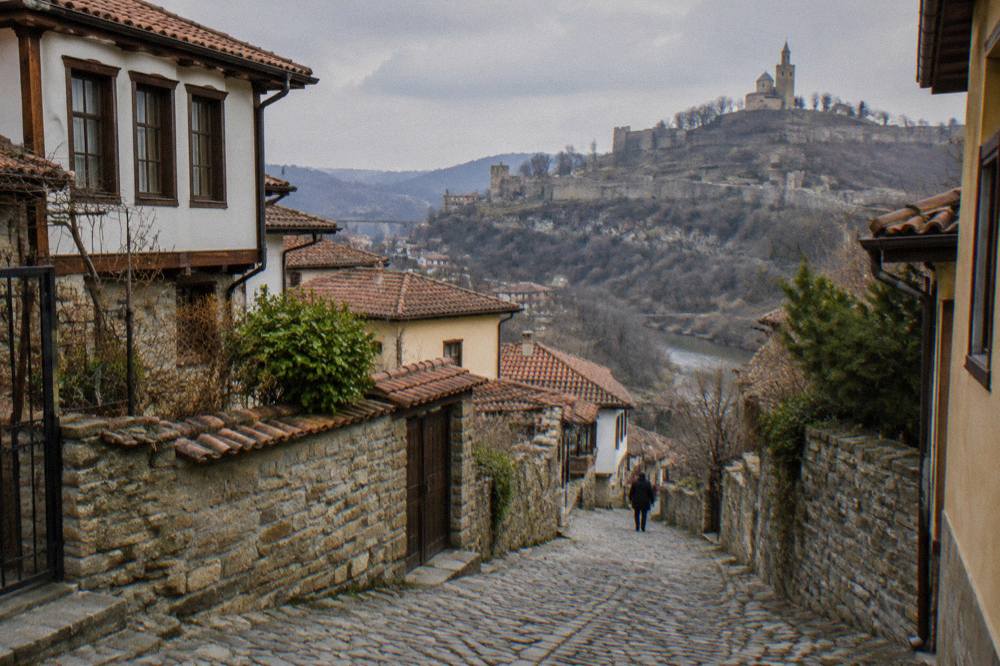
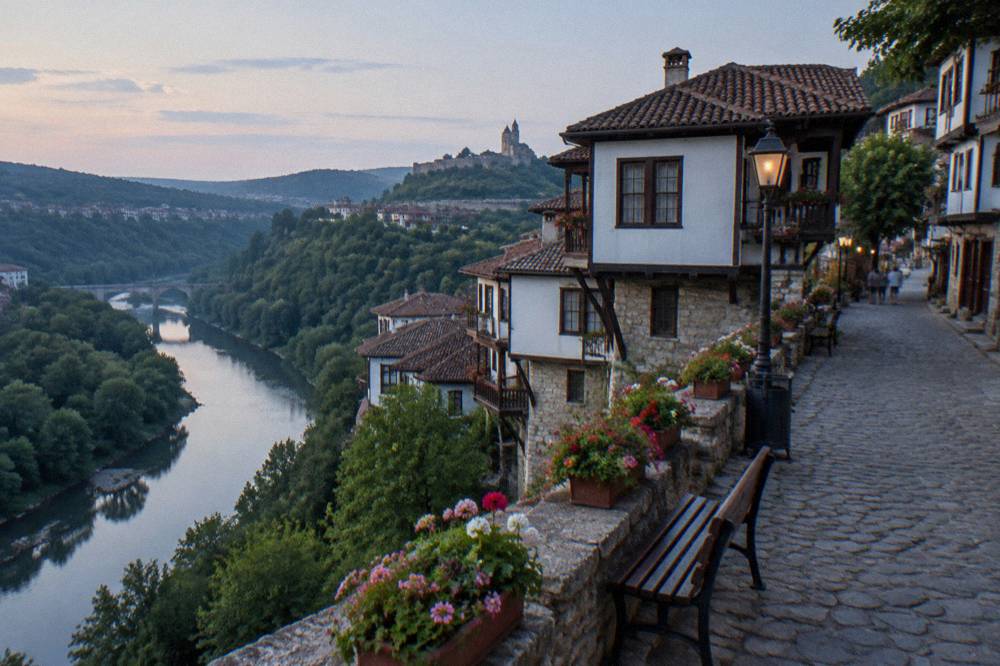
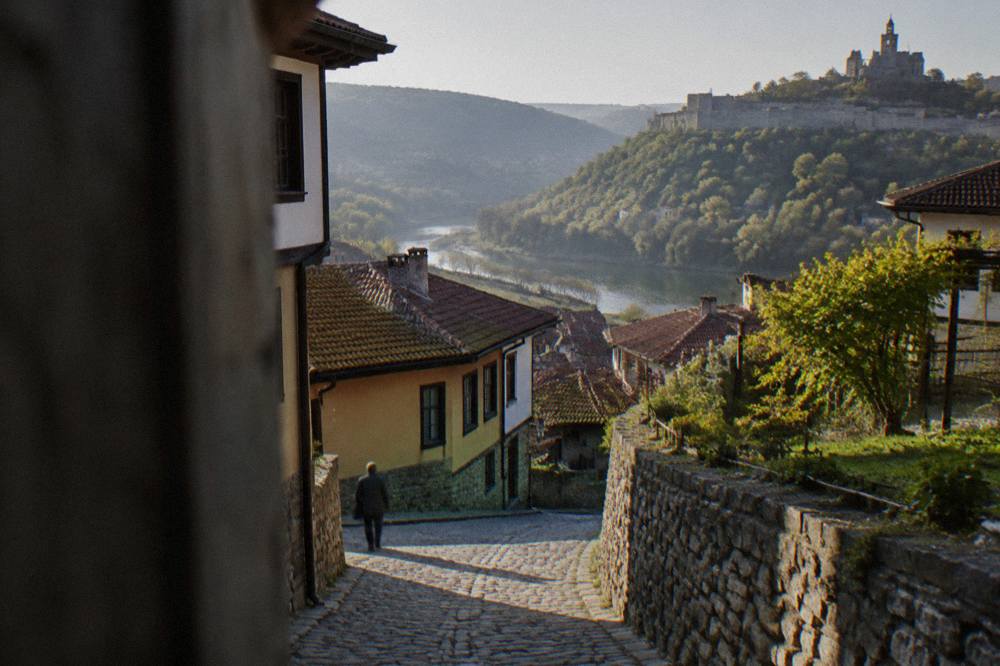
The old quarters are not a museum precinct with barrier gates, but they are hillside streets, with the Varosha quarter, General Gurko Street and the lanes around Samovodska Charshiya laid out for an era long before the automobile, and they are best done on foot. Treat the question as terrain rather than regulation. The streets rise from the Yantra towards the ridges, they are narrow, and everything you came to see along them is experienced at walking pace anyway. Rather than testing what a car can physically reach, plan around what it should reach: your accommodation, and nothing more.
Confirming the vehicle side of things with your host, as above, settles the only decision that matters. On the walking side, the ticketed sights cluster conveniently. The table below lists the main museum sites with their adult tickets and seasonal hours exactly as the Regional Museum of History prints them, which is the planning skeleton for a car-free day.
| Museum site | Adult ticket | Summer hours (April to September) |
|---|---|---|
| Tsarevets Architectural-Museum Reserve | 7.67 euro | daily 08:00 to 20:00, last entry 19:00 |
| Trapezitsa Architectural-Museum Reserve | 5.11 euro | daily 09:00 to 19:00, last entry 18:00 |
| Church of the Holy Forty Martyrs | 5.11 euro | daily 09:00 to 18:00, last entry 17:30 |
| Archaeological Museum | 5.11 euro | daily 09:00 to 18:00, last entry 17:00 |
| Tsarevgrad Tarnov multimedia visitor centre | 7.67 euro | daily 09:00 to 19:00, last entry 18:00 |
Two seasonal flags matter for planning. Winter hours at the museum sites start on 25 October 2026, and Trapezitsa is closed to visitors from 30 November 2026 to 31 March 2027. The Trapezitsa funicular stops for the season on 31 October 2026. A family ticket at Tsarevets, covering parents and up to three children aged 7 to 18, is 10.23 euro; children under 7 enter free across the museum network. The two-day pass covering 10 museum sites costs 20.45 euro for an individual and is valid 1 April to 30 November.
The fortress is the anchor sight, and an audio format suits the hill: you set the pace, the audio does the narrative, and there is no group timetable pulling you off a viewpoint. The tour's own page carries the current details, and you can pair it with the internal Veliko Tarnovo audio tour page or go straight to the operator: Check availability.
Which Day Trips From Veliko Tarnovo Justify Hiring A Car?
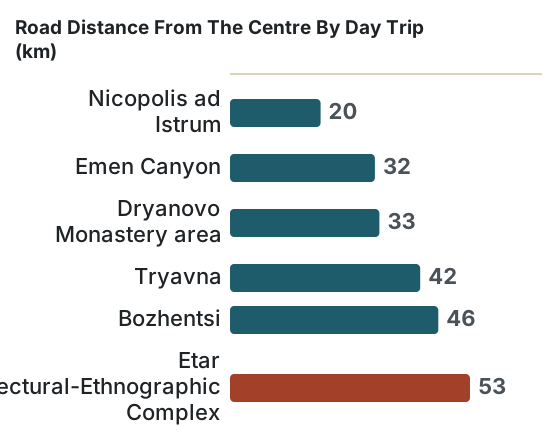
A car earns its keep on the regional day trips, above all to Etar, Tryavna, the Dryanovo Monastery area and Emen Canyon, which lie roughly 32 to 53 road kilometres from the centre and are the journeys where driving saves the most hassle. The open-air museum at Etar is about 53 km away by road, Tryavna about 42 km, the Dryanovo Monastery about 33 km and Emen Canyon about 32 km, with Bozhentsi about 46 km. For those loops, a hire car or a booked day tour both work, and the choice comes down to how much of the driving you want to do yourself.
Etar is the easiest case to make. The Architectural-Ethnographic Complex at Gabrovo is open all year with no days off, and its ticket page lists an adult ticket of 7.16 euro, pupil and student entry at 3.07 euro, pensioner entry at 4.09 euro, and free entry for children under 7. A combined Etar and Veliko Tarnovo product is also on the roster as a booked alternative to driving it yourself.
| Day trip destination | Road distance from the centre | Ticket status |
|---|---|---|
| Nicopolis ad Istrum | about 20 km | 5.11 euro |
| Emen Canyon | about 32 km | natural site |
| Dryanovo Monastery area | about 33 km | check locally |
| Tryavna | about 42 km | check locally |
| Bozhentsi | about 46 km | check locally |
| Etar Architectural-Ethnographic Complex | about 53 km | adult 7.16 euro |
Nicopolis ad Istrum, the Roman site in the village of Nikyup, is the quiet member of that list and the only one on UNESCO's Tentative List (since 1984). The Regional Museum of History runs it with an adult ticket of 5.11 euro. Its hours run 09:00 to 18:00 from April to September, 09:00 to 17:00 in October, and 09:00 to 16:30 from November to March, with visits in the 2025/26 winter arranged by appointment. Check the current price on the official ticket page before booking any secondary day-trip sight, since figures for Bacho Kiro cave, Krushuna Falls, Devetashka Cave, Tryavna's museums, Bozhentsi, Shipka and the Kazanlak museums are not carried on primary pages.
Emen Canyon has one figure worth knowing precisely: the municipal tourism site places it about 20 km west of Veliko Tarnovo, a gorge of the Negovanka river where Lower Boaz has 90 m sheer cliffs. By the mapped road route it is about 32 km. Either way it is a half-day loop that pairs naturally with a car.
If driving the Gabrovo loop yourself does not appeal, the booked Etar-and-city combination covers the open-air museum and the old capital in one product, and leaves the parking question entirely to the operator.
How Do You Arrive In Veliko Tarnovo Without A Car?
Trains and buses reach the city directly from Varna, Ruse and Sofia, with no direct train from Sofia (a change at Gorna Oryahovitsa is standard), and the fastest Sofia connections take 4 h 33 min on the current BDZ timetable. From Varna there is one direct train at 3 h 53 min, and from Ruse a direct one at 2 h 25 min. Buses from Sofia take about 3 to 3.5 hours with several operators, running from the Yug bus station at 74 Hristo Botev Boulevard near the centre, while regional routes use the Zapad station on Nikola Gabrovski Boulevard.
No airport with scheduled flights serves the city, so flying visitors arrive through Sofia, about 216 road km away, Varna, about 214, or Bucharest Otopeni, about 205. The full arrival picture, including the train change at Gorna Oryahovitsa station about 10 km from the centre, is laid out in how to get to Veliko Tarnovo, with the airport choice in the nearest airport guide and the station details in the train station guide. Train times change, so check the BDZ timetable before booking.
Flying in through one of them. Book an airport transfer.
| Route | Fastest connection | Notes |
|---|---|---|
| Sofia to Veliko Tarnovo | 4 h 33 min by train | no direct train, change at Gorna Oryahovitsa |
| Varna to Veliko Tarnovo | 3 h 53 min by train | one direct train daily |
| Ruse to Veliko Tarnovo | 2 h 25 min by train | direct connection |
| Sofia to Veliko Tarnovo by bus | about 3 to 3.5 h | several operators, Yug station |
| Bucharest to Veliko Tarnovo by bus | about 3 h 50 min to 4 h 15 min | direct buses |
The pattern that emerges is simple: the city is easier without a car than with one, and the region is easier with one. Arrive by rail or coach, base yourself centrally, and hire a car only for the day-trip loops if the booked tours do not cover them. More on the train station and the bus station sit in their own guides.
What Does A Car-Free Day In Veliko Tarnovo Actually Look Like?
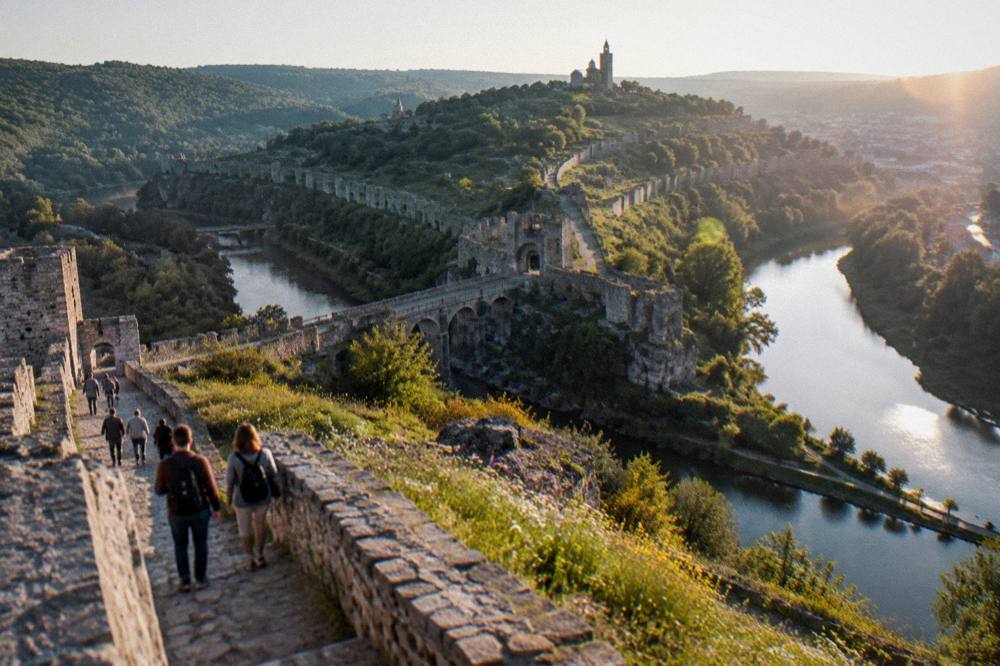
A car-free day runs the fortress in the morning, the old streets through the middle of the day, and Tsar Asen I Square in the evening if a Sound and Light performance is announced, with every leg of it on foot and the whole circuit inside the historic core. Tsarevets opens at 08:00 in the April to September season, the Patriarchal Cathedral on the hill is covered by the same ticket, and the descent lands you within reach of the Forty Martyrs church, where the marble victory column of Ivan Asen II, dating from 1230, commemorates the Battle of Klokotnitsa.
The middle of the day belongs to the lanes. Samovodska Charshiya and Gurko Street cost nothing and are open at all hours, and Varosha wraps around the slope below them. The Archaeological Museum, adult ticket 5.11 euro, sits on Sylvester Penov Street for a rainy alternative, and the Tsarevgrad Tarnov multimedia centre adds a wax-figure stop at 7.67 euro. Food stops are covered in the restaurant guide and the Bulgarian food primer; the cost guide puts the museum tickets in budget context, and every price is in euro, since Bulgaria adopted the currency on 1 January 2026 at the fixed rate of 1.95583 lev per euro.
Evening is the free spectacle. Sound and Light, the audio-visual show on Tsarevets, runs on announced evenings only, and the viewing from Tsar Asen I Square costs nothing. There is no fixed weekly schedule, so check the show's announcements or ask at the Tourist Information Centre. A paid option puts you on the panoramic platform; confirm current prices at booking. If the evening is quiet instead, the nightlife guide covers what stays open after dark.
A seasonal planning table for the year round:
| Season | ERA5 reanalysis, 1991-2020 | What it means for walking the hills |
|---|---|---|
| July and August | mean daily highs 27.6 C and 28.1 C | fortress circuit best in the morning |
| May and June | 95.7 mm and 85.0 mm of rain | the two wettest months in the table |
| January | mean daily high 4.9 C, low -3.8 C | winter hours apply, from 25 October 2026 |
| September and October | highs 23.3 C and 17.6 C | October hours at Tsarevets: 09:00 to 18:00 |
For travellers who like structure without a group, a self-guided audio format fits this day exactly. You walk the fortress and the city with commentary on your own schedule, which is the same freedom the car gives up and the walk gives back.
Should You Combine Veliko Tarnovo With A Road Trip?
Yes, if the itinerary runs through northern Bulgaria, because the city sits within about 20 to 53 road km of Emen Canyon, Nicopolis ad Istrum, the Dryanovo area, Tryavna, Bozhentsi and Etar, and within 79 km of Krushuna Falls and the Shipka church, making it the natural overnight base for the loop. The northern Bulgaria road trip pattern works best with one or two nights here: park at the hotel, spend a car-free day on the hills, then drive out on the museum and monastery loops. Beyond the immediate loop, Ruse is about 105 road km, the Kazanlak tomb about 98 km and the Ivanovo rock-hewn churches about 128 km.
The two UNESCO inscribed sites in the region, the Rock-Hewn Churches of Ivanovo and the Thracian Tomb of Kazanlak, both inscribed in 1979, sit at the outer edge of a road-trip radius from the city. Nothing in Veliko Tarnovo itself is inscribed or on the Tentative List, which surprises visitors who assume the fortress carries the label. The full regional picture is in the northern Bulgaria road trip guide and the Bucharest to Sofia route, which uses the city as a waypoint.
For timing the trip, the best time to visit guide and the weather guide carry the month-by-month picture, and the spring and autumn guide covers the shoulder seasons. One dated hook if you are planning far ahead: the Etar International Fair of Traditional Crafts runs 4 to 6 September 2027 in its 20th edition, a natural anchor for a Gabrovo loop.
Common Questions About Parking In Veliko Tarnovo
Where can I park in Veliko Tarnovo?
Confirm parking directly with your accommodation before arriving. The old quarters are hillside streets best explored on foot, and each hotel and guesthouse makes its own parking arrangements, so there is no single citywide arrangement a guide can quote in advance.
Is the old town of Veliko Tarnovo car-free?
Treat it as pedestrian territory in practice. Varosha, General Gurko Street and Samovodska Charshiya are free public spaces open at all hours, laid out on hills long before cars, and every sight in them is experienced at walking pace. Park at your base and walk.
Do I need a car in Veliko Tarnovo?
No. The fortress, the old streets, the Asenevtsi Monument and the central square form one walkable zone, and trains and buses reach the city from Sofia, Varna, Ruse and Bucharest. A car only earns its keep on the regional day trips such as Etar, Tryavna, Dryanovo and Emen Canyon.
Can I visit Veliko Tarnovo by train?
Yes. There is no direct train from Sofia, with changes at Gorna Oryahovitsa and a fastest connection of 4 h 33 min on the current BDZ timetable. Varna has one direct train at 3 h 53 min and Ruse a direct one at 2 h 25 min. Check the BDZ timetable before booking, as times change.
Is parking free anywhere in Veliko Tarnovo?
The reliable approach is to arrange parking through your accommodation and treat the car as parked for the duration of your city sightseeing, which the compact, walkable core makes easy.
What about parking in Arbanasi?
Arbanasi lies about 2.8 km straight-line northeast of the centre, and its churches and Konstantsalieva House are ticketed museum sites with seasonal hours. As in the city, confirm parking with your host there before arriving, and note that Konstantsalieva House opens Friday to Sunday only from 30 November 2026 to 20 March 2027.
The final word on the car is the simplest one: park it at your accommodation, confirm that arrangement when you book, and spend your time in Veliko Tarnovo the way the hills intend, on foot between the fortress, the old lanes and the square. For more on the wider region, see what the Veliko Tarnovo Travel Guide covers across its attraction, day-trip and itinerary pages, or start with the city's history and the old capital question.