Banitsa, Boza And The Bulgarian Breakfast
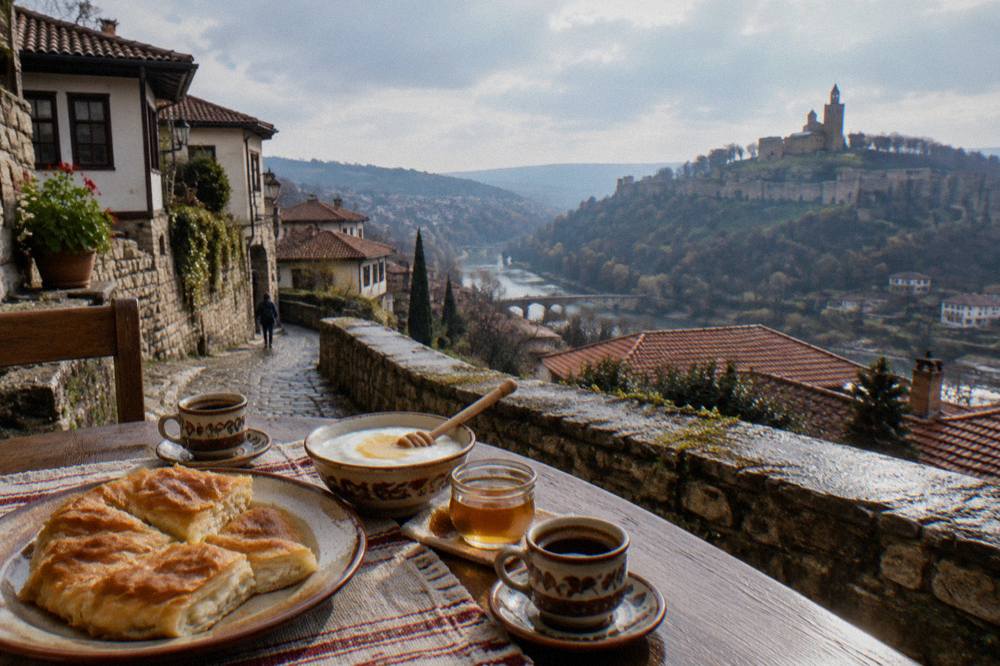
Banitsa is the filo pastry pie that anchors the Bulgarian breakfast, and in Veliko Tarnovo it is eaten on the run, at a table, or warm out of the oven with boza beside it. This is what the meal actually contains and how it fits a morning in the old capital.
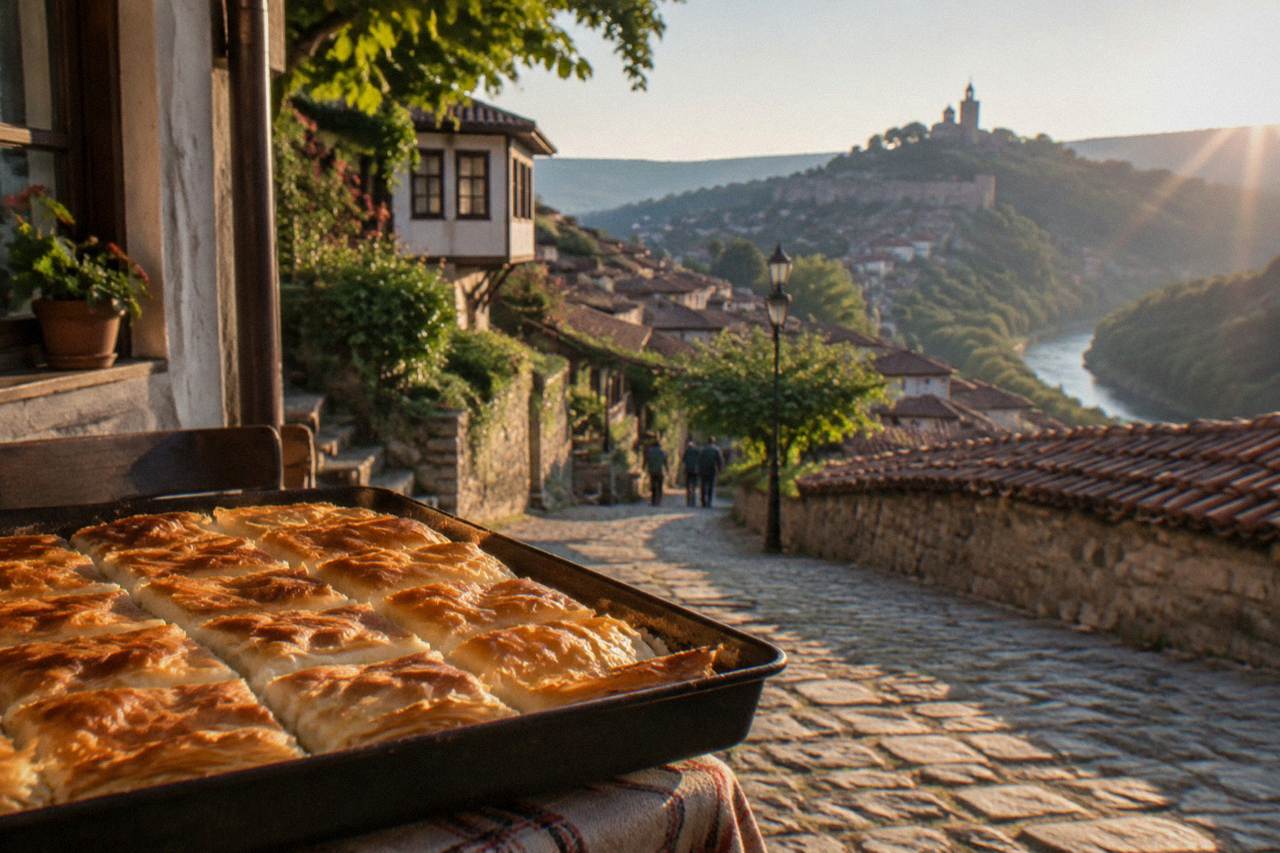
Banitsa is a baked filo pastry pie filled most often with sirene cheese and eggs, eaten across Bulgaria at breakfast and sold by the piece. In Veliko Tarnovo it pairs with boza, a thick fermented grain drink, or ayran, and it costs little because Bulgaria has used the euro since 1 January 2026 with prices printed in euro at museum counters.
Banitsa is the dish that answers the Bulgarian breakfast, and in Veliko Tarnovo, the former capital of the Second Bulgarian Kingdom on the Yantra river, it is the smell of the morning as much as the food of it. This guide covers what banitsa is, what goes inside it, what boza and ayran have to do with it, how the meal fits the rhythm of a day among Tsarevets, Trapezitsa and Samovodska Charshiya, and what the practical facts of eating in Bulgaria look like now that the country uses the euro. Nothing here depends on any single bakery or cafe, because the point of the Bulgarian breakfast is that it is a national custom rather than one address. For the wider table beyond the morning, start with the companion page on Bulgarian food in Veliko Tarnovo.
What Is Banitsa And Why Is It The Bulgarian Breakfast?
Banitsa is a baked pie made from thin filo pastry sheets layered with a filling, rolled or folded, and baked until the top turns deep gold, and it is eaten across Bulgaria at breakfast, at festive tables and as a hand-held snack sold by the piece. The standard filling is sirene, a brined white cheese, beaten with eggs, though the word covers a family of sweet and savoury versions. It is a home dish and a street food at once, which is why it anchors the morning meal.
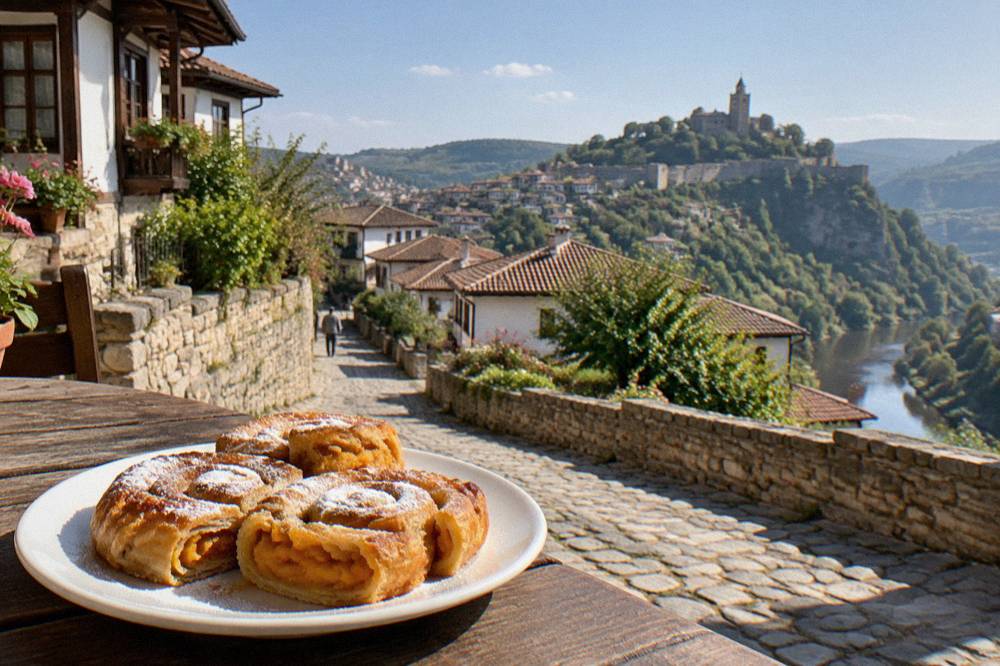
The pastry is the constant. Sheets of filo, thin enough to read through, are stacked with filling between them or rolled around it, brushed with butter or oil, and baked until the layers separate into crisp leaves. In the classic version the filling is sirene crumbled into eggs, sometimes thinned with yogurt or sparkling water so it stays soft while the pastry crisps. The pie is cut into squares or spiral slices and eaten warm or at room temperature, standing at a counter or sitting down with a drink beside it.
No restaurant, bakery, mehana or cafe in Veliko Tarnovo is named on this page, and no meal price is printed. What can be said is the custom itself: banitsa is eaten everywhere in the country, all year, and it crosses the line between everyday food and celebration food. On holidays, particularly around Christmas and New Year, households bake banitsa with lucky charms or written wishes folded into the pieces, a custom called gaguzilne in some regions, and each person's piece is said to hint at their year. That festive layer sits on top of an utterly ordinary one, the square of banitsa bought in the morning and eaten on the move.
For travellers planning the whole day rather than only the morning, the site's root page on things to do in Veliko Tarnovo lists the paid and free sights, and the question of timing is covered in the best time to visit Veliko Tarnovo.
What Does A Bulgarian Breakfast In Veliko Tarnovo Look Like?
A Bulgarian breakfast in Veliko Tarnovo is built around baked or fried dough plus dairy: a square of banitsa or a mekitsa, a fried disc of yeast dough, sometimes sandwiches with sirene or lyutenitsa, and a drink of boza, ayran or Turkish-style coffee. The meal is quick, savoury-leaning and repeatable every day of the week, and its centre of gravity is cheese rather than sweetness. Sweetness, when it appears, comes from banitsa's own variants rather than a separate dessert course.
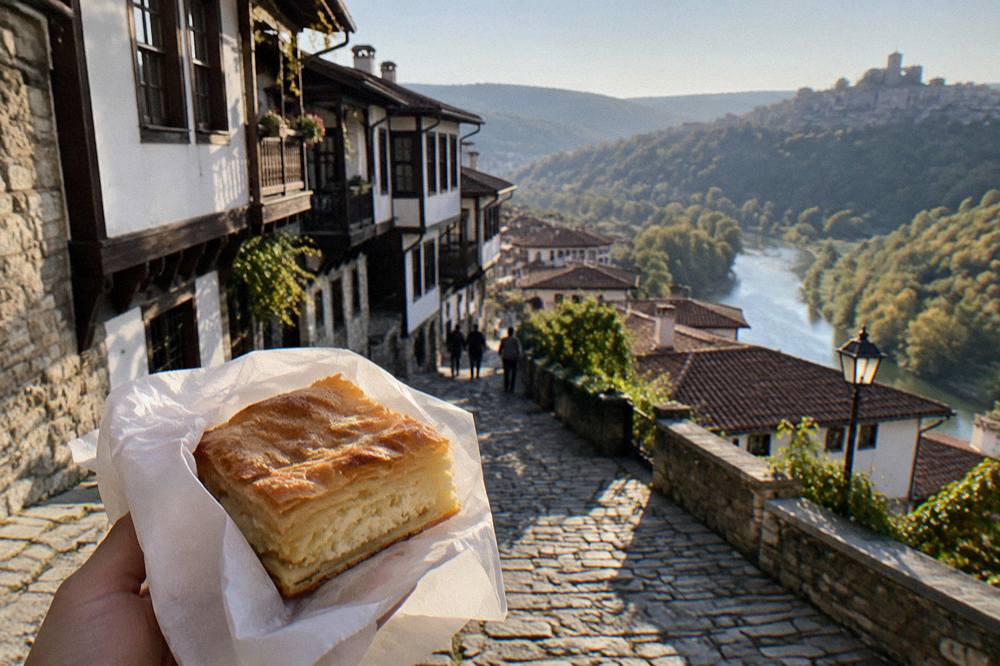
The plate rarely piles up. One or two pieces of banitsa, a drink, maybe fruit or yogurt, and the meal is done. What varies is the format: at home the pie comes out of the oven in a tray; on the street it is sold by the piece, sometimes with a sheet of paper wrapped around it for the walk; at a slower table it arrives with a drink and time. Mekitsa is the other morning constant, a flattened round of leavened dough fried in oil and dusted with sirene or sugar, closer to a fritter than a pastry, and often the weekend version of the weekday banitsa.
Bulgarian yogurt deserves its own word because it is not a generic side. The country's yogurt is made with Lactobacillus bulgaricus, the bacterium named for Bulgaria, and it is eaten plain, with honey or jam, or strained thicker. At breakfast it appears in a bowl or inside the dough dishes themselves, where yogurt stirred into an egg filling keeps banitsa's middle soft. Sirene, the brined white cheese, plays the role that feta plays elsewhere in the Balkans, and it shows up at every meal of the day, crumbled over salads, melted into pastry or simply cut into slices.
| Dish | What it is | When it is eaten |
|---|---|---|
| Banitsa | Filo pastry layered or rolled with a filling, baked | Every day, all year |
| Mekitsa | Fried yeast dough disc, dusted with cheese or sugar | Weekends, leisurely mornings |
| Snezhanka sandwich | Bread with sirene, butter and cucumber | Quick weekday mornings |
| Kiselo mlyako | Bulgarian yogurt with Lactobacillus bulgaricus | Any meal, including breakfast |
| Boza | Thick, lightly fermented grain drink | The traditional banitsa partner |
| Ayran | Thinned yogurt drink with salt | Warmer months |
A morning built around food can still end among the sights. One indoor option that pairs well with a slow breakfast day is the Check availability link for the Illusions Museum in Veliko Tarnovo, an entry ticket that fits the kind of morning where plans stay flexible and the weather does not matter. The site's guide to eating out in Veliko Tarnovo covers the full spread of the city's food culture for the rest of the day.
What Goes Into A Banitsa: Fillings And Shapes?
The classic banitsa filling is sirene cheese beaten with eggs, and around that centre the family branches into sweet versions filled with pumpkin or milk custard, meat versions, spinach versions and plain cheese-and-yogurt versions. The shapes branch too: rolled spirals, flat stacked trays, horseshoe coils and individual parcels all appear, and every one of them is still called banitsa. The filling decides whether the pie reads as breakfast, dessert or a full meal.
The cheese and egg filling is the everyday standard. Sirene is crumbled fine, beaten into eggs, loosened with yogurt or soda water, seasoned sparingly, and poured between the filo layers. Pumpkin banitsa, tikvenik, is the great sweet counterpart: grated pumpkin mixed with sugar and cinnamon, rolled tightly in filo so the slices show a spiral, and finished with a syrup of sugar and water poured over the hot pastry. It belongs to autumn and the winter holidays, and it is closer to dessert than breakfast, though the line blurs. Milk custard banitsa, mlechna banitsa, bakes the filo soaked in a sweet milk and egg mixture so it sets soft, almost like a pudding under a crisp lid.
Then there is the category of small rolled pieces, banichki, cigar-shaped parcels eaten by hand, and the coiled horseshoe version that some households bake for name days and holidays. Meat fillings exist, usually with onions, and greens appear too, leeks or spinach with cheese. The ingredients are flour, a fat, a filling, and an oven, which is why it travelled so completely through the country's kitchens.
| Version | Filling | Character |
|---|---|---|
| Classic | Sirene, eggs, yogurt or soda water | Everyday, savoury |
| Tikvenik | Grated pumpkin, sugar, cinnamon, syrup | Sweet, autumn and winter |
| Mlechna | Milk, eggs, sugar poured over filo | Soft, custard-like |
| Zelnik | Leeks or greens with cheese | Savoury, regional |
| Mesna | Minced meat with onions | Hearty, meal-sized |
| Banichki | Any filling, small rolled parcels | Hand-held snack |
A note on honesty: no bakery, producer or vintage is named anywhere in this guide, and no origin date for banitsa is claimed, because the dish's history is not the kind of fact this site prints. The customs described here are general Bulgarian practice, and the city's own tables, from the city centre to Arbanasi, follow it.
What Is Boza And What Do Bulgarians Drink At Breakfast?
Boza is a thick, mildly fermented drink made from fermented grains, wheat, millet or rye, with a dense texture, a dark caramel colour and a sweet-and-sour taste that has no close equivalent in western European drinks, and it is the traditional partner to banitsa in the Bulgarian morning. Alongside it stand ayran, a salted thinned yogurt drink, and coffee prepared Turkish-style in a small pot.
Boza is the drink that surprises visitors first. It pours slowly, coats the glass, and lands somewhere between a beverage and a porridge. The fermentation is light, enough to give a faint tang and a low alcohol trace, and the grain base gives it a malt-like sweetness. The pairing with banitsa is a national institution: the sweet, dense drink against the salty, fatty pastry, one warming the other. Sprinkled cinnamon or roasted chickpeas on top are traditional garnishes in some parts of the country.
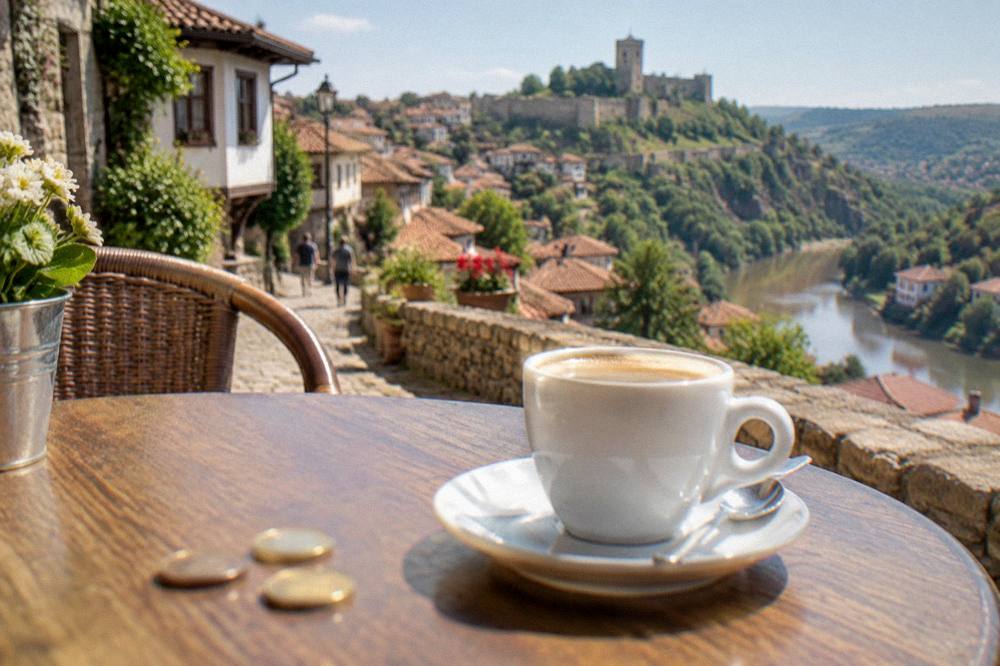
Ayran runs in the opposite direction, cold, thin and salty, made by whipping yogurt with water and salt. It is the summer counterpart to boza's winter weight, and it accompanies grilled food as readily as breakfast. Coffee, meanwhile, is brewed strong in a small long-handled pot and served in tiny cups, sometimes with a sweet on the side, and tea with herbal infusions, mountain tea or mint among them, holds its own place at the winter table.
| Drink | What it is | Traditional partner |
|---|---|---|
| Boza | Fermented grain drink, thick and sweet-sour | Cheese banitsa |
| Ayran | Salted yogurt drink, thin and cold | Grills, summer meals |
| Bulgarian coffee | Brewed in a small pot, served in tiny cups | Any pastry |
| Kiselo mlyako | Plain Bulgarian yogurt | Mekitsa, honey |
| Tea with herbs | Mountain tea, mint or chamomile infusions | Winter mornings |
For the alcoholic half of the Bulgarian table, which begins later in the day than breakfast, the site carries a separate guide to rakia and Bulgarian wine, and the evening side of the city is covered in the page on Veliko Tarnovo nightlife.
Is Banitsa Sweet Or Savoury In Veliko Tarnovo?
Both, and the choice is made by the filling rather than the name: cheese and egg banitsa is savoury and is the default breakfast, while tikvenik with pumpkin and mlechna banitsa with milk custard are sweet and lean toward the holiday table and the afternoon. In Veliko Tarnovo, as across Bulgaria, nobody treats the two as rivals, and a single tray of each can sit side by side at a family table.
The savoury pie is the workhorse. It cuts into tidy squares, holds its shape in the hand, and delivers enough fat and protein from cheese and eggs to stand in for a full meal. The sweet versions are more occasion-bound. Tikvenik appears when pumpkins are in season, from autumn through winter, and it carries the smell of cinnamon the way a Christmas market carries woodsmoke. Mlechna banitsa is softer, eaten from a dish with a spoon, and it is the one that most often replaces a dessert rather than precede it. The wider set of guides lives on Veliko Tarnovo Travel Guide.
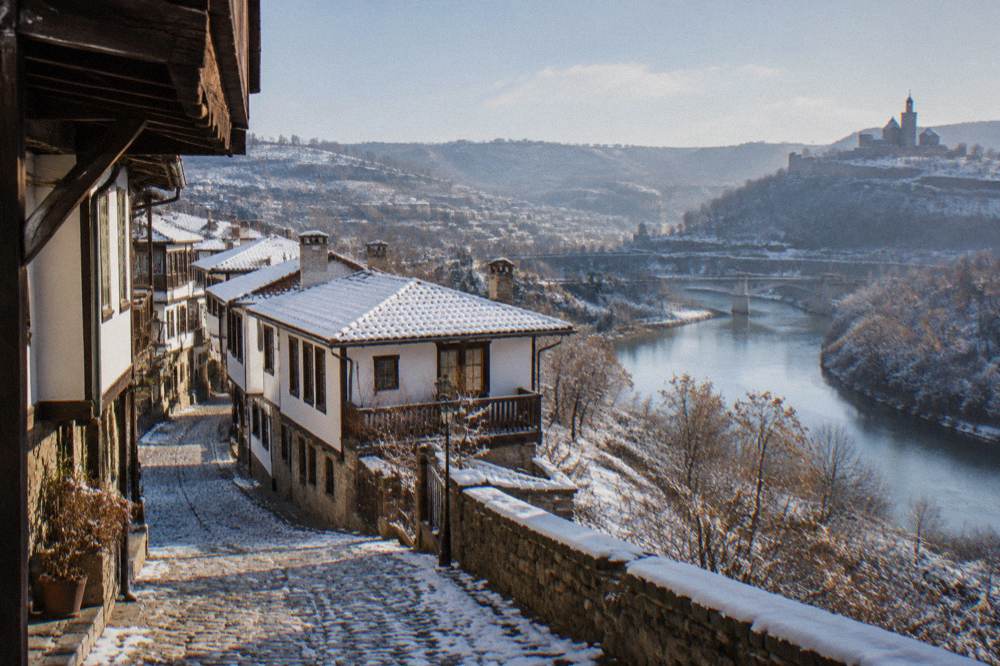
The seasonal rhythm matters to a traveller because Veliko Tarnovo's year is strongly seasonal. The city's climate, per the ERA5 reanalysis for 1991-2020, is continental: mean daily highs of 27.6 C in July and 28.1 C in August against 4.9 C in January, with a mean daily low of -3.8 C in January and rain peaking at 95.7 mm in May. A warm pastry and a cold ayran suit a July morning on a terrace; a hot boza suits a January one with snow on the Tsarevets hill. The full breakdown lives on the Veliko Tarnovo weather page, and the shoulder seasons get their own treatment in the guide to spring and autumn in Veliko Tarnovo.
| Month | Mean daily high (C) | Mean daily low (C) | Rain (mm) |
|---|---|---|---|
| January | 4.9 | -3.8 | 56.1 |
| April | 16.9 | 6.0 | 71.6 |
| July | 27.6 | 17.2 | 79.5 |
| August | 28.1 | 17.1 | 51.3 |
| October | 17.6 | 8.0 | 58.9 |
| December | 6.1 | -1.7 | 60.6 |
Figures are ERA5 reanalysis, 1991-2020, for the grid cell near central Veliko Tarnovo, modelled values rather than a station record.
How Does Breakfast Fit Into A Day In Veliko Tarnovo?
A breakfast-first day in Veliko Tarnovo works because the city's sightseeing is compact and the sights open mid-morning: eat early, walk Samovodska Charshiya, General Gurko Street and the Varosha quarter while the light is low, then take Tsarevets Fortress, which the Regional Museum of History's ticket page lists at 7.67 euro for an adult and 10.23 euro for a family, from 08:00 to 20:00 between April and September, with winter hours from 25 October 2026.
The order of a day is a matter of opening hours, and those are published. Tsarevets, with the Patriarchal Cathedral of the Holy Ascension on the hill, runs on the museum's seasonal schedule and has no closing day, though a two-hour Tuesday maintenance slot from 09:10 appears on the ticket page. Trapezitsa across the river keeps seasonal hours too and closes entirely from 30 November 2026 to 31 March 2027, a date trap worth knowing for a late-autumn visit. The Church of the Holy Forty Martyrs, where Bulgaria's independence was declared on 22 September 1908, charges 5.11 euro per the museum's ticket page. All of this is detailed sight by sight on the pages for Tsarevets Fortress and the walking tour of Veliko Tarnovo.
Breakfast slots neatly in front of all of it. The free spaces, the Asenevtsi Monument, Samovodska Charshiya, General Gurko Street and the Varosha quarter, cost nothing at any hour, and the Sound and Light show on announced evenings is free to watch from Tsar Asen I Square, so a food-heavy morning does not push the day's budget anywhere near the museum prices.
Can You Make Banitsa At Home After Visiting Veliko Tarnovo?
Yes, and it is a forgiving dish to reproduce: filo sheets, a filling of sirene or feta beaten with eggs and a splash of yogurt or soda water, butter or oil between the layers, and about half an hour in a hot oven. The home version is the original version, and every bakery piece sold in Bulgaria descends from a household tray, so a traveller who has eaten it in Veliko Tarnovo has already seen the whole recipe.
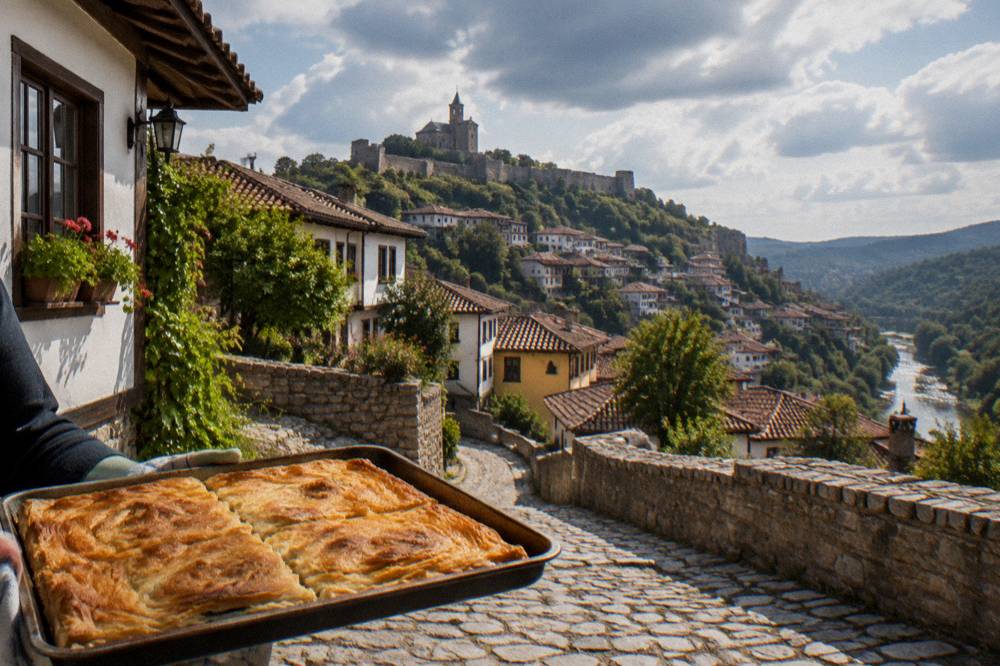
The method is layered rather than precise. Butter a tray, lay filo sheets one at a time, brushing each with fat, dot or pour the cheese and egg mixture in two or three stages, fold the overhanging sheets over the top, and bake until the surface is deep gold. Resting the pie for a few minutes before cutting lets the filling set. Sweet versions swap the cheese for grated pumpkin with sugar and cinnamon, roll the filo into a log, and finish with hot sugar syrup poured over the finished pastry. Substitutions are unproblematic: feta stands in for sirene, ready-made filo for hand-rolled sheets, and the dish tolerates both.
What travels well from the trip is the habit more than the recipe: a warm square of pastry, a glass of something tart beside it, and no hurry. The Bulgarian breakfast is not a ceremony. It is a small daily structure, and it is one of the parts of the country that survives the journey home intact.
What Should You Know About Money When Eating Out In Veliko Tarnovo?
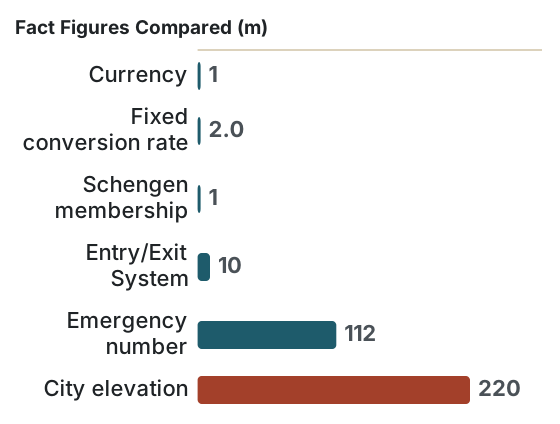
Bulgaria has used the euro since 1 January 2026 at a fixed rate of 1.95583 lev per euro, so every price in Veliko Tarnovo, from a museum ticket to a piece of banitsa, is now quoted and paid in euro, and no visitor needs to convert from the lev any more. The country is also a full Schengen member since 1 January 2025, and the Entry/Exit System has run at all external borders since 10 April 2026.
The changeover matters for small daily purchases because the old lev prices linger in memory and in older travel writing. Museum tickets demonstrate the new reality: the Regional Museum of History prints them in euro, 7.67 euro at Tsarevets and 5.11 euro at Trapezitsa, and the two-day pass covering ten museum sites costs 20.45 euro for an individual. Food prices are not quoted on this page, but the currency that pays for them is settled fact. The practical details, cards, cash and changeover quirks, are collected in the guide to the euro and money in Bulgaria, and the broader budget picture is in the page on Veliko Tarnovo cost.
| Fact | Detail |
|---|---|
| Currency | Euro since 1 January 2026 |
| Fixed conversion rate | 1.95583 lev per euro |
| Schengen membership | Full member since 1 January 2025 |
| Entry/Exit System | Running at all external borders since 10 April 2026 |
| Emergency number | 112, free |
| City elevation | 220 m |
Where Does The Bulgarian Breakfast Sit In The Country's Food Culture?
The Bulgarian breakfast sits at the everyday end of a food culture whose centre of gravity is the table: dough dishes like banitsa and mekitsa, dairy in the form of sirene and Bulgarian yogurt, and preserves like lyutenitsa and honey form the morning layer, while grills, stews and salads carry the afternoon and evening, and rakia and wine open the longer meals. Breakfast is deliberately light so the later tables can be long.
That structure explains why banitsa, a dish with almost no ceremony attached, ends up representing the country so completely. It is the piece of Bulgarian food culture that repeats daily, that crosses every region and every season, and that needs nothing beyond flour, cheese and an oven. The rest of the cuisine is more situational: shopska salad with its cheese snowfall, kebapche and karnache grilled over coals, slow stews and stuffed vegetables, all of which belong to the lunch and dinner table and to the mehana tradition. Those dishes and their customs fill the site's food pages, beginning with Bulgarian food and the city's own restaurant culture.
Food is also a fair reason to time a visit. The folklore festival ran 18 to 25 July in 2026, Arbanasi Summer Music filled the village churches from 15 to 25 July 2026, and the Christmas market in Marno Pole park follows a late-November-to-1-January pattern, dates announced by the municipality closer to each season. Each of those moments changes what the morning tastes like around it, warm drinks in December, terrace mornings in July, without changing the dishes themselves. The calendar is collected in the guide to festivals and events in Veliko Tarnovo.
A food-centred visit can stretch outward too. The Monastery of the Holy Transfiguration of God, about 6 km from the centre, is one of the monasteries that ring the city, and a self-guided visit there makes a calm counterpart to the pastry-and-museum mornings, as does a monasteries and waterfalls tour from Veliko Tarnovo that covers several of the region's religious sites in a single loop. The wider set of options, from Emen Canyon to Etar, is laid out in the site's collection of guides, and arrival logistics, trains, buses and airports, are covered under how to get to Veliko Tarnovo.
The pairing of a simple morning with a full afternoon is really the whole argument of this page. Banitsa asks nothing of the day and gives it a shape, and the city around it, fortress hill, river bend, market street, supplies everything the breakfast does not.
Common Questions About The Bulgarian Breakfast In Veliko Tarnovo
What is banitsa?
Banitsa is a baked Bulgarian pie made of filo pastry sheets layered or rolled with a filling, classically sirene cheese beaten with eggs. Sweet versions include tikvenik with pumpkin and mlechna banitsa with milk custard. It is eaten at breakfast and as a snack, sold by the piece, and baked at home across the country.
What do Bulgarians drink with banitsa?
The traditional partner is boza, a thick, lightly fermented grain drink with a sweet-and-sour taste, sometimes garnished with cinnamon. Ayran, a salted thinned yogurt drink, and coffee brewed Turkish-style in a small pot are the other common breakfast drinks.
Is banitsa sweet or savoury?
Both. The everyday breakfast version with sirene cheese and eggs is savoury, while tikvenik with pumpkin, sugar and cinnamon and the milk custard version are sweet. All of them carry the same name.
What is the difference between banitsa and mekitsa?
Banitsa is baked filo pastry with a filling inside. Mekitsa is a disc of leavened dough fried in oil and dusted with sirene or sugar, closer to a fritter. Mekitsa leans toward leisurely weekend mornings.
Can you eat breakfast cheaply in Veliko Tarnovo?
No meal price is quoted on this page. What is settled is the currency: Bulgaria uses the euro since 1 January 2026 at a fixed rate of 1.95583 lev per euro, so prices are paid in euro. Check prices where you buy.
What is sirene?
Sirene is a brined white cheese made from cow, sheep, goat or buffalo milk, crumbly and salty, used in banitsa, over salads and on the table at every meal. Feta is the closest widely available equivalent.
How Do You Plan A Breakfast-Heavy Day In Veliko Tarnovo?
A breakfast-heavy day in Veliko Tarnovo runs early food, then free streets, then ticketed sights: eat while the morning is quiet, walk Samovodska Charshiya, General Gurko Street and the Varosha quarter at no cost, cross to Tsarevets from 08:00 in the April-to-September season at 7.67 euro per the museum's ticket page, and keep the evening open for the Sound and Light show, free from Tsar Asen I Square on its announced evenings.
Layer the logistics under the food. Arrival, trains and buses are covered in the guide to getting to Veliko Tarnovo, the districts to sleep in are mapped in where to stay in Veliko Tarnovo, and the deeper background of the medieval capital, restored as a state in the late 12th century and fallen to the Ottomans in 1393, fills the history of Veliko Tarnovo page. A first visit fits into the patterns laid out in the one-day and two-day itineraries, either of which leaves room for a proper breakfast at the front of the day.
The square of banitsa is where the day starts, the glass of boza is what makes it Bulgarian, and the fortress above the Yantra is what makes the morning worth getting up for in this particular city.