Bulgarian Phrases, The Cyrillic Alphabet And The Head Nod
Bulgarian is written in Cyrillic and a nod of the head can mean no. A short, practical phrase list, an alphabet decoder and the polite forms that matter in Veliko Tarnovo.
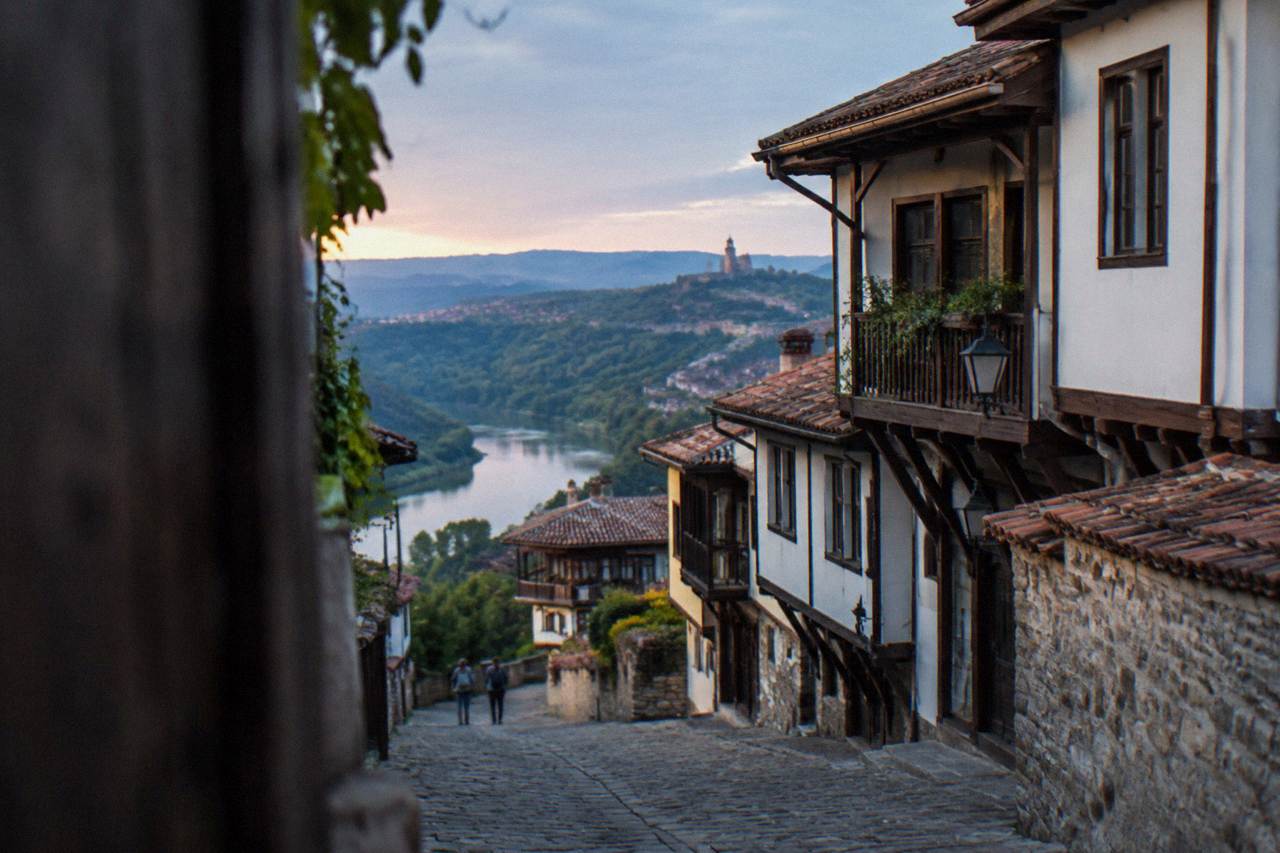
Yes, a small phrase list pays off in Veliko Tarnovo. Learn zdravey (hello), blagodarya (thank you), molya (please), kolko struva (how much) and the Cyrillic letters on street signs, and note that a nod can mean no while a side-to-side shake can mean yes.
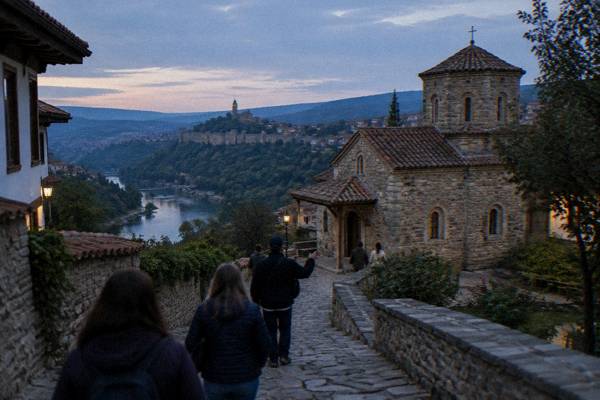
Veliko Tarnovo sits on the Yantra river in northern Bulgaria, an inland city that was the capital of the Second Bulgarian Kingdom from the late 12th century, and its street signs, menus and museum labels are written in the Cyrillic alphabet that Bulgarians created the Slavic written tradition around. A traveller who arrives knowing only a handful of words and the sound values of thirty letters can read place names aloud, recognise prices and order a coffee without pointing. This guide collects the phrases that carry real weight in the city, explains the alphabet in a table you can scan in a minute, and untangles the one gesture that catches every first-time visitor off guard: the Bulgarian head nod, which works in the opposite direction from the one English speakers expect.
Do You Need Bulgarian In Veliko Tarnovo?
You do not need fluent Bulgarian to visit Veliko Tarnovo. Museum signage at the major sites carries English, the Regional Museum of History's ticket pages run in both Bulgarian and English, and walking tours are led in languages visitors can book. But about twenty words and the Cyrillic alphabet change the texture of the visit, turning street names, bus destinations, and shop windows into participation. Museum signage at the major sites carries English information, the Regional Museum of History's ticket pages run in both Bulgarian and English, and the walking tours on the roster are led in languages visitors can book. What stays Bulgarian is the layer between the sights: street names, bus destinations, shop windows, the chalk board outside a bakery. Reading those turns a visit from observation into participation, and the effort is met warmly.
Start with the words that do social work rather than transactional work. A greeting before a question, a thank you after an answer: these are the phrases that mark a visitor as polite rather than rushed. The tables below give the written form, a rough Latin-letter rendering and a pronunciation hint. Stress in Bulgarian falls unpredictably, and the hints mark it in capitals where it matters.
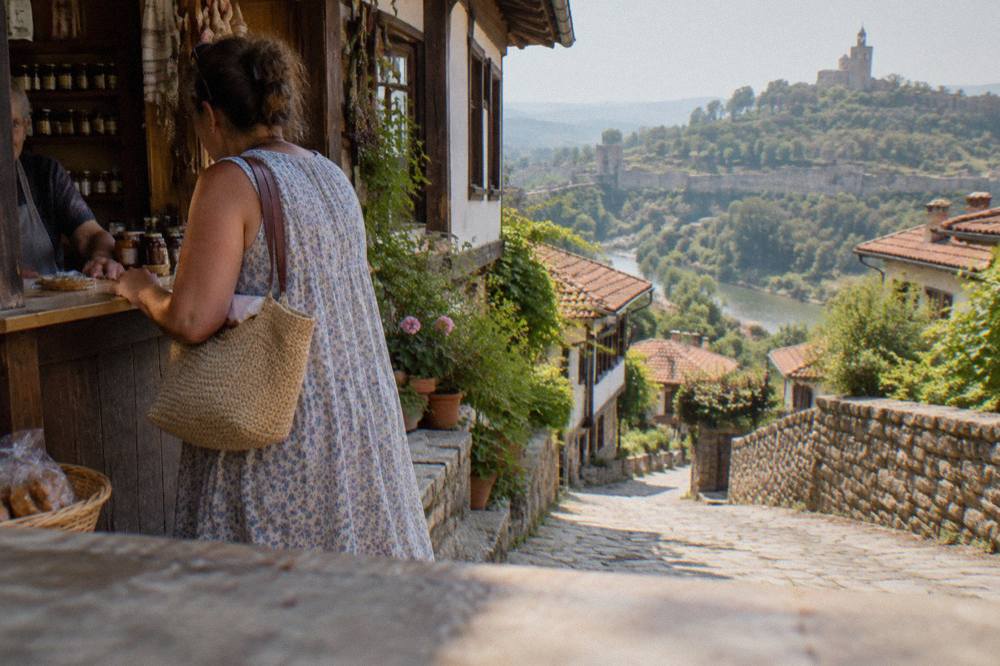
The vocabulary is small because Bulgarian grammar is generous to beginners. There is no article in front of a noun, the definite article attaches to the end of the word instead, and questions can be asked with rising intonation alone. Say "kafе?" with a lift at the end, in the direction of the counter, and the sentence has been completed. For more on what daily life in the city costs, see the companion guide to spending in Veliko Tarnovo, and for the food vocabulary that pairs with these phrases, the Bulgarian food guide covers the dishes by name.
How Do You Read Cyrillic Signs In Veliko Tarnovo?
Cyrillic reads left to right like the Latin alphabet, and about two thirds of its letters have a sound you already know, so a one-time pass through the alphabet table below is enough to pronounce Tsarevets, Trapezitsa and Samovodska Charshiya off a sign. The alphabet was created for Slavic languages in the First Bulgarian Kingdom's literary tradition and carried forward in the Second, which is why Bulgaria treats 24 May, the day of the script's creators, Cyril and Methodius, as a national holiday. The city's university bears the names of those two brothers.
The trap letters are the ones that look like Latin letters but sound different. The letter "В" is a V, not a B. The letter "Н" is an N. The letter "Р" is an R, the "С" is an S, and the "У" is a U. Once those five are locked in, sign reading becomes a puzzle rather than a wall. The table maps every letter you will meet on a street in Veliko Tarnovo.
| Cyrillic letter | Sounds like | Appears in |
|---|---|---|
| А а | a in "father" | Арбанаси (Arbanasi) |
| Б б | b | баня (banya) |
| В в | v | Велико Търново (Veliko Tarnovo) |
| Г г | g | Гурко (Gurko) |
| Д д | d | Дунав (Danube) |
| Е е | e in "met" | Емен (Emen) |
| Ж ж | s in "pleasure" | жена (zhena) |
| З з | z | замък (zamak) |
| И и | ee in "see" | Иван (Ivan) |
| Й й | y in "yes" | май (may) |
| К к | k | крепост (krepost) |
| Л л | l | лев (lev) |
| М м | m | музей (muzey) |
| Н н | n | Никюп (Nikyup) |
| О о | o in "port" | отворено (otvoreno) |
| П п | p | patriarshiya |
| Р р | r (rolled) | река (reka) |
| С с | s | Самоводска (Samovodska) |
| Т т | t | Трапезица (Trapezitsa) |
| У у | oo in "boot" | улица (ulitsa) |
| Ф ф | f | Фердинанд (Ferdinand) |
| Х х | ch in "loch" | хляб (hlyab) |
| Ц ц | ts in "cats" | Царевец (Tsarevets) |
| Ч ч | ch in "church" | черква (cherkva) |
| Ш ш | sh | шоп (shop) |
| Щ щ | sht | щастие (shtastie) |
| Ъ ъ | u in "butter" | Търново (Tarnovo) |
| Ь ь | softens the letter before it | апартамент |
| Ю ю | u in "cute" | юли (yuli) |
| Я я | ya in "yard" | ябълка (yabalka) |
The letter "Ъ" is the one that hides inside the Bulgarian spelling of the city's own name. That letter has no clean English equivalent, and the rendering "Veliko Tarnovo" is the standard Latin form used across this site and across official English pages. The "ь" rarely appears on signs a visitor needs, but it completes the set of thirty.
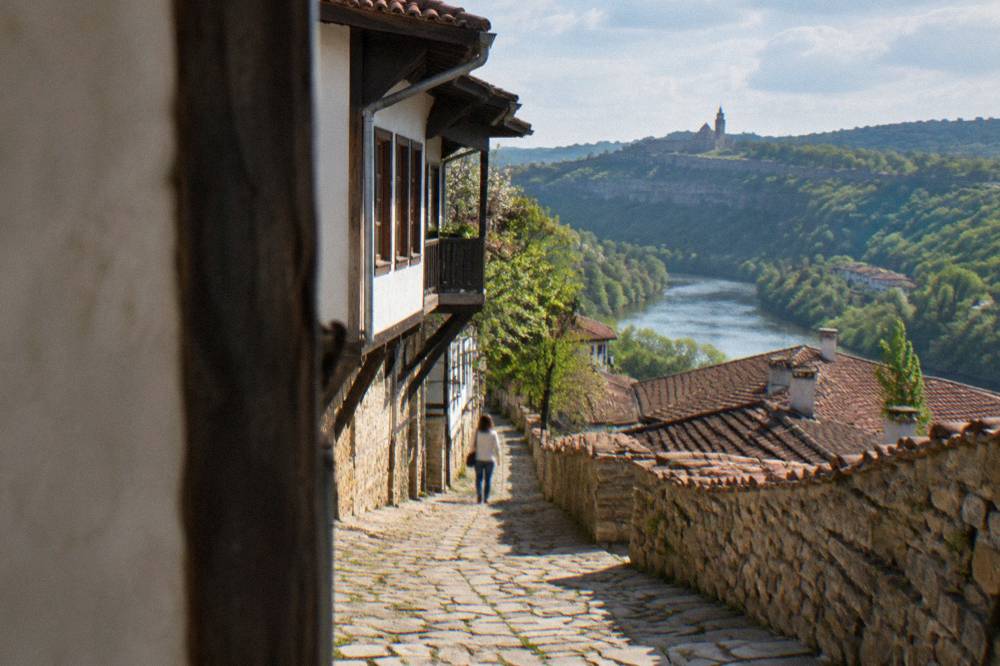
Two sight names reward reading aloud before arrival. Царевец, Tsarevets, the fortress hill, carries the "ц" ts sound at the end. Трапезица, Trapezitsa, the second fortified hill across the river, starts with the same sound. Both are on museum signage in Latin letters as well, but the bus destination boards and the riverside path markers are Cyrillic only. The walking routes are covered in detail in the guide to getting around Veliko Tarnovo.
Why Does A Nod Mean No In Bulgaria?
In Bulgaria a single sharp nod of the head, chin dipping down and up, means no, and a side-to-side shake means yes, the reverse of the convention an English speaker carries, so the reliable fallback is the words da for yes and ne for no, spoken plainly. The reversed nod is a Balkan convention, and the version of the story told in Bulgaria ties it to Ottoman-era times, when the gesture is said to have been flipped as a quiet act of contradiction. That story is folklore rather than documented history, and no date supports it, so treat it as colour and not as fact.
The practical advice is simple. When a question matters, in a shop, at a ticket counter, when confirming a price, use words. "Da" rhymes with "ma" and means yes. "Ne" rhymes with "neh" and means no. Both are short enough to say twice. When a local answers a question with a nod that seems wrong, read the face and the words, not the head, and the misunderstanding dissolves.
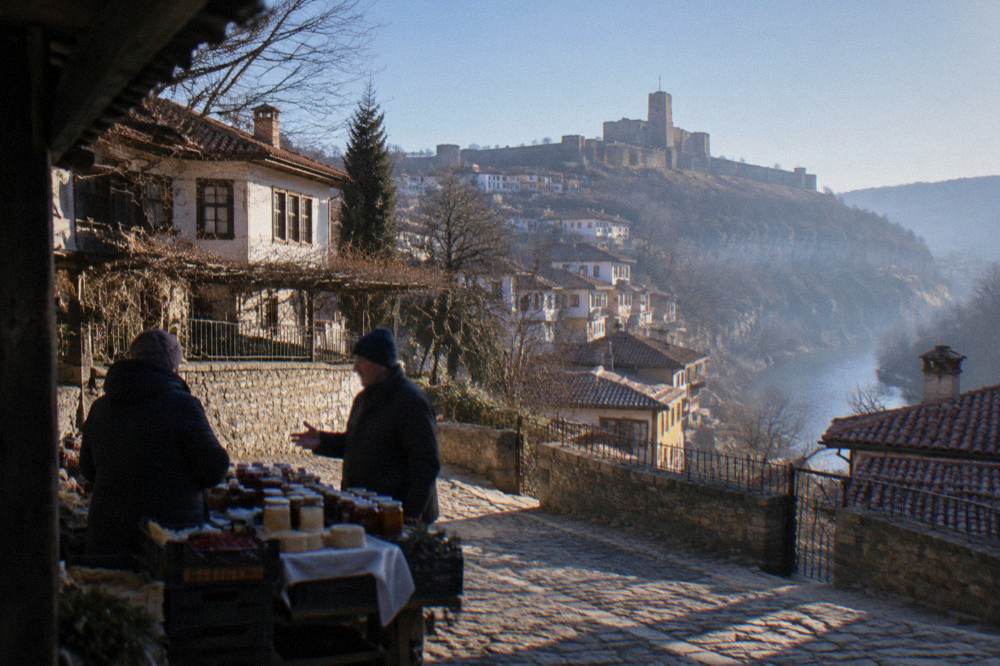
The gesture question comes up on every guided walk of the city centre, and a guide can demonstrate the two movements on the spot, which lands faster than any written description. The city monuments walking tour covers the central sights in one loop, and its operator's listing explains the languages it runs in; you can also Check availability directly. For travellers weighing a visit at all, the piece on whether Veliko Tarnovo is worth visiting is a companion read.
What Are The Essential Bulgarian Phrases For A Day In Veliko Tarnovo?
The essential set for a day in the city is ten items long: zdravey for hello, dovizhdane for goodbye, blagodarya for thank you, molya for please, izvinete for excuse me, da and ne for yes and no, nyama razbiram for I do not understand, govorya li angliyski for do you speak English, and kolko struva for how much does it cost. That list handles greetings, exits, politeness, recovery from confusion and every purchase on Samovodska Charshiya.
The table below gives each phrase in Cyrillic, in Latin letters and with the stressed syllable marked in capitals. Learning them in Cyrillic from the start is the more efficient route, since the same ten phrases then double as alphabet practice.
| English | Cyrillic | Say it | Meaning note |
|---|---|---|---|
| Hello | Здравей | zdra-VEY | informal, one person |
| Hello (formal/plural) | Здравейте | zdra-VEY-te | safe default to anyone |
| Good morning | Добро утро | DO-bro U-tro | until midday |
| Good day | Добър ден | DO-bar DEN | the all-purpose daytime greeting |
| Good evening | Добър вечер | DO-bar VE-cher | after dark |
| Goodbye | Довиждане | do-vizh-DA-ne | formal parting |
| Thank you | Благодаря | bla-go-DA-rya | stress on DA |
| Please / you're welcome | Моля | MO-lya | doubles as "you're welcome" |
| Excuse me / sorry | Извинете | iz-vi-NE-te | for attention and apology |
| Yes | Да | da | short and clear |
| No | Не | ne | short and clear |
| I don't understand | Не разбирам | ne raz-BI-ram | pairs with slower speech |
| Do you speak English? | Говорите ли английски? | go-vo-RI-te li an-GU-li-ski | formal plural form |
| How much does it cost? | Колко струва? | KOL-ko STRU-va | the market question |
| Where is...? | Къде е...? | KADE e | plus any place name |
| Cheers! | Наздраве! | naz-DRA-ve | literal sense: "to health" |
Bulgarian has a formal and an informal "you", vi and ti, and the safe rule for a visitor is to use the formal greetings above with everyone. Shopkeepers, ticket sellers and museum staff will switch to informal themselves if the moment calls for it, and no visitor is expected to lead that shift. The formal forms are also the ones printed on signs and official notices, which makes them the easiest to spot and copy.
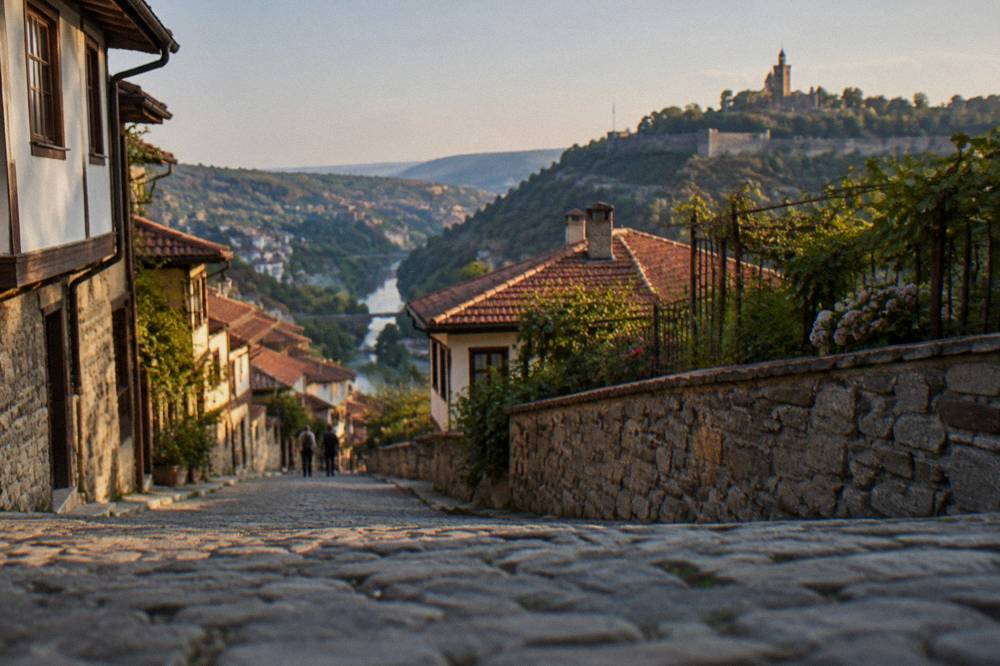
Politeness carries weight in a city whose residents number about 77,067 across the municipality as of the 31 December 2025 estimate. A greeting before a request is the convention that matters, and "Dobar den" on entry to a small shop is the single highest-value phrase on the whole list. The restaurant vocabulary below builds on the same skeleton.
How Do You Order Food And Drink In Bulgarian?
Ordering in Bulgarian runs on three verbs and a pointing finger: "iskam" for I want, "mozhe" for may I have, and "smetkata molya" for the bill please, plus the words for water, coffee, beer and wine, which are voda, kafe, bira and vino. Menus in Veliko Tarnovo's central streets carry English translations at many venues, but the words for the dishes themselves are worth knowing, and the full dish dictionary sits in the guide to Bulgarian food with the breakfast and banitsa page beside it.
Bulgarian restaurant culture has its own fixed points. Bread arrives at the table and appears on the bill as a small cover item. Salads come before grilled mains, and the salad course is a real course rather than a side. Rakia, the fruit brandy, opens a long meal, and the toast "nazdrave" precedes the first sip. The rakia and Bulgarian wine guide covers that tradition in depth.
| English | Cyrillic | Say it |
|---|---|---|
| menu | меню | me-NYU |
| water | вода | VO-da |
| still water | вода без газ | VO-da bez gaz |
| sparkling water | вода с газ | VO-da s gaz |
| coffee | кафе | KA-fe |
| beer | бира | BI-ra |
| wine | вино | VI-no |
| I would like... | бих искал / бих искала | bih IS-kal / bih IS-kala |
| The bill, please | сметката, моля | SMET-ka-ta MO-lya |
| delicious | вкусно | VKUS-no |
| bon appétit | добър апетит | DO-bar a-pe-TIT |
The two forms of "I would like" reflect Bulgarian's grammatical gender: a male speaker says "bih iskal" and a female speaker says "bih iskala". The waiter will understand either way, and "mozhe" followed by a pointed finger at the menu works everywhere. "Mozhe li edna voda?" is a complete, polite sentence for a bottle of water. More of these guides are collected on Veliko Tarnovo Travel Guide.
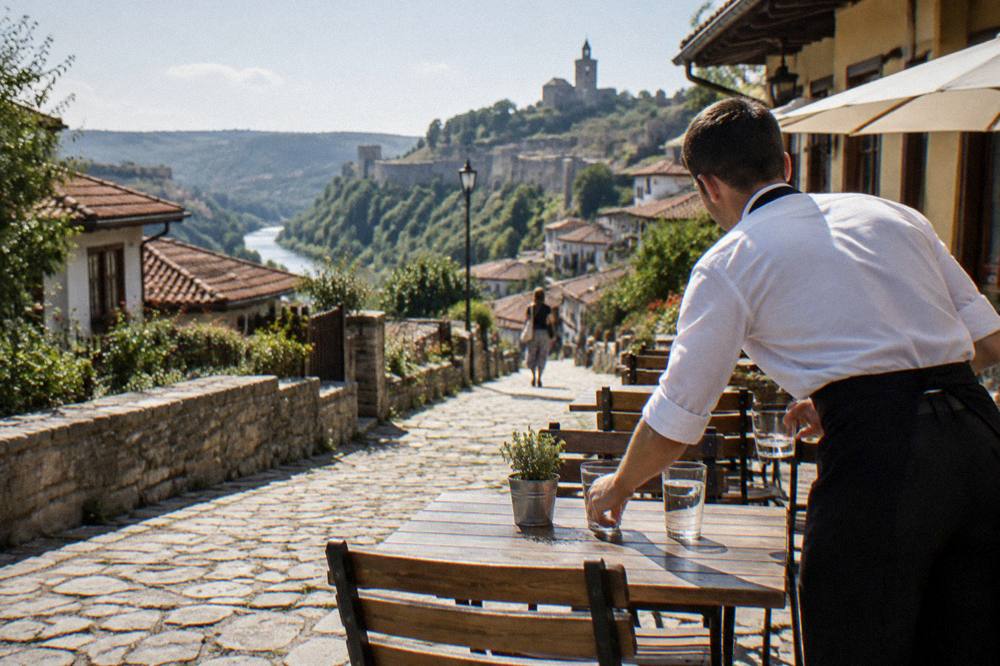
The phrase card to carry there is short: "suho" for dry, "sladko" for sweet, "cherveno" for red and "byalo" for white.
How Do You Count In Bulgarian?
Bulgarian numbers one to ten are edno, dve, tri, chetiri, pet, shest, sedem, osem, devet and deset, and the numbers 11 through 19 are built by adding "nadese" (and ten) to the root, so eleven is "edinadeset" and nineteen is "devetnadese". Tens follow the same logic: dvadeset for twenty, trideset for thirty, up to sto for a hundred and hilyada for a thousand. Prices on museum tickets across the city are printed in euro since Bulgaria adopted the currency on 1 January 2026, at the fixed rate of 1.95583 lev per euro, so the numbers to listen for at a ticket window are small ones.
| Number | Cyrillic | Say it |
|---|---|---|
| 1 | едно | ED-no |
| 2 | две | DVE |
| 3 | три | tri |
| 4 | четири | CHE-ti-ri |
| 5 | пет | pet |
| 6 | шест | shest |
| 7 | седем | SE-dem |
| 8 | осем | O-sem |
| 9 | девет | DE-vet |
| 10 | десет | DE-set |
| 20 | двадесет | DVA-de-set |
| 100 | сто | sto |
| 1,000 | хиляда | hi-LYA-da |
Two pronunciation traps sit inside this table. "Dve", the number two, is one syllable despite the way it looks. "Sto", a hundred, is not the English "sto" in "story" but a pure "stoh". Hearing prices comes down to catching the first number spoken, since the euro amount at the museum ticket windows will be a single figure like "sedem euro shestdeset i sedem" for seven euro sixty-seven.
What Do The Words On Signs Around Veliko Tarnovo Mean?
Signs around Veliko Tarnovo decode to a short list: otvoreno means open, zatvoreno means closed, vhod means entrance, izhod means exit, ulitsa means street, tsentar means center, muzey means museum, krepost means fortress, cherkva means church, bezplatno means free of charge, toaletna means toilet, and apteka means pharmacy, making the signage of the old town, bus station and museum network readable. With those seven plus the sight names themselves, the signage of the old town, the bus station and the museum network becomes readable. The Gorna Oryahovitsa rail junction, where Sofia trains change, posts platform information in Cyrillic with the city's name as "В. Търново", the abbreviation of Veliko Tarnovo.
| Sign word | Cyrillic | Means |
|---|---|---|
| open | отворено | otvoreno |
| closed | затворено | zatvoreno |
| entrance | вход | vhod |
| exit | изход | izhod |
| street | улица | ulitsa |
| centre | център | tsentar |
| museum | музей | muzey |
| fortress | крепост | krepost |
| church | черква / църква | cherkva / tsarkva |
| free of charge | безплатно | bezplatno |
| toilet | тоалетна | toaletna |
| pharmacy | аптека | apteka |
The word "bezplatno", free of charge, is worth recognising on sight, because the city's free sights are exactly the public ones: the Asenevtsi Monument, Samovodska Charshiya, General Gurko Street, the Varosha quarter, and watching the Sound and Light show from Tsar Asen I Square on its announced evenings. The show runs on announced dates only, with no fixed nightly schedule, and the free viewing spot is the square in front of Tsarevets. The Sound and Light guide alongside the history of Veliko Tarnovo pages collect the context.
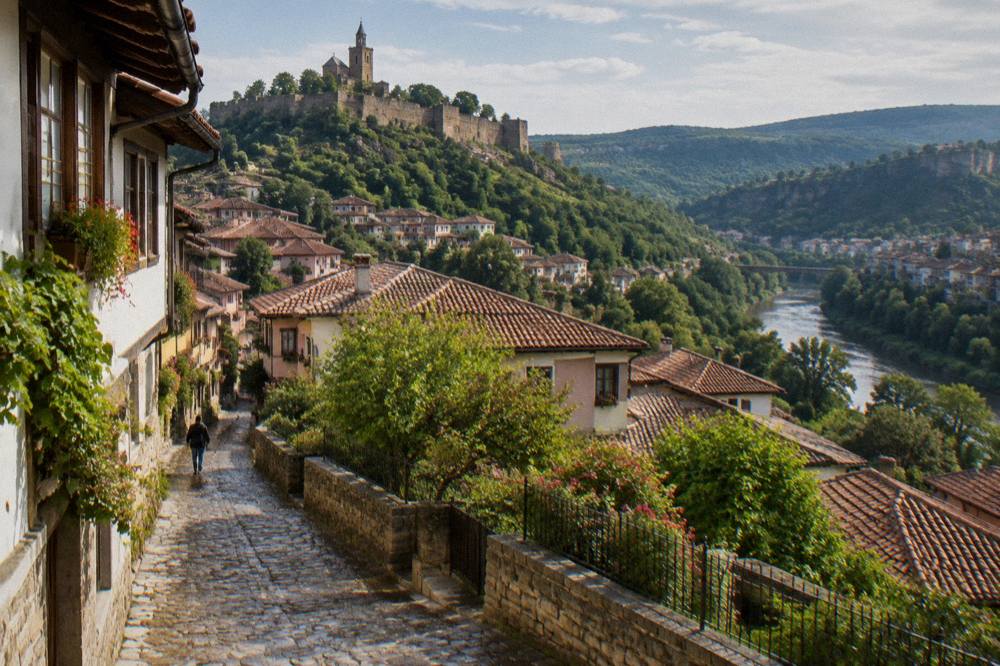
Getting to the city, for anyone still planning, is covered in how to get to Veliko Tarnovo and the pages on the train station and the bus station. The one rail fact worth translating in advance: there is no direct train from Sofia, and connections change at Gorna Oryahovitsa, whose boards read "Г. Оряховица".
How Do You Be Polite In Bulgarian Beyond Please And Thank You?
Politeness in Bulgarian rests on the formal address, the greeting on entry, and a few habits. Hold the formal "vi" register with strangers, with "gospodin" and "gospozho" covering formal address, greet a small shop with "Dobar den", answer a poured glass with "nazdrave" and a small sip, and let "molya" work as please, you're welcome and pardon me all at once. Bulgarians use first names less quickly than English speakers do, and the formal "vi" address with "zdraveyte" as the greeting is the register to hold with strangers of any age. Names themselves follow a patronymic pattern on official documents, but a visitor never needs that layer; "gospodin" for a man and "gospozho" for a woman cover formal address on their own.
Three habits travel well in the city. Greet the room when entering a small shop, with "Dobar den". Accept what is offered, since refusal of a poured glass at a table reads as refusal of the company; "nazdrave" and a small sip is the gracious minimum. And when a conversation in English begins, the question "govorite li angliyski", asked in Bulgarian first, signals the effort that the language switch then rewards.
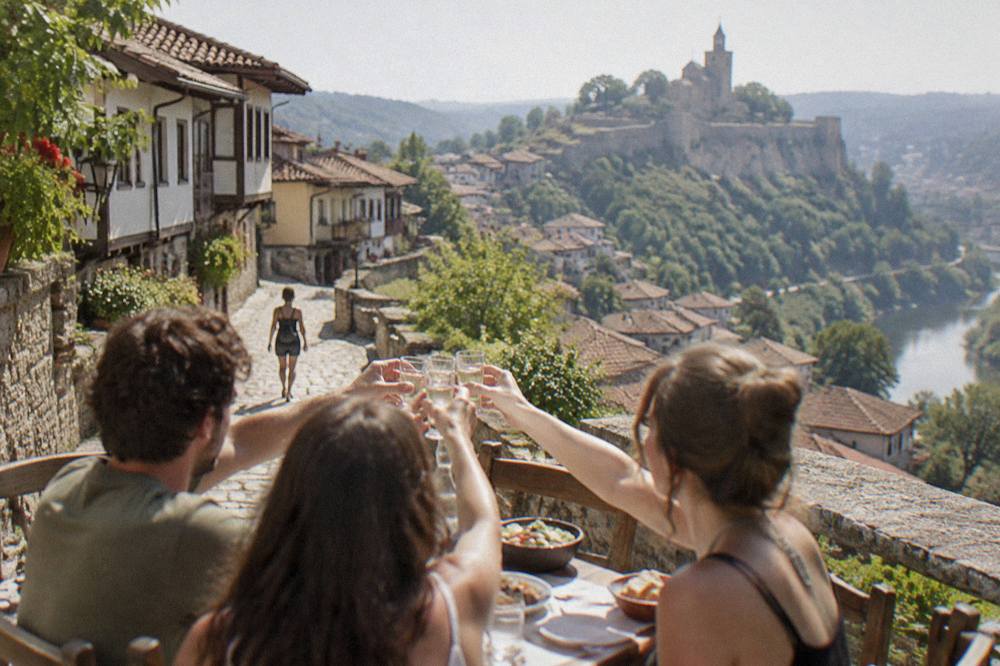
The city rewards the attempt unevenly and warmly in the same moment: a phrase begun in Bulgarian and finished in English draws a smile more reliably than fluent English alone does. That is the whole strategy of this page. Twenty words, thirty letters, the words "da" and "ne" as the antidote to the nod, and the rest of the visit in whatever mixture the day allows. For the practical layers around the language, the Bulgaria travel tips and euro and money guides finish the preparation.
Common Questions About Bulgarian Phrases For Travellers
Is English spoken in Veliko Tarnovo?
English is present at the city's museum sites, on the Regional Museum of History's bilingual ticket pages, and on the guided walking tours the roster offers, so a visitor can move through the main sights without Bulgarian. Outside those settings, the Cyrillic alphabet and a ten-phrase list change the experience, and a greeting in Bulgarian before switching to English is met warmly.
Why does a nod mean no in Bulgaria?
The Bulgarian head nod is reversed: a single dip of the chin means no, and a side-to-side shake means yes. Stories that explain the reversal as an Ottoman-era act of quiet defiance circulate widely, but they are folklore without a documented date, so treat them as colour. The reliable fallback is spoken words: "da" for yes and "ne" for no.
How hard is it to learn the Cyrillic alphabet?
Most readers can sound out Cyrillic signs after one pass through a thirty-letter table. About two thirds of the letters map to sounds an English reader already knows, and the trap letters are few: "В" is a V, "Н" is an N, "Р" is an R and "С" is an S. Place names like Tsarevets and Trapezitsa then become readable off the riverside signs.
What are the most useful Bulgarian words for a short visit?
The working set is short: zdravey or zdraveyte for hello, dobar den for good day, dovizhdane for goodbye, blagodarya for thank you, molya for please, izvinete for excuse me, da and ne for yes and no, kolko struva for how much does it cost, and smetkata molya for the bill at a table. "Dobar den" on entering a shop is the single phrase with the highest return.
Is Bulgarian written the same as Russian?
Bulgarian and Russian share the Cyrillic script and much vocabulary, but they differ in letters and grammar. Bulgarian drops letters Russian keeps, uses "Ъ" as a vowel in ordinary words like the city's own name, and attaches its definite article to the end of the noun. A Russian reader decodes Bulgarian signs; a Bulgarian phrasebook is still the right tool for speaking.
What language helps most besides Bulgarian in the region?
German has a long presence in Bulgarian tourism, and Russian overlaps with the script and vocabulary, but English is the practical second language at the city's sights and on its guided tours. The phrases and the alphabet on this page cover what the signs, menus and ticket windows of Veliko Tarnovo require.